
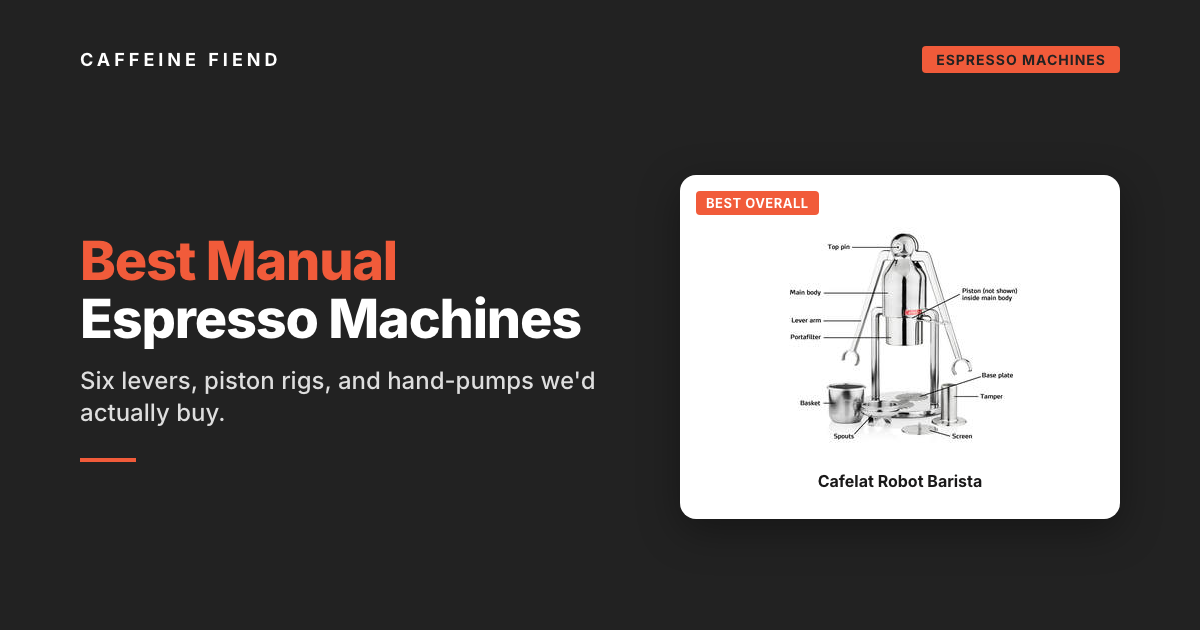
Our top pick is the Cafelat Robot Barista. It’s a stainless-and-cast-aluminum lever machine that pulls 58 mm shots as good as prosumer semi-autos three times the price, so long as you’re willing to boil your own water and drive the piston with your own arm.
A manual espresso machine is a hobby object. If pulling a shot is a moment you look forward to, this whole category is for you. If it’s a chore between you and your caffeine, you want the semi-auto with the button.
The picks below are the manual espresso makers we’d spend real money on. And no, a manual espresso maker is not “training wheels” for a real espresso machine. Fed the right grind and given a real preheat, most of these will make a shot that stands up next to a Lelit Bianca.
Manual Espresso Machines at a Glance
| Model | Award | Mechanism | Basket | Heated group? | Steam wand? | Weight | Best for |
|---|---|---|---|---|---|---|---|
| Cafelat Robot Barista | Best Overall | Dual-arm manual lever | 58 mm | No (external kettle) | No | ~7.5 lb | The 58 mm café-serious workflow |
| Flair 49 PRO | Best All-Metal Countertop Flair | Direct-lever manual | 49 mm | No (external preheat) | No | 7 lb | Lifetime-tier all-metal build |
| Flair Neo Flex | Best Budget (Under $100) | Direct-lever manual | 49 mm | No, no-preheat cylinder | No | 4.51 lb | Real 9-bar espresso for under $100 |
| La Pavoni Europiccola Lusso | Best with a Steam Wand | Spring-less direct lever | 51 mm | Heated brass boiler | Yes (chromed brass) | ~14 lb | A lever that also does a real cappuccino |
| Wacaco Picopresso | Best Portable | Hand-pumped piston | 52 mm | No (external kettle) | No | 0.77 lb | Travel, bikepacking, hotel espresso |
| ROK Presso Smartshot | Best Tactile / Design Pick | Dual-arm hand pump | ~49 mm | No (external kettle) | No | ~4 lb | No-electricity countertop ritual |
No price column on purpose. Amazon prices bounce around and the Associates agreement doesn’t let us paste live retail figures anyway. Each pick’s CTA carries the live number.
How We Picked
We built this list around a manual espresso machine’s job as we see it in home kitchens. A machine you use on purpose, with a grinder that can keep up, that makes real 9-bar espresso once you learn the workflow. We researched more than a dozen candidates across countertop levers, hand-pumps, and portable pistons, then filtered them through four criteria.
- Shot quality at 9 bar with a competent grinder. The Specialty Coffee Association pegs the espresso standard at 9 ± 1 bar of extraction pressure, 195–205°F water, 20–30 seconds. Any pick had to hit that under a normal home setup.
- Workflow honesty. How long does the preheat take? How hard is the arm? What breaks if you get the technique wrong? A pick that hides its trade-offs behind a “just squeeze the lever” video is a pick that gets returned.
- Availability and current model. Every pick is still being sold as of July 2026, with a live retailer link, at a real US market MSRP. Anything discontinued or superseded by a newer model got cut.
- A defensible con. If we couldn’t name one specific thing we didn’t love, we dropped the pick and moved on.
Nothing here is a fabricated hands-on lab test, and we’re honest about that. The picks below reflect long-form owner reviews from Coffee Chronicler, Home Grounds, Barista Magazine, Livingetc, and BIKEPACKING.com, plus manufacturer spec sheets we verified against the current live product pages.
The Best Manual Espresso Machines
Best Overall: Cafelat Robot Barista
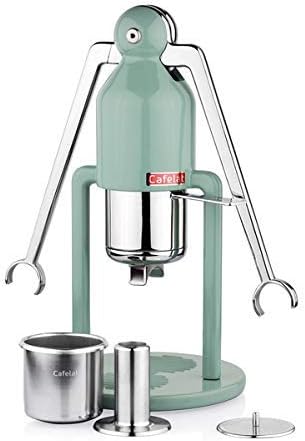
Verdict. The Cafelat Robot Barista is the pick if you want café-quality 58 mm espresso at home and you don’t need push-button convenience. It’s a beautifully engineered piece of Hong Kong design that has become the industry’s default answer for “what should I get if I love levers.” Coffee Chronicler’s Asser Christensen puts the trade-off cleanly: “This machine does produce great shots, but it requires a significant level of user-involvement to reach the pinnacle of espresso-making.” The Robot pulls a real 9 bar, holds heat well for what it is, and takes any 58 mm accessory in the aftermarket. The Barista variant we recommend adds a factory-fitted pressure gauge and a bottomless portafilter, which turns the learning curve from “guess” to “feel.”
Pros:
- Full 58 mm accessories ecosystem. Same portafilter size as a Gaggia Classic, Rancilio, or Lelit. Every WDT tool, distributor, and precision basket on the market fits.
- Café-quality shots on par with three-figure-multiple electric machines. Total control over pre-infusion, pressure, and pull curve.
- Lifetime-grade materials. Die-cast aluminum body, stainless steel arms and portafilter, silicone gaskets you can replace.
Cons:
- No integrated heat. You bring water off the boil in a kettle every single shot.
- Dispersion screen is thin enough to bend. Own it a while and don’t lean into the puck-prep like you would on a Breville. It’s easier to warp than you’d think.
Best for: The 58 mm-workflow reader who wants a lifetime tool, has a real grinder budgeted separately, and drinks straight espresso, cortados, or Americanos. If you drink lattes daily, keep reading. The Robot ships in “Regular” and “Barista” trims. The Barista is worth the delta for the gauge alone.
Best All-Metal Countertop Flair: Flair 49 PRO
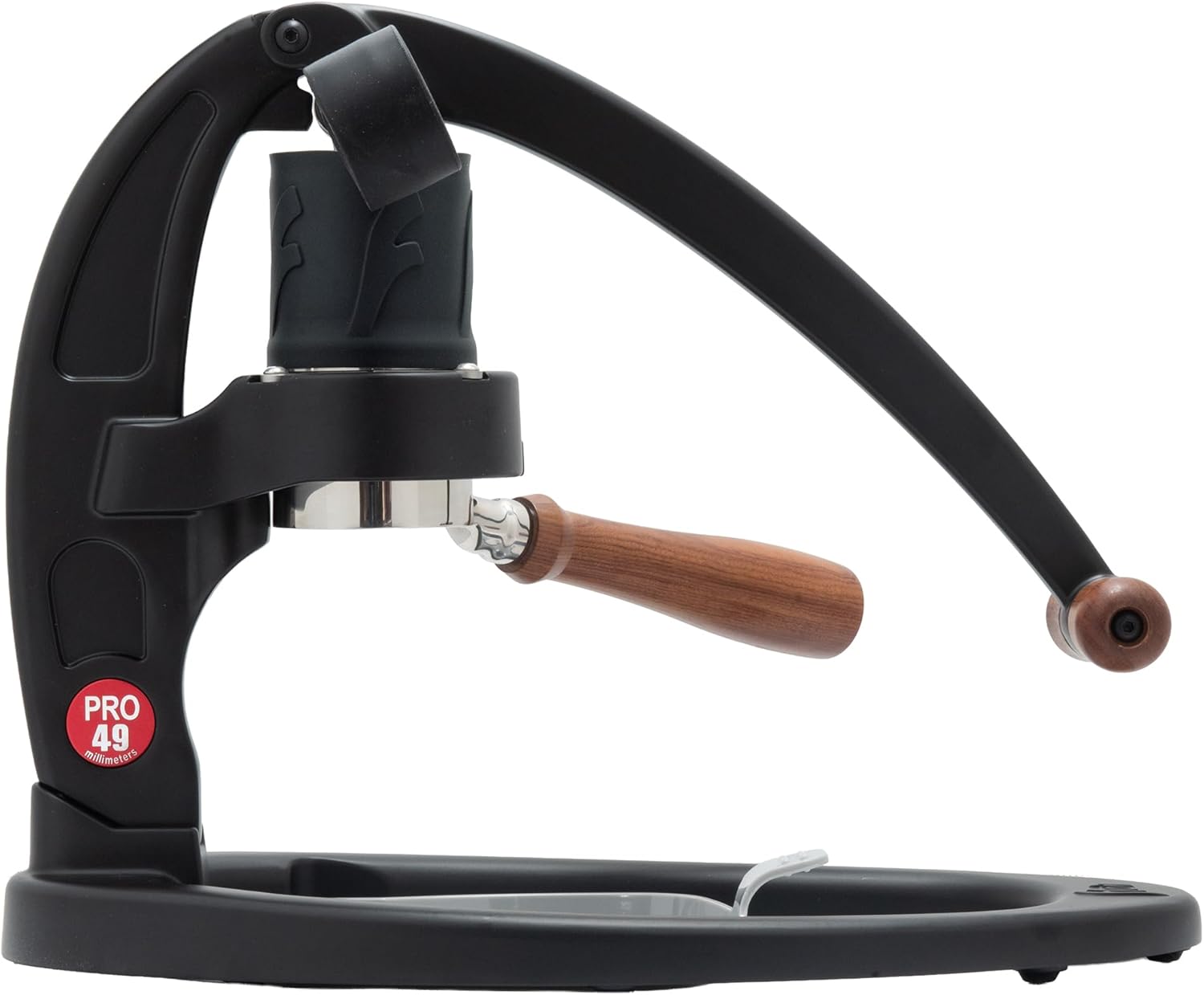
Verdict. If you want the Flair experience in metal instead of polymer, the Flair 49 PRO is the current answer. Flair announced it in March 2026 as the update to the older Pro 2 line, and Amazon has since grafted the new machine onto the old Pro 2 ASINs, so the same product page now carries “Flair UPDATED 49 PRO” as the listing title and years of Pro-family reviews as social proof. What you’re paying for is a fully stainless steel brew path, a die-cast metal frame that survives a decade of daily shots, an integrated pressure gauge, and the elongated lever Flair added for better mechanical advantage. It’s a 49 mm basket, smaller than the 58 mm ecosystem, but the trade-off is a lighter, more portable-ish setup that heats faster.
Pros:
- All-metal build feels lifetime-tier. Nothing in the water path is plastic. Compared to the polymer Neo Flex, it feels like a different price bracket.
- Integrated pressure gauge. You learn to feel 9 bar in a week because you can watch it happen.
- Portable enough to travel with. Assembled it’s 13.5 in long, but it breaks down cleanly for a suitcase.
Cons:
- Preheat ritual every shot. No built-in heater. You’ll flush the brewing cylinder and portafilter with hot water before every pull, and add 2 to 3 minutes to your morning. Barista Magazine’s Josh Taves, a US Barista Championship finalist, wrote of the Flair family that “it is perhaps the most infinitely adaptable home espresso maker on the market,” and note that “adaptable” is doing a lot of work in that sentence. It’s not automatic anything.
- 49 mm basket ecosystem is smaller. Fewer WDT tools, distributors, and precision baskets to choose from than a 58 mm workflow.
- No steam wand. Milk-drink households need a separate frother.
Best for: The reader who wants a lifetime-tier all-metal lever, doesn’t mind a preheat ritual, and drinks espresso straight (or steams milk separately).
Best Budget: Flair Neo Flex
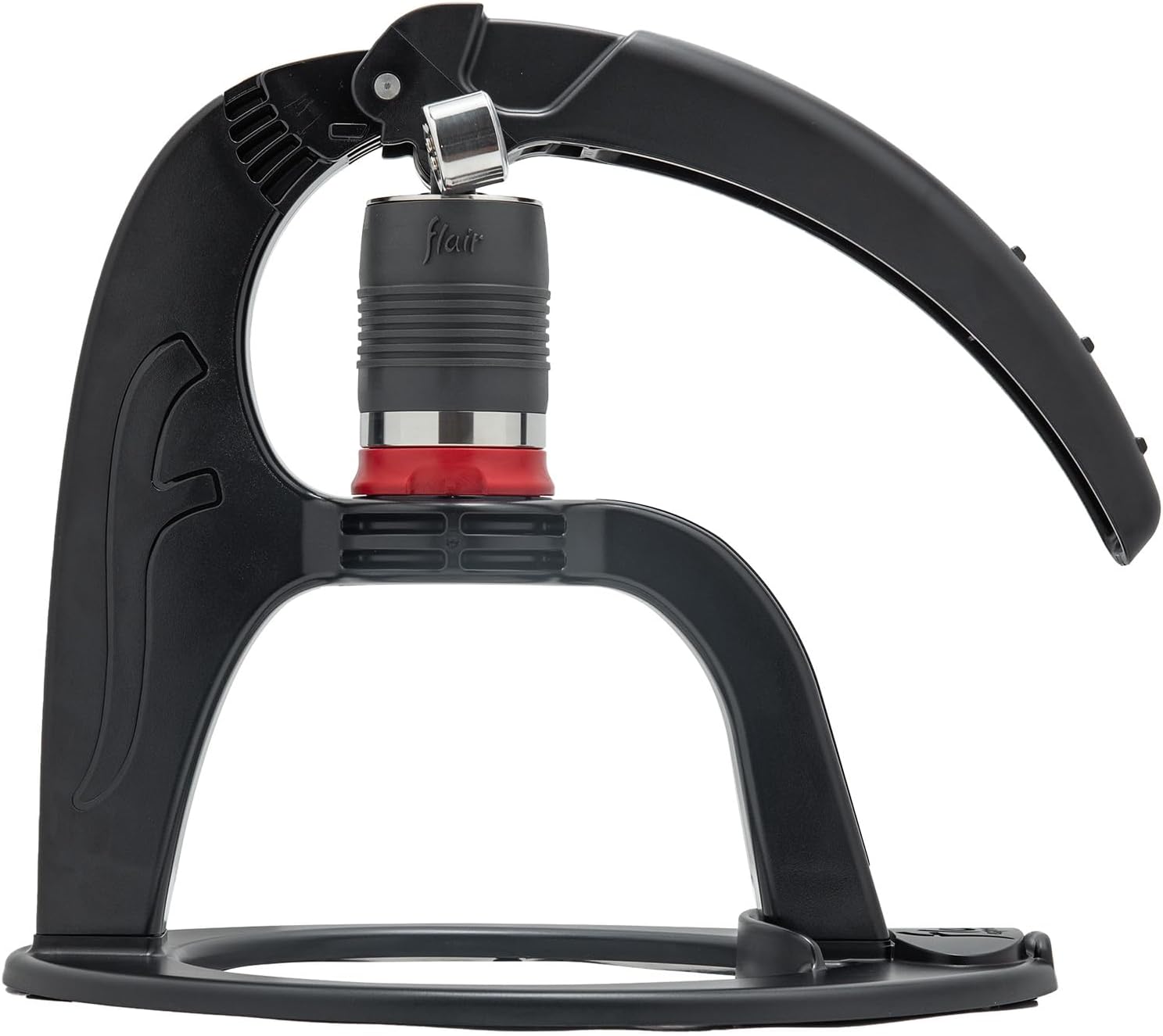
Verdict. For under $100, nothing else pulls a real 9-bar shot the way the Flair Neo Flex does. Flair relaunched the Neo Flex in 2024 with the two upgrades the older Neo needed. A thin-walled brewing cylinder that eliminates the preheat ritual, and an integrated pressure gauge tuned for 9 bar. It also ships with two portafilters in the box: a Flow-Control for beginners (built-in restrictor makes forgiving shots easier) and a Bottomless 2-in-1 you can grow into. Coffee Chronicler’s take is our take: “The Flair Neo Flex is a super affordable, user-friendly manual espresso maker,” though it “does cut some corners, primarily concerning the plastic frame and the peculiar pressure release system.”
Pros:
- Real crema-topped 9-bar espresso for under $100. The lowest financial floor on real espresso in this category.
- No preheat cylinder ritual. Big upgrade over the old Neo. You can pull a shot in five minutes flat.
- Two portafilters included. You get the learning-curve safety net and the upgrade path in the box.
Cons:
- Plastic frame and pressure release feel budget in the hand. Because they are. If you spend a lot of time on this machine you’ll want to upgrade within a year.
- Flair’s own brewing guidance is thin. New owners lean on Reddit and YouTube for dial-in guidance. Plan for a weekend of learning.
Best for: The curious beginner who wants to see if manual espresso is worth it before they spend $500, or the traveler who wants a plug-in-nothing setup for hotels and rental kitchens.
Best with a Steam Wand: La Pavoni Europiccola Lusso
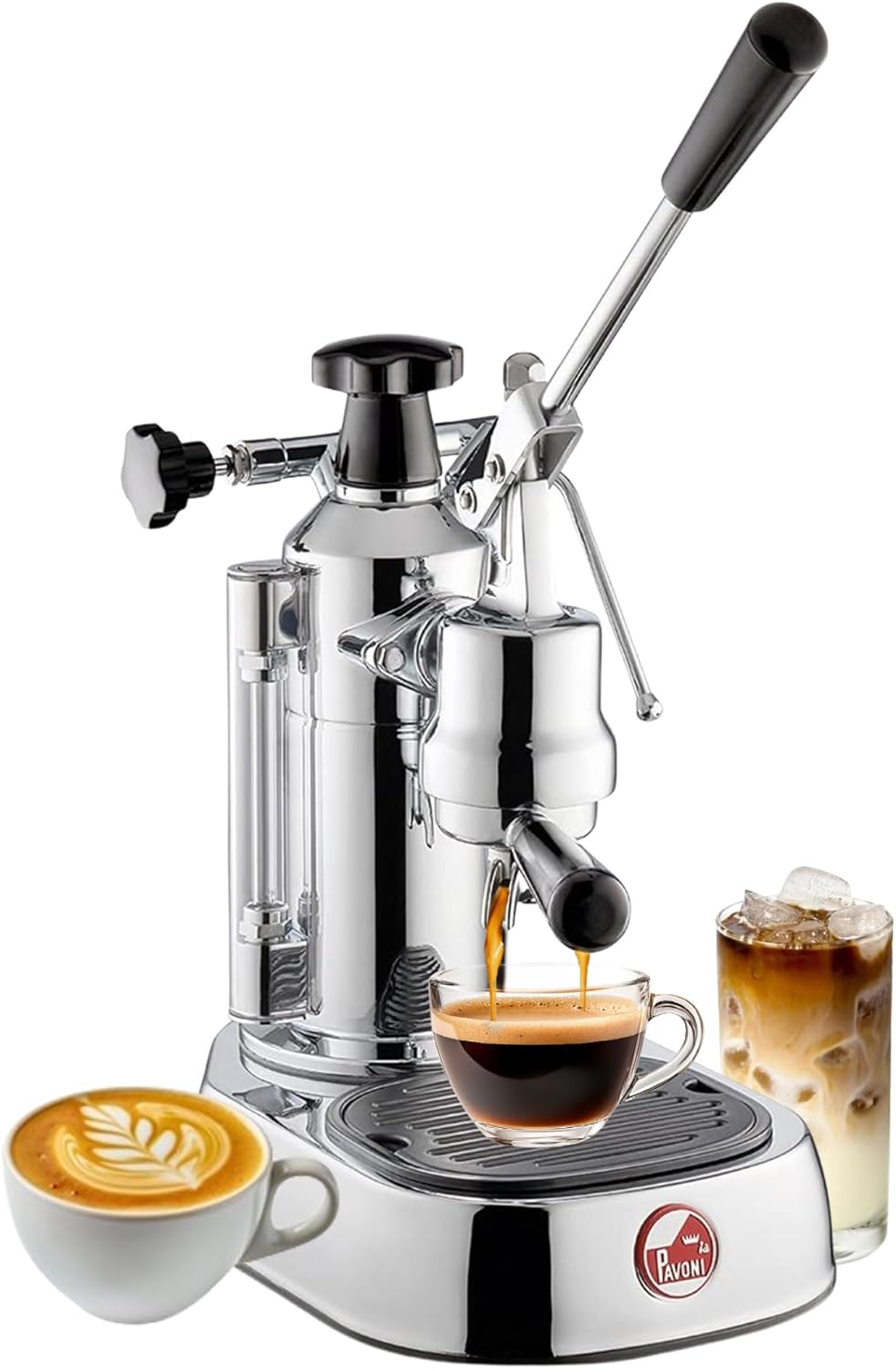
Verdict. Every other pick on this list is espresso-only. The La Pavoni Europiccola is the one manual lever with a real chromed brass steam wand, a heated brass boiler, and the Italian aesthetic that turns a countertop into a shrine. It’s beautiful: Art Deco chrome and wood, the kind of machine you keep out on purpose. Home Grounds’ Julia Bobak describes the shots as “wonderfully sweet and balanced” once the temperature-surfing technique clicks. That last part is the whole catch. This is a small single-boiler machine, and you have to time your shots against boiler temperature so the water doesn’t scald the puck. Get it right and you have a lever cappuccino at home. Get it wrong and you get burnt espresso.
Pros:
- Real integrated steam wand. The only pick in the roundup that can steam milk, with a proper chromed brass 3-hole wand, not a panarello aerator.
- Iconic Art Deco chrome-and-wood aesthetic. It’s a beautiful object. That’s not nothing.
- Sweet, balanced shots when you dial it in. Temperature-surfed correctly, this thing pulls old-school Italian espresso, a different flavor profile from the modern extraction-forward Flair or Robot.
Cons:
- Steep learning curve. Temperature surfing is not “just pull the lever.” You have to time shots to the pressurestat cycle. Home baristas underestimate how long this takes to feel natural.
- Can’t brew and steam at the same time. Single boiler. Make the espresso, then make the milk, then reassemble the drink cold-ish. Not the daily-latte machine.
- 51 mm basket ecosystem is thin. Fewer aftermarket accessories than 58 mm or even 49 mm.
Best for: The aesthetics-first home barista who wants a chrome heirloom lever that also makes a real cappuccino, and is willing to spend a month learning to temperature-surf.
The Europiccola we link to is the 0.8 L boiler variant. If you have a household of two or more milk-drink drinkers, look at the Professional Lusso sibling with the 1.6 L boiler instead. Same workflow, larger tank, longer runs before the boiler needs to catch up.
Best Portable: Wacaco Picopresso
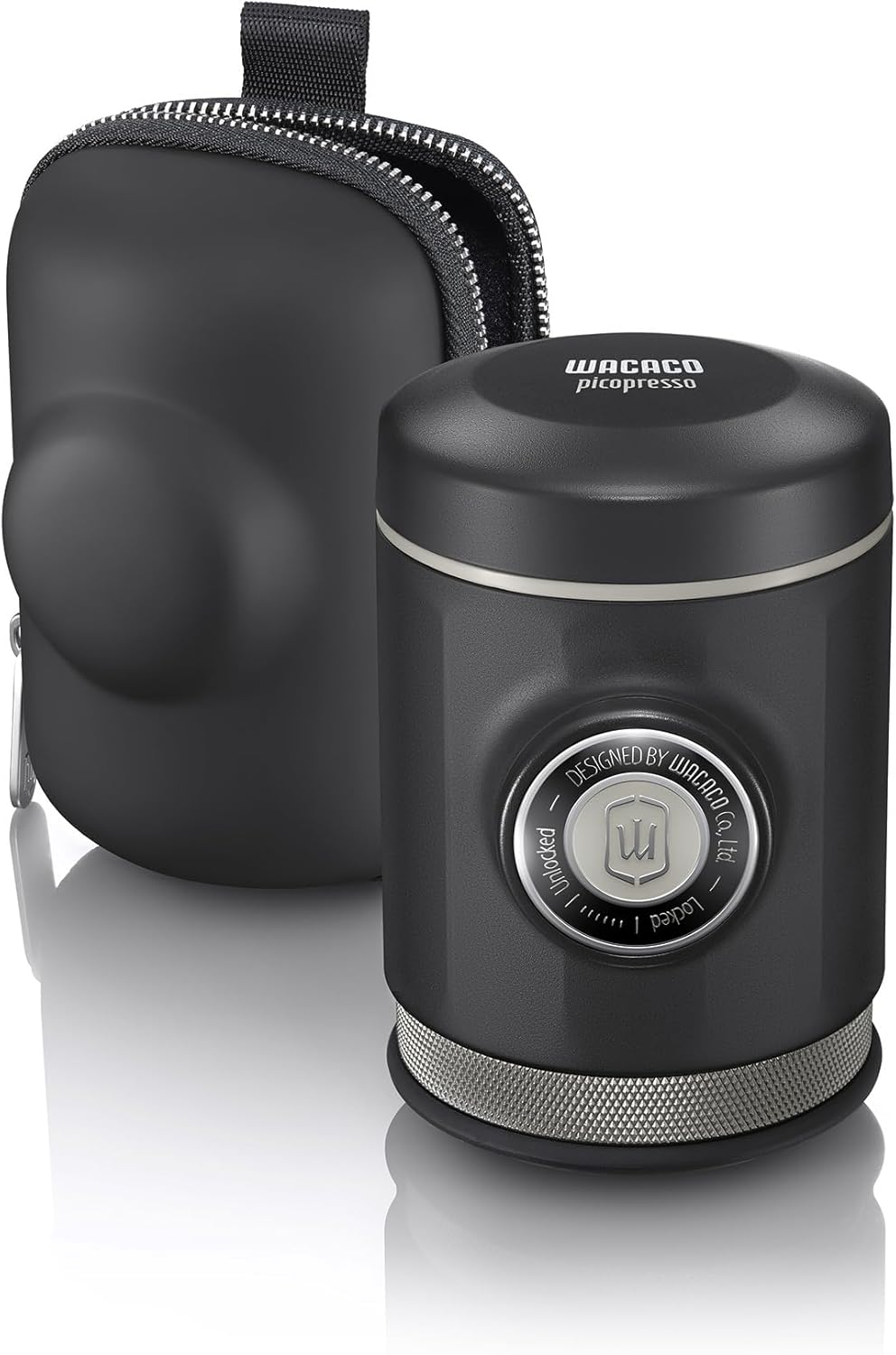
Verdict. The Wacaco Picopresso is the pick when your espresso needs to fit in a jacket pocket. It’s a hand-pumped piston about the size of a large lens hood, weighs 350 grams, and takes an 18 g double dose in a commercial-spec 52 mm naked portafilter: real espresso specs in a body that fits in a jacket pocket. BIKEPACKING.com’s Lucas Winzenburg summed it up as well as anyone: “I’ve frankly been blown away by the quality of espresso that this little thing can produce.” He also named the catch, which is precision. “Even a one-gram variation can make a difference.”
Pros:
- Real 18 g doubles from a 350-gram device. Commercial-spec portafilter and basket in a hand-pump body. Pocketable.
- Ships with the full kit. Tamper, scoop, distribution tool, funnel, protective case. Nothing else to buy.
- Reliable at 18 bar pump pressure. For a manual portable, the extraction consistency is unusually good.
Cons:
- Zero built-in heat. You bring hot water. In cold environments the shot cools fast, and you can taste the drop.
- Demands a dialed grind. The 18 g dose is unforgiving. A one-gram variation is the difference between crema and a puddle. Plan the grinder trip before the machine trip.
Best for: Travel, bikepacking, camping, hotel rooms, and office espresso, for a picky drinker who already grinds fresh and can carry a small kettle or borrow the hotel one.
Best Tactile / Design Pick: ROK Presso Smartshot
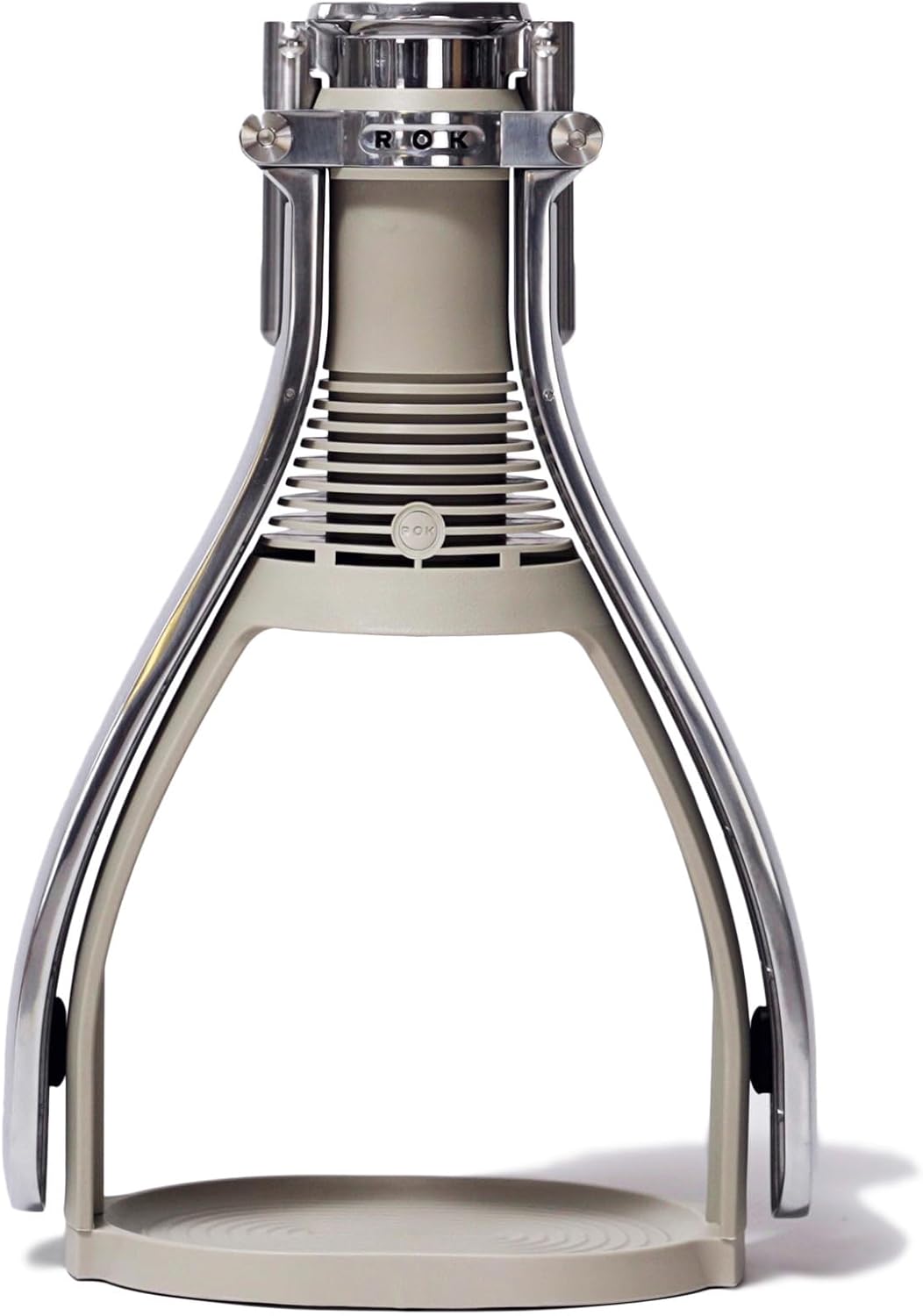
Verdict. The ROK Presso Smartshot is the manual espresso maker that has always felt like a design object first and a coffee tool second. Livingetc’s Olivia Wolfe wrote what a lot of ROK owners feel: “I couldn’t recommend the ROK machine more … a true stand-out appliance in its field.” The Smartshot is the current 2024+ generation, replacing the older EspressoGC. It’s a die-cast metal countertop lever with wing-style arms and a wooden-handled portafilter, and it does not require electricity. You bring hot water, you spoon in grounds, you press the arms down. It’s the lowest-effort learning curve on this list, and the machine that best answers “what do I put on my counter if I want people to ask what it is?”
Pros:
- Design that earns a spot on your counter. ROK has always been an aesthetics-forward brand and the Smartshot is the current expression of that.
- Low-effort learning curve. Two-arm wing pump is intuitive. First shot in the first hour of ownership, without a YouTube deep-dive.
- No electricity, no pods, no plastics in the brew path. Ships from a US warehouse with a 2-year warranty.
Cons:
- Temperature management is on you. Aluminum sheds heat fast, the machine is light, and the base can rock during the pull if you plant the arms hard. There’s a real practice curve to consistent crema.
- Single-shot oriented dosing. Owners on the product page note you can’t pull a proper volumetric double. If you want back-to-back drinks, this isn’t the pick.
Best for: The reader who wants a no-electricity countertop lever that doubles as design and doesn’t need to pull four drinks a morning. Also the reader shopping for a serious coffee friend who already has a Breville. The ROK is a distinct experience, not a downgrade.
What to Look For in a Manual Espresso Machine
Six things carry the buy decision, in roughly this order.
- Mechanism type. Direct lever, dual-arm hand pump, and spring-lever piston all pull espresso, but the feel is different. Direct levers (Cafelat Robot, Flair) put your hand on the pressure and give you the most control. Hand pumps (ROK, Picopresso) are more intuitive and forgiving. Spring pistons (La Pavoni) are a curve. The boiler runs, you release the lever, and the spring pushes.
- Portafilter size. 58 mm is the industry standard and unlocks the whole aftermarket. 51 mm and 49 mm are smaller ecosystems. The accessories exist, but you have fewer options and higher prices per accessory.
- Heated vs. unheated. Most of these machines don’t have a heater. That means an external kettle every shot, plus a preheat pass to bring the brew path up to temp. It’s a meaningful workflow tax. If that’s a chore before you’ve had coffee, that’s a signal you want the semi-auto.
- Build materials and warranty. All-metal builds (Cafelat, ROK, Flair 49 PRO, La Pavoni) last a decade. Polymer builds (Neo Flex) are a lower price tier and read that way in the hand. Neither is wrong. Buy the tier that matches how long you want to own it.
- Steam wand or not. Only the La Pavoni has one. If you drink lattes or flat whites daily, this is a category question, not a model question. Read the “manual vs. semi-auto” section below and probably buy a Bambino Plus.
- The grinder you’ll pair with it. Yes, this is technically a separate purchase. But we treat it like part of the machine spec, because it is.
The Grinder Is Half the Shot
The grinder sets the ceiling on your shot quality, and no machine on this list can rise above it.
A Flair 49 PRO fed by a $50 blade grinder pulls worse shots than a Flair Neo Flex fed by a Baratza Encore ESP. James Hoffmann has been saying this for a decade: “your grinder will make more difference to your coffee than any other piece of equipment you own.”
The math is unforgiving. Espresso needs an ultra-fine, uniform grind. Blade grinders can’t do uniform. Entry burr grinders can hit fine but drift over the course of a bag. You want a stepped or stepless burr grinder with real espresso-range resolution. The Baratza Encore ESP if you’re on a budget, a 1Zpresso J-Ultra or Timemore Sculptor 064 if you have a bit more room, or something in the Niche Zero or DF64 category if you’re serious. Our manual coffee grinder guide breaks down the tiers.
If you can only spend $500 total on this hobby, spend $200 on a Neo Flex and $300 on the grinder, not the other way around. Every owner tells us the same thing three months in.
Manual vs. Semi-Auto Espresso: Which One Is You?
If you’re on the fence between a manual espresso maker and a real semi-auto (a Breville Bambino Plus, a Gaggia Classic Pro, or something one tier up), here’s the honest cut.
Buy a manual espresso machine if:
- You look forward to the ritual, the preheat, the tamp, the arm.
- You drink espresso, cortados, or Americanos more than you drink lattes.
- You want a machine that feels handmade and hobby-shaped rather than automatic.
- You’re okay dedicating a weekend to learning the workflow.
Buy a semi-auto instead if:
- Coffee is a means to an end at 6:45 a.m., not the point of your morning.
- You drink lattes or flat whites daily and want a real steam wand with automation.
- You want to hit “brew” and walk away.
Almost every “the manual espresso maker turned out to be too fussy and now lives in a cabinet” story we hear is a case of somebody buying against their actual routine. See our full best espresso machine for home roundup for the semi-auto side.
So Which Manual Espresso Machine Should You Buy?
If we had to pick one, it’s the Cafelat Robot Barista. The 58 mm workflow, the aftermarket ecosystem, the shot quality, the build quality you don’t outgrow. Pair it with a real grinder and you’ve rebuilt a café at home.
If $600 for a machine is more than you want to spend today, get the Flair 49 PRO. Same lifetime-metal build, smaller basket, less money. Or start with the Flair Neo Flex for under $100 and see how you feel after a month.
If you drink cappuccinos daily, buy the La Pavoni Europiccola. It’s the only pick with a real steam wand and it looks like art on your counter.
For espresso on the road, the Wacaco Picopresso is the cleanest 350-gram answer we’ve found. And if you want a design piece that pulls a decent shot without electricity, the ROK Presso Smartshot is the machine your guests will ask about.
Frequently Asked Questions About Manual Espresso Machines
Are manual espresso machines any good?
Yes. Fed the right grind and given a real preheat, a good manual espresso machine like the Cafelat Robot or Flair 49 PRO pulls shots that stand up to prosumer semi-autos three times the price. What they trade against convenience isn’t shot quality, it’s workflow. You bring hot water, you preheat the brew path, and you drive the piston with your arm. If that trade is appealing, you’ll love the category. If it’s friction, you want a semi-auto instead.
Do manual espresso machines make real espresso?
Yes. Every pick above can hit the Specialty Coffee Association’s espresso standard of 9 ± 1 bar at 195–205°F for 20–30 seconds on a normal home setup with a competent grinder. You’re driving the pressure yourself, so shot consistency depends on your technique. Once you dial it in, it’s the same 9 bar as a $2,000 machine.
Is a manual espresso maker worth it?
A manual espresso maker is worth it if you want a hobby object, a piece of gear you enjoy using with your hands, that also happens to make excellent coffee. It’s not worth it if you want convenience. Buyers who pick a manual because they think it’s a starter espresso machine tend to regret it within three months. Buyers who pick it because they like the ritual tend to still be pulling shots on it in 2035.
What’s the easiest manual espresso maker to use?
The Flair Neo Flex is the easiest to learn on, thanks to the no-preheat cylinder and the included Flow-Control portafilter that softens the technique curve. If you want minimal setup fuss and a low-effort learning curve on the counter, the ROK Presso Smartshot’s dual-arm wing pump is the most intuitive. It takes about ten minutes to get your first drinkable shot.
Do I need a special grinder for a manual espresso machine?
Yes. Espresso needs an ultra-fine, uniform grind, and a blade grinder can’t produce it consistently. Plan on a burr grinder with real espresso-range resolution: a Baratza Encore ESP at the entry level, a 1Zpresso J-Ultra or Timemore Sculptor 064 mid-tier, or a Niche Zero or DF64 category grinder if you’re serious. It’s the single biggest lever on shot quality, more important than the machine itself.
Can you use a manual espresso machine for milk drinks?
Only the La Pavoni Europiccola and its Professional sibling have an integrated steam wand. Every other manual lever on this list is espresso-only. If you drink lattes or flat whites daily, either buy the La Pavoni and learn to temperature-surf, or pair a Cafelat Robot with a standalone milk frother. If you want automatic milk texture, a semi-auto like the Breville Bambino Plus is the honest answer.
How much does a good manual espresso machine cost?
A good manual espresso machine ranges from about $100 (Flair Neo Flex) at the entry point to $500 to $700 at the countertop-flagship tier (Cafelat Robot Barista, Flair 58 Plus 2, La Pavoni Europiccola). Portable manual espresso makers like the Wacaco Picopresso sit in the $100 to $150 range. Add a real espresso grinder ($150 to $400) and you have a full setup. The machine cost alone is misleading; budget for the grinder up front.