
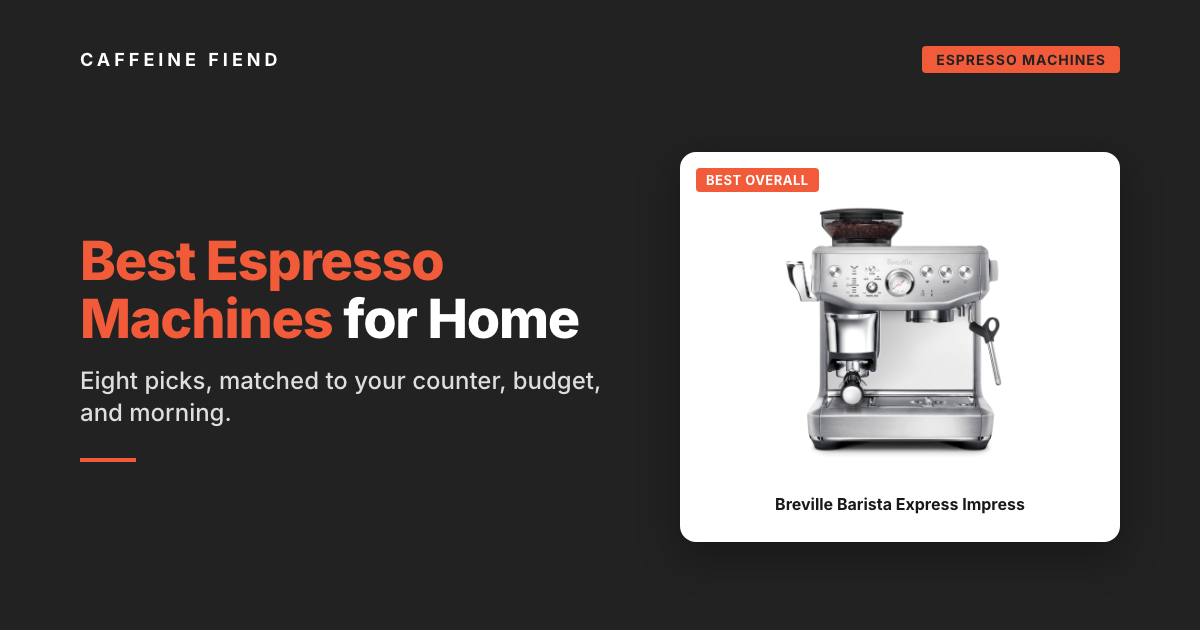
The Short Answer: For most home buyers, the Breville Barista Express Impress is the best espresso machine for home: built-in grinder, assisted tamping, real espresso, sub-$1,000.
Our Best Overall is the Breville Barista Express Impress. The built-in grinder and the assisted-tamping puck system handle the two steps that defeat almost every first-time semi-auto buyer. It pulls real espresso without you needing to mod it, watch YouTube tutorials for a month, or take out a second loan on a Lelit. It’s the home machine we’d recommend to a friend who said just tell me what to get.
A quick definition for the road. PID = the temperature controller that holds brew water at a stable target, usually around 200°F. Without one, the boiler drifts and shot-to-shot consistency suffers. We’ll reference it on most picks; that’s the whole thing it does.
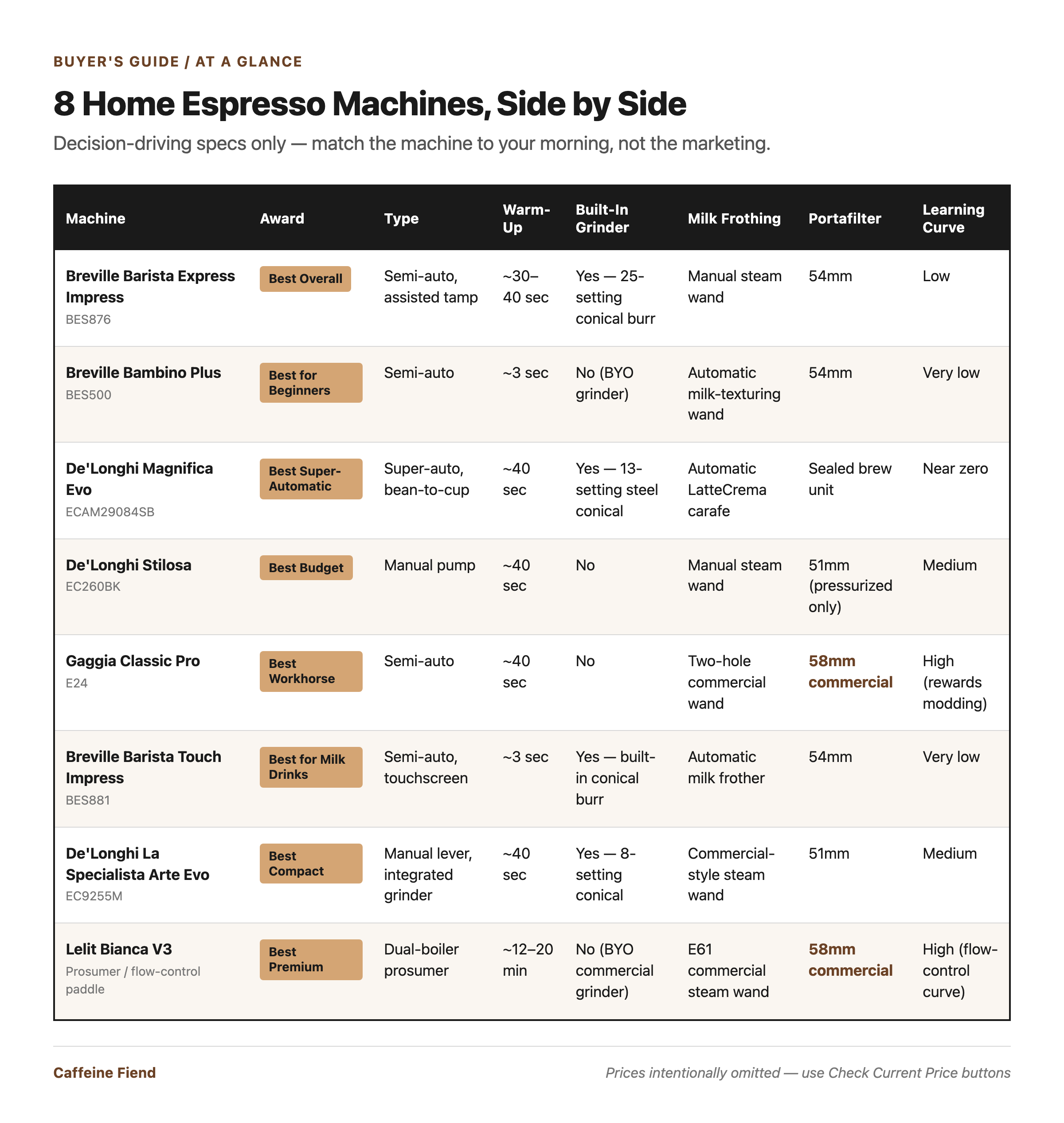
Quick Comparison: 8 Home Espresso Machines at a Glance
| Pick | Award | Machine Type | Warm-Up | Built-In Grinder | Milk Frothing | Portafilter | Learning Curve | Why It Matters |
|---|---|---|---|---|---|---|---|---|
| Breville Barista Express Impress (BES876) | Best Overall | Semi-auto, assisted tamp | ~30–40 sec | Yes (25 settings, conical burr) | Manual steam wand | 54mm | Low | One box, real espresso, sub-$1,000 |
| Breville Bambino Plus (BES500) | Best for Beginners | Semi-auto | ~3 sec | No (BYO grinder) | Automatic milk-texturing wand | 54mm | Very low | Smallest credible footprint, fastest start |
| De’Longhi Magnifica Evo (ECAM29084SB) | Best Super-Automatic | Super-auto, bean-to-cup | ~40 sec | Yes (13 settings) | Automatic LatteCrema carafe | n/a (sealed brew unit) | Near zero | The cup without the ritual |
| De’Longhi Stilosa (EC260BK) | Best Budget | Manual pump | ~40 sec | No | Manual steam wand | 51mm (pressurized basket) | Medium | Cheapest way to try home espresso |
| Gaggia Classic Pro (E24) | Best Semi-Automatic Workhorse | Semi-auto | ~40 sec | No | Two-hole commercial steam wand | 58mm commercial | High (rewards modding) | Commercial-spec hardware under $500 |
| Breville Barista Touch Impress (BES881) | Best for Milk Drinks / Touchscreen | Semi-auto, assisted tamp, touchscreen | ~3 sec | Yes | Automatic milk frother | 54mm | Very low | Mixed-household, saved drinks per person |
| De’Longhi La Specialista Arte Evo (EC9255M) | Best Compact with Grinder | Manual lever, integrated grinder | ~40 sec | Yes (8 settings) | Commercial-style steam wand | 51mm | Medium | Compact kitchen needs one box, not two |
| Lelit Bianca V3 | Best Premium / Enthusiast | Dual-boiler prosumer + flow-control paddle | ~12–20 min | No (BYO commercial grinder) | E61 commercial steam wand | 58mm commercial | High | Prosumer flow control at sub-prosumer price |
How We Picked
For this roundup, the picks were built from a combination of our own time on the gear, long-term hands-on reviews from coffee writers we trust (CoffeeGeek, Tom’s Guide, Tom’s Coffee Corner, Coffeeness, Home Grounds, Coffee Kev), the manufacturer spec sheets, and the home-barista forums.
A pick made the list only if it cleared six criteria.
- Build quality: Real espresso parts where they matter. Boiler material, portafilter spec, group head, steam wand. The basket has to hold up under 9 bar of pressure twice a day for a decade.
- Brew temperature stability: PID control or another credible way to hit and hold around 200°F at the puck. The shot doesn’t taste consistent if the brew temp doesn’t.
- Pressure: Actual extraction at or near 9 bar, the SCA-defined espresso standard. Don’t be impressed by “15 bar” or “20 bar” pump ratings. That’s pump headroom, not extraction pressure.
- Workflow: What it’s actually like to make a drink on it, from cold start to wiping down the wand. Warm-up speed, grinder integration, drip-tray size, milk system.
- Grinder strategy: Does it have a built-in burr grinder? If not, does the buy-in still leave room in the budget for a real grinder? The grinder makes more difference to the shot than any other piece of equipment, as James Hoffmann puts it.
A beginner who hates fiddling should buy super-automatic at any budget, and a tinkerer should buy semi-automatic even on a tight one.
A note on prices: you won’t find any in this article. Amazon prices move, the Associates agreement frowns on us pinning them in body copy, and a number we printed today would be wrong by next Tuesday. Use the Check Current Price buttons for what each one actually costs right now, and use the qualitative bands (“budget,” “mid-range,” “premium”) below to know which neighborhood you’re in.
Best Overall: Breville Barista Express Impress
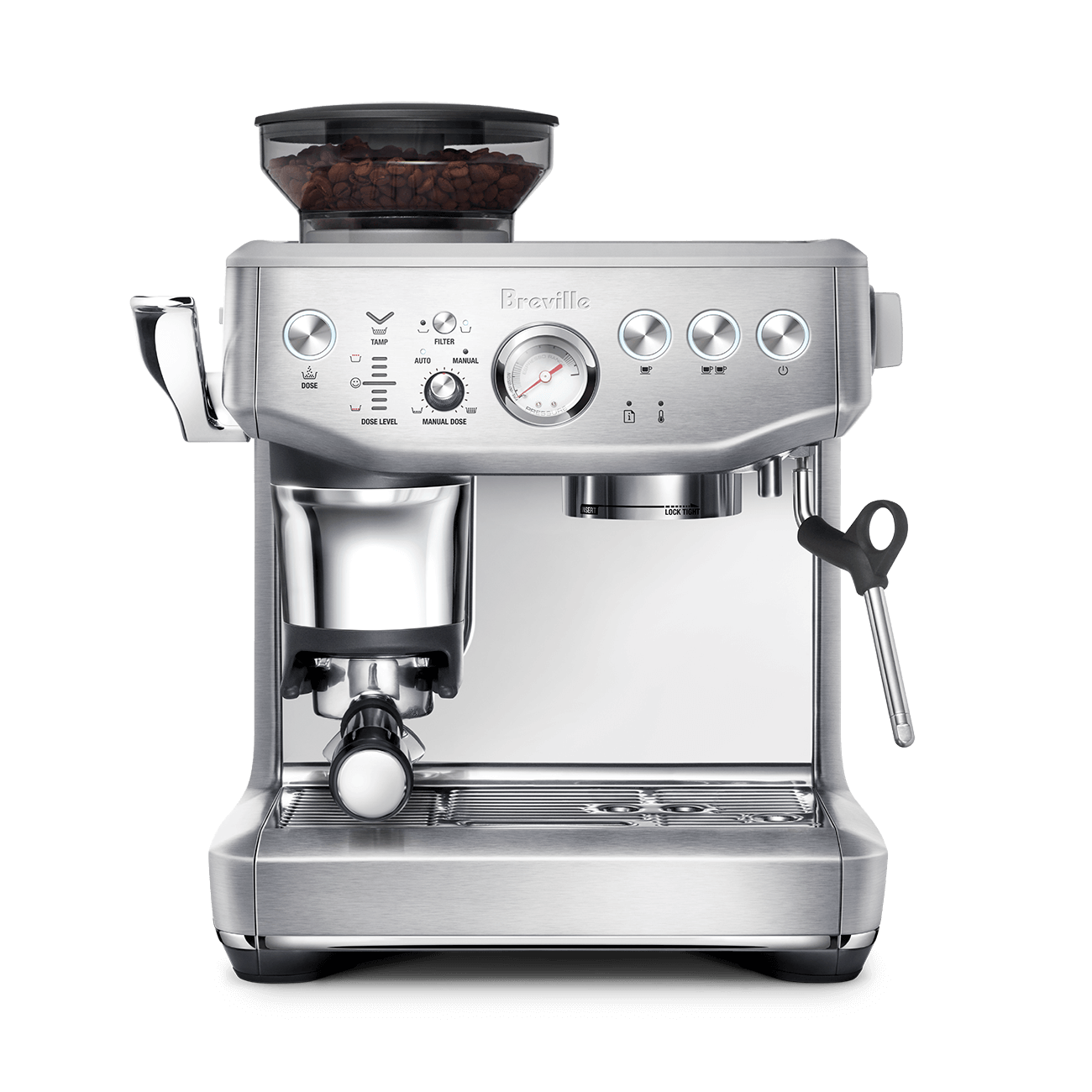
Verdict: The best espresso machine for home for the vast majority of first-time semi-auto buyers. Price band: mid-range (under $1,000 tier).
The thing the Barista Express Impress gets right is that it handles the two most error-prone steps in home espresso for you. Nothing else at this price gets that quite as right. The built-in 25-setting conical burr grinder doses grounds straight into the portafilter, and then the Impress puck system applies a constant 22 lbs of pressure with a small 7° polish twist when you press the lever. Translation: you don’t have to learn to tamp evenly, you don’t have to time anything, and you don’t have to dial in a separate grinder on day one. You wedge the portafilter in, push, lock, brew. That’s roughly two-thirds of the learning curve that defeats first-time owners of cheaper machines.
The 1600W ThermoCoil heater holds extraction temperature with a built-in PID near 200°F, and the on-machine pressure gauge gives you real visual feedback on whether the shot is running at 9 bar or whether the grind is too fine or too coarse. CoffeeGeek’s hands-on writeup put it well: the prominent pressure gauge is “useful for users interested in learning about extraction.” You can use it as a black box on day one and grow into it over six months.
The 54mm portafilter is the consumer-Breville standard. It’s not commercial-spec like the Gaggia’s 58mm, which limits which aftermarket baskets and tampers fit.
Pros
- Built-in 25-setting conical burr grinder: No separate grinder to buy on day one. This is a $200+ savings versus the Bambino Plus build-out, and it’s the cleanest path to a complete setup in one box.
- Impress assisted-tamping system: Auto-dose plus a constant 22 lbs tamp pressure removes the two steps that defeat most first-time semi-auto buyers.
- PID-controlled brew temperature plus pressure gauge: Consistent extraction temp
Cons
- Slower warm-up than its ThermoJet siblings. This is the one. The 1600W ThermoCoil heater takes roughly 30 to 40 seconds from a cold start versus the ~3 seconds on the Bambino Plus and Barista Touch Impress.
Best for: First-time semi-auto buyer who wants one box on the counter that handles real espresso, and is willing to learn the basics, but not willing to mod the machine, time their tamps, or buy a separate grinder.
Best for Beginners: Breville Bambino Plus
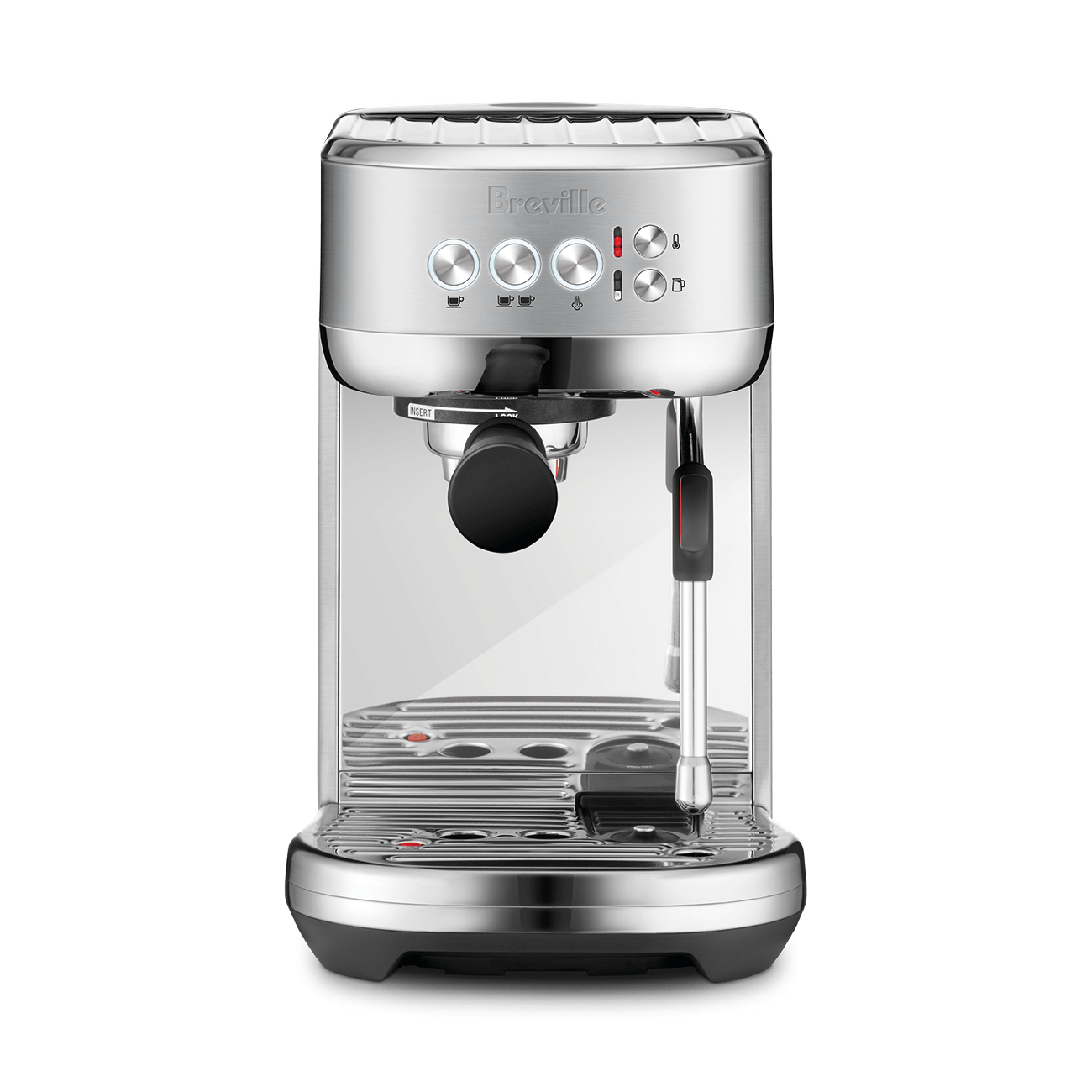
Verdict: The smallest credible espresso maker for home on the market, with the fastest warm-up in the price band and a milk-frothing wand that actually works on autopilot. The honest beginner pick if your counter is the size of a cutting board. Price band: mid-range (~$500 machine-only).
The Bambino Plus is 7.6 inches wide. That’s narrower than most stand mixers, narrower than a kettle plus a French press side by side, and it’s the smallest footprint we’d trust to make real espresso. If your counter is the kind where the toaster and the kettle have territorial disputes, the Bambino is the peace treaty. The ThermoJet heater hits brew temperature in roughly 3 seconds (the spec is “ready when you walk over to it”) and the automatic milk-texturing wand has selectable temperature and froth levels. You hit the steam button, pour milk into the pitcher, and let the machine handle the texturing while you pull the shot. If you’ve never used a manual steam wand and don’t want to learn, this and our best milk frother roundup are the right places to start. Tom’s Guide called it “the reigning entry-level champ … beyond easy to master right out of the box. You don’t need to calculate ratios or count seconds,” and we’d agree.
The catch is that the Bambino Plus has no built-in grinder. That makes it cheaper machine-only than the Barista Express Impress but means you’re shopping for a burr grinder alongside it. Budget another $200 to $300 for a decent one (a Baratza Encore ESP, a 1Zpresso Q2 if you’re going manual, or the Breville Smart Grinder Pro if you want auto-dosing). The good news is that decoupling the grinder gives you a clean upgrade path: when you want a better grinder in two years, you swap it without replacing the machine.
Pros
- 3-second warm-up. Walk up cold, walk away with espresso a minute later. Fastest in the price band, no competition.
- Will you actually use the steam wand? Yes. The automatic milk-texturing wand has selectable foam levels and makes latte and cappuccino milk repeatable without manually learning to steam.
- Smallest credible-espresso footprint: 7.6 inches wide. Fits where almost nothing else does.
- Modular setup: No built-in grinder means you pair it with whatever grinder fits your budget today, and upgrade the grinder independently in two years.
Cons
- The drip tray is tiny and fills fast. TechGearLab’s bench review flagged this and so will you, by week two. The machine also vibrates noticeably during extraction (don’t stack mugs on top). And the fixed-temperature PID can run hot on dark roasts, which matters if you’re brewing French or Italian-roast beans rather than medium-light.
Best for: First espresso machine for home where the counter is tight and the buyer wants a complete setup well under $700 once the grinder is added.
Best Super-Automatic: De’Longhi Magnifica Evo
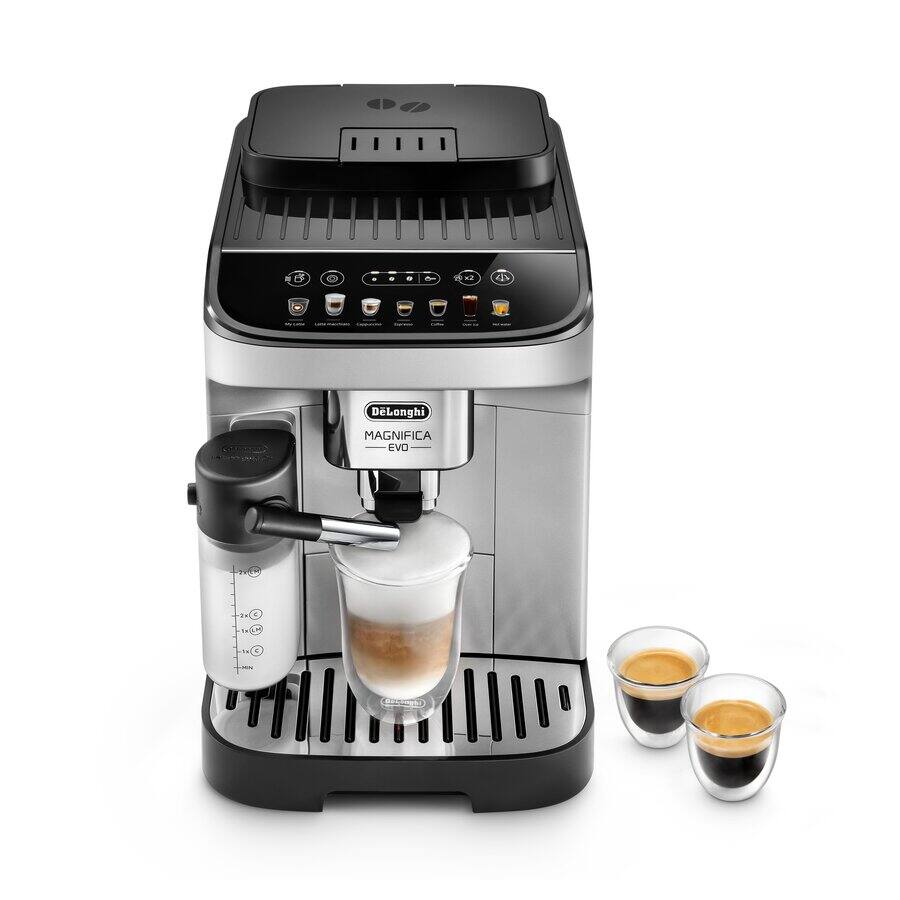
Verdict: The best espresso maker for home for the reader who wants the cup, not the ritual. One button, real espresso, milk frothed for you. The pick for buyers who’d be honest about how often they’d actually pull a manual shot before work. Price band: mid-range to premium (around $1,000).
The Magnifica Evo is a super-automatic: bean-to-cup, all of it sealed inside. You fill the bean hopper, fill the water tank, and pick a drink from the on-machine menu. The built-in 13-setting steel conical burr grinder doses and grinds. The brew unit tamps and extracts. The LatteCrema carafe (the automatic milk-frothing pitcher that snaps onto the side) steams milk to a programmable temperature and foam level. Seven one-touch beverages. There’s no dial-in, no portafilter, no learning curve. You point at the cappuccino icon and walk away.
Does a super-auto shot match a well-pulled semi-auto shot? Honest answer: almost, not quite, and probably close enough for most people. Tom’s Coffee Corner ran a 3-month, 190+ shot test and concluded the Magnifica produces “consistently good bean-to-cup espresso with medium-dark roasts, an extremely easy daily workflow, and maintenance that home users will actually follow through on.” That last clause is the underrated one. The auto-clean cycle is why this machine is still in use at year three, while the prosumer rig three counters over has descaling sludge from January and a thin layer of grinder dust nobody’s wiped since the housewarming. The Magnifica is the only pick on this list that actually nags you into descaling it, which is annoying for about two seconds and saves the machine for a decade.
Pros
- One button, real espresso. This is the pick for people whose mornings can’t accommodate a 90-second workflow on the best day, much less the day the toddler’s screaming.
- Will you actually descale it? Yes. This is the only machine on the list that nags you into it. Maintenance you’ll actually do is the difference between a five-year machine and a two-year machine.
- Excellent automatic milk frothing: The LatteCrema carafe produces genuinely competent foam without manual steam-wand skill.
- Mixed-household compatible: Seven one-touch beverages cover everyone in the kitchen, including the teenager who wants caramel oat milk something.
Cons
- The built-in grinder is loud, noticeably louder than the rest of the super-automatic field. Tom’s Coffee Corner’s long-term test flagged it specifically. Don’t run a 6am cycle if your bedroom shares a wall with the kitchen. There’s also a deeper trade-off: the bean-to-cup format locks the espresso enthusiast out. You can’t dial in extraction the way you can on a semi-auto, can’t run a non-pressurized basket, can’t experiment with grind. If you’re 50/50 on whether you want to learn espresso, this pick decides for you. You won’t be learning it.
Best for: The buyer who wants real espresso at home without becoming a hobbyist, and the household where the daily-use case is mixed milk drinks for multiple people.
Best Budget: De’Longhi Stilosa
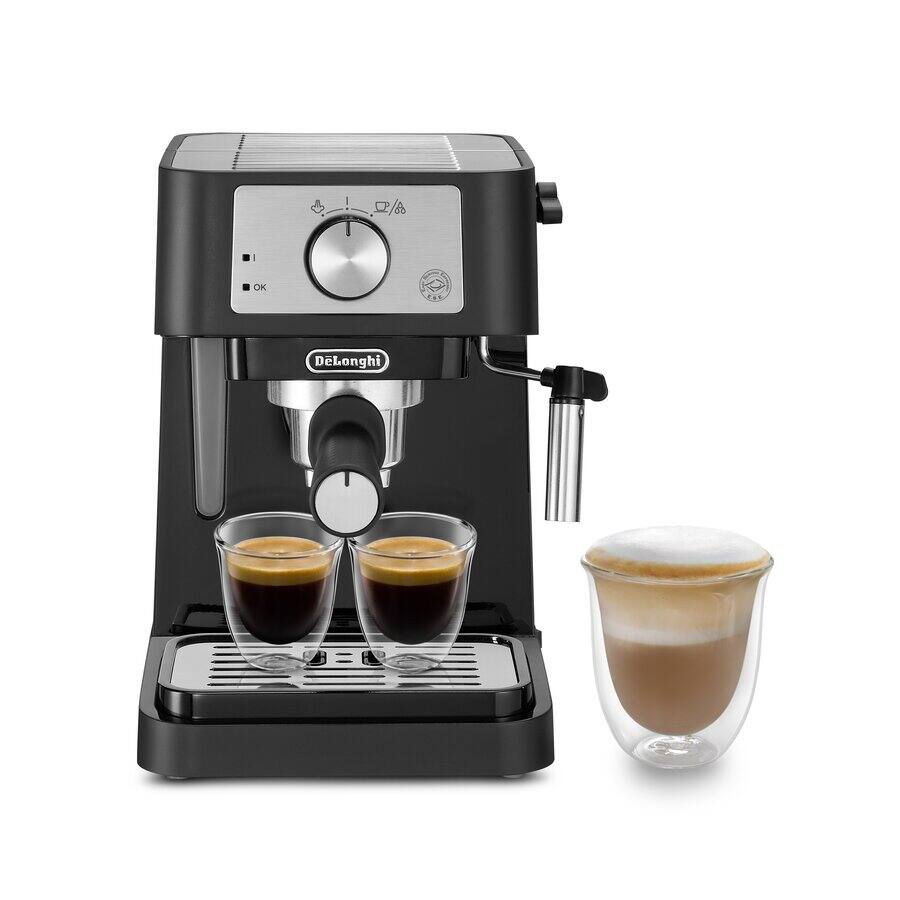
Verdict: The honest sub-$150 entry pick. Real boiler, real steam wand, the basics done correctly in a price bracket where most machines are barely better than pod machines. Price band: budget (~$100).
The Stilosa is what we’d send a college roommate, a first-apartment buyer, or anyone who’s not sure they’ll stick with home espresso and doesn’t want to spend several hundred dollars to find out. The single thing that separates it from its sub-$150 competitors is a stainless steel boiler. That’s rare at this price, where most machines use a thermoblock that struggles with brew-temperature consistency. The steam wand has a full range of motion (Coffeeness’s review specifically called this out as uncommon on budget machines), the 15-bar pump regulates extraction down to the 9-bar SCA target through the OPV, and the build is decent metal-and-plastic rather than feeling like it was glued together in someone’s garage.
Where the Stilosa shows its budget is in the basket strategy. It ships with pressurized filter baskets only, the kind that artificially generate pressure regardless of grind quality and produce a fake-crema, fake-pressure shot from almost any input. That’s a feature for true beginners (forgiving of bad grind) and a bug for anyone who wants to actually evaluate espresso (the shot is being faked for you). If you go this route, plan to buy an aftermarket non-pressurized basket and a real burr grinder before you can credibly say you’re drinking espresso.
The other small catch: the portafilter is 51mm, which is non-standard. Commercial baskets are 58mm and most aftermarket accessories are sized accordingly, so your upgrade path on this machine is shallow. Treat the Stilosa as a tryout, not as a long-term home. It’s the espresso equivalent of a rental car: you take it home, you find out if you actually like the thing, and if you do, you go buy the real one.
Pros
- Stainless steel boiler at the budget tier: Better brew-temperature stability than thermoblock competitors at this price.
- Full-range-of-motion steam wand: You can actually move it where you need it, which on a budget machine is not a given.
- 9-bar extraction via OPV: Hits the real espresso target, not just the pump headroom.
- Low risk: If you decide home espresso isn’t for you, you’re out about a hundred bucks instead of five hundred.
Cons
- Pressurized basket only, out of the box. Fake crema. You’re not really evaluating espresso until you swap in a non-pressurized basket. The 51mm non-standard portafilter also means aftermarket parts are limited compared to a 58mm machine. Cheap with caveats.
Best for: Trying home espresso without committing $500 to find out if you like it, college apartment or first-place buyer with no counter and a tight budget.
Best Semi-Automatic Workhorse: Gaggia Classic Pro
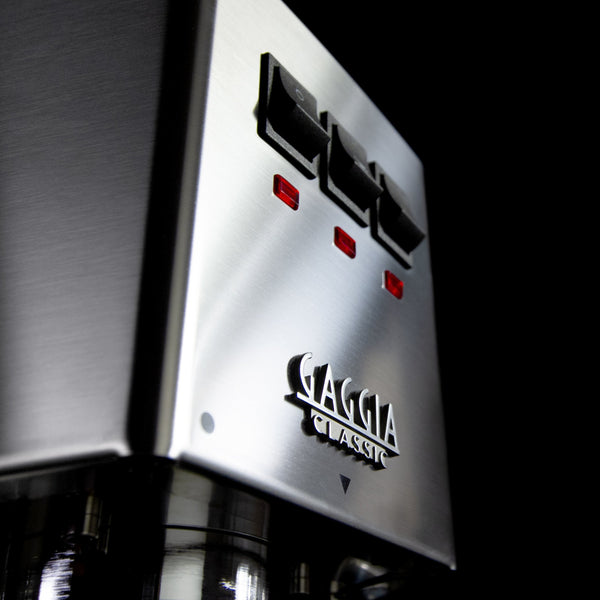
Verdict: The best espresso machine for home for the tinkerer. Commercial-spec hardware at sub-$500, infinite mod path, and a reputation it’s held for two decades because the build is honest. Price band: mid-range (~$450).
The Classic Pro E24 is the machine that gets recommended in every r/espresso thread that involves the words “long-term” or “modding.” It’s a 17-gauge stainless steel single-piece body, a brass boiler that the E24 update enlarged about 30% to roughly 100ml, a brass group head, and (here’s the part that matters) a 58mm commercial-style stainless portafilter and a two-hole commercial steam wand. Everything that touches the puck or the milk is the same spec as a coffee-shop machine. At this price, that’s an outlier. Most $450 machines use a 54mm consumer portafilter, plastic group internals, and a panarello-style steam wand that frothing geeks call “fake steam.”
Coffee Kev’s hands-on review nailed it: the Classic Pro “produces espresso at under $500 that competes with machines costing twice as much, with an upgrade path allowing you to grow with it for years … the Classic is one of the most modded espresso machines on the planet.” That mod path is the whole point. We’re going to skip the Pros/Cons block on this one and just say what the deal actually is, because the Gaggia doesn’t make sense in a bulleted list.
Here’s the real verdict. Out of the box the OPV (over-pressure valve) ships set at ~12 bar from the factory, which is above the 9-bar SCA standard, and the machine has no PID. The brew temperature wanders enough that the most-recommended first mod is a PID kit. The OPV swap is a 30-minute job with a screwdriver and a $15 spring; the PID kit is an hour with a soldering iron or a $50 add-on board. Once you do both, you have a machine that genuinely competes with the Bambino Plus and Barista Express on shot quality, with commercial-spec hardware underneath — 58mm portafilter, brass group, two-hole steam wand, the works. Used Classic Pros hold their value because the mod community keeps demand high; you can buy one used, mod it, and sell it five years later for what you paid.
The Gaggia mod community is its own subculture. There’s someone on r/gaggiaclassic right now, at 11pm on a Tuesday, arguing about which OPV spring rate pairs best with which PID kit and posting oscilloscope readings of their group-head temperature curves. That’s exactly the kind of rabbit hole the right buyer wants. If reading that paragraph made you uncomfortable, the Classic Pro is the wrong pick and you should buy the Barista Express Impress and don’t look back. If reading that paragraph made you open a new tab to look up “Gaggia PID kit,” you’re the buyer this machine was built for.
Best for: The tinkerer who treats the machine as a starting point, accepts they’ll eventually OPV-mod and PID-mod it, and wants commercial-spec hardware at sub-$500 to do it on.
Best for Milk Drinks and Touchscreens: Breville Barista Touch Impress
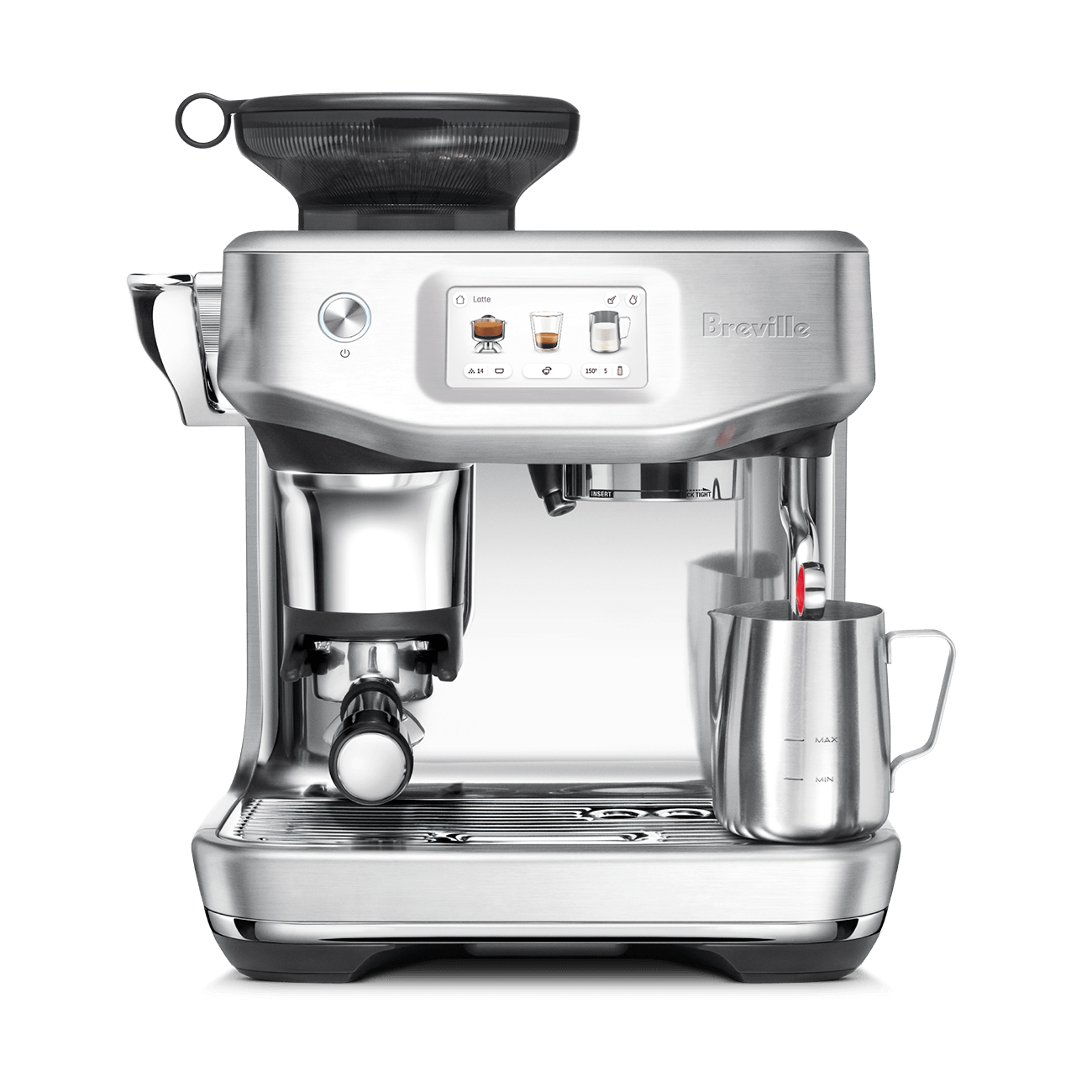
Verdict: Barista Express Impress results, plus a touchscreen with saved drink recipes per household member, plus a 3-second warm-up. The slickest UX in the semi-auto field at this price. Price band: premium (~$1,200).
The Barista Touch Impress is what happens when Breville takes the Impress puck system from the Barista Express, drops the slow ThermoCoil for the 3-second ThermoJet, and adds a color touchscreen with up to eight personalizable drink profiles. The grind, dose, tamp, brew temperature, milk temp, and milk foam level are all stored per drink, per person. Pick “Mom’s cappuccino” on the touchscreen, the machine does the rest. Coffeeness’s blind-tasting take on the Touch line gave it our favorite line in this whole roundup: “The resulting espresso shots are truly impressive, particularly if you’ve taken the time to dial everything in such that you can use the non-pressurized baskets. If I didn’t know otherwise, I would have believed the shots I tasted came from a commercial or prosumer machine.”
This is the right pick for the household with mixed milk-drink preferences where one person wants a flat white and one wants a cortado and nobody wants to learn how to free-pour. It’s also the right pick if you’re shopping for one machine you’ll keep for five-plus years and you want the convenience layer permanently baked in. The party trick is that the kid home from college can punch in their drink without anyone explaining how grams of dose work, and nobody pulls a bad shot by accident.
What you give up at this price, surprisingly, is dual-boiler architecture. The Barista Touch Impress is a single-boiler machine, which means you brew the shot, wait for the boiler to swing up to steam temperature, and then steam milk. Multiple buyers in the Home Barista forum’s Touch vs. Dual Boiler thread call this out as the decision pivot at the price point. The same money buys you a true dual-boiler machine (Breville’s own Dual Boiler, for example) where brew and steam happen simultaneously. Whether that matters depends on whether you’re making two milk drinks back to back or one drink at a time.
Pros
- Saved drink profiles per household member. Works as advertised. The cleanest UX in the semi-auto field at this price, and the only one where the kid home from college can punch their drink without explaining grams.
- 3-second warm-up via ThermoJet: Pairs the Impress puck convenience with the Bambino Plus’s instant-on heater.
- Built-in conical burr grinder: One-box setup, no separate grinder budget needed.
- Programmable milk temperature and foam, per drink, per user. Whatever your daughter’s flat white needs is what the machine pours when she pokes her face on the touchscreen.
Cons
- Single-boiler architecture at a price where dual-boiler is available. You can’t brew and steam at the same time. For one drink at a time it’s a non-issue. For making two cappuccinos back to back, you’re waiting 15 to 30 seconds in between, and a Breville Dual Boiler at the same money would let you do both at once. Worth knowing before you click buy.
Best for: Mixed-household milk-drink convenience, repeat-drink personalization, and Barista Express Impress quality with even less daily effort.
Best Compact with Grinder: De’Longhi La Specialista Arte Evo
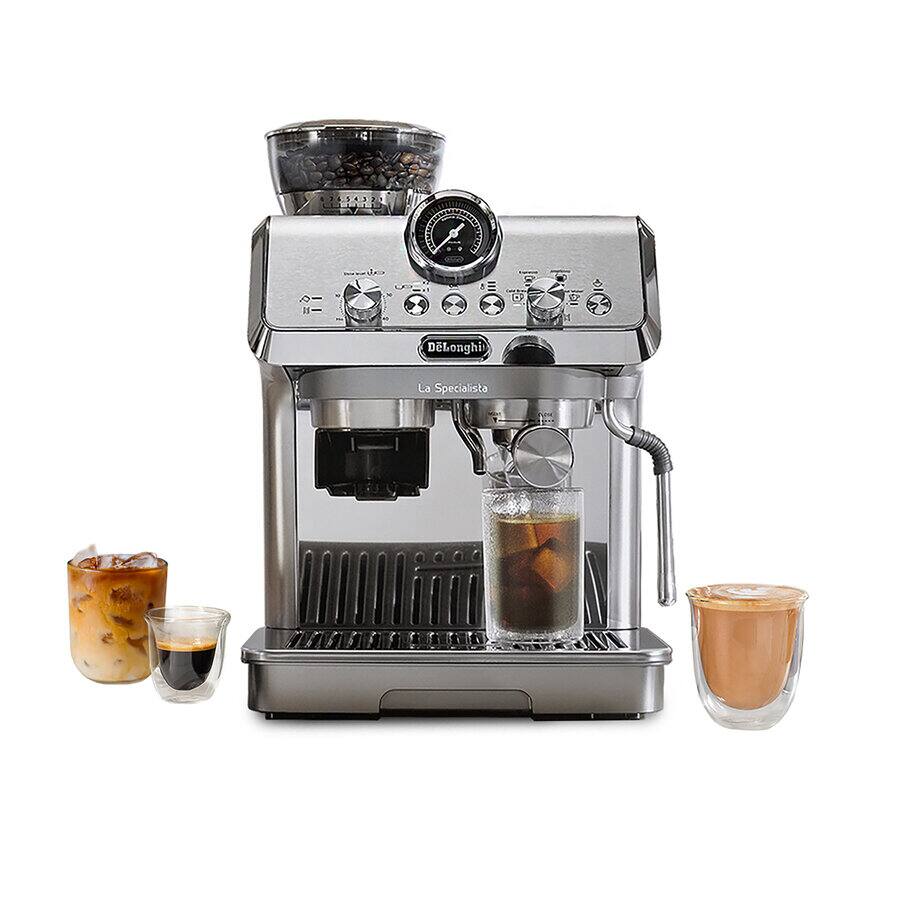
Verdict: The compact-kitchen pick. Integrated grinder, manual-lever espresso, cold-brew mode, and a retro-looking footprint that doesn’t sprawl across a counter. Price band: mid-range (~$500).
The La Specialista Arte Evo is De’Longhi’s answer to the Bambino Plus + separate grinder pairing, packaged into a single retro-looking box. Built-in 8-setting conical burr grinder, 15-bar pump regulated to 9-bar brew extraction, three infusion-temperature profiles with Active Temperature Control, and (uniquely in the price band) a cold-extraction mode that does cold brew in under 5 minutes. The commercial-style steam wand actually steams milk like a steam wand, not a panarello. Tom’s Guide’s hands-on review framed the value cleanly: “An attractive espresso machine with a retro vibe and streamlined design with a compact footprint, making it ideal for smaller kitchens … the new La Specialista Arte Evo is … a fantastic deal for a bean-to-cup when you consider that the Breville Bambino Plus is $499 and grinders cost around $200.”
We’d push back gently on the “fantastic deal” framing. The Arte Evo is genuinely good, but its built-in grinder has a real ceiling, see below. Still, the compact-with-grinder positioning is real and it’s a niche the Bambino Plus + grinder pairing doesn’t fill. If your counter is narrow and you want one box instead of two, this is the pick.
The cold-brew mode is the surprise. Most home espresso machines treat cold coffee as someone else’s problem. The Arte Evo cycles cold water through a tailored extraction profile in under 5 minutes, which is genuinely useful in summer and an order of magnitude faster than overnight steeping. If August is when your espresso machine goes dormant, this is the one that doesn’t.
Pros
- Integrated burr grinder plus cold-brew in a compact footprint: Rare combination at the price.
- Commercial-style steam wand, not a panarello: Real milk steaming, not assisted.
- Three temperature profiles: Light, medium, dark roast profiles via Active Temperature Control.
- Retro design that holds up on the counter: Looks like it belongs in a 1960s diner, in a good way.
Cons
- The built-in grinder has only 8 settings with no in-between adjustment, which Tom’s Guide flagged as “rather limiting” once you start trying to dial in a real shot. Compared to the 25 settings on the Barista Express Impress’s grinder, you’ll feel the ceiling sooner. The manual workflow is also more involved than the brand’s super-automatic Magnifica line. If you want one-touch, buy the Magnifica Evo instead.
Best for: Small kitchens that need a grinder, a real espresso machine, a real steam wand, and cold brew capability in one box.
Best Premium / Enthusiast: Lelit Bianca V3
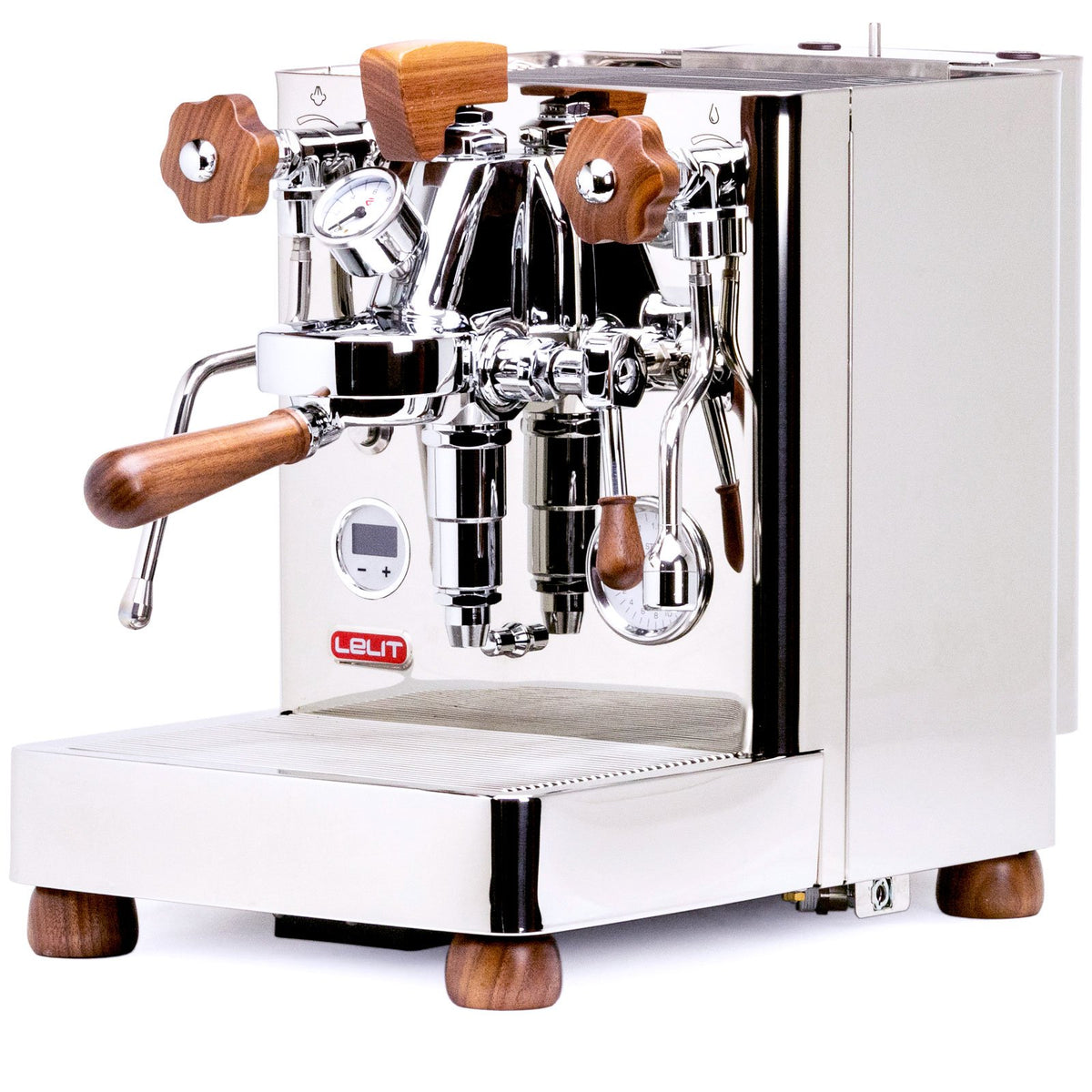
Verdict: Prosumer hardware at a sub-prosumer price. E61 group, dual boiler, rotary pump, and a flow-control paddle that lets you shape extraction pressure mid-shot. The right pick for the buyer who’s done with the convenience tier and knows it. Price band: premium (~$3,000).
Here’s what the first morning with a Bianca looks like. You walk into the kitchen, the machine is hot (because you scheduled a smart plug to flip it on at 6:40). You pull the paddle back, the rotary pump hums into life, and the shot starts at 3 bar for a long, gentle pre-infusion. Twelve seconds in, you slide the paddle forward to 9 bar and the espresso starts to drip in tight ropes that flatten into a syrupy stream. You taper at the end, the paddle drops back to 5 bar, the shot finishes. The whole thing takes 32 seconds and tastes like the best cortado you’ve ever had at a third-wave shop. Day one, your shots are honestly worse than the Bambino Plus’s because you’re learning a new variable. Week three, they’re better than the Bambino Plus has ever been able to pull. That’s the deal with the Bianca.
The Lelit Bianca V3 is the only pick in this roundup that we’d genuinely call the best professional espresso machine for home. The spec sheet reads like a small commercial machine shrunk to fit a kitchen counter. Dual boilers (800ml brew, 1.5L steam, both AISI 316L stainless). An E61 commercial-style group head. A rotary pump that’s quieter and longer-lived than the vibratory pumps on every other pick here. Optional direct plumbing. And the headline feature: a paddle on top of the E61 group that lets you manipulate brew pressure in real time during the shot.
Real flow profiling is normally a $5,000+ feature. The shot starts at low pressure for a long pre-infusion, then ramps to 9 bar for extraction, then tapers as the shot finishes. The Bianca puts that on a $3,000 machine, runs it through an analog paddle that’s actually fun to use, and pairs it with a feature set (E61, dual boiler, rotary pump) normally bundled with the higher tier. Home Grounds’s hands-on take put it best: the Bianca “sits in rare territory: prosumer performance without the commercial price tag … approachable for beginners, deep enough for obsessive home baristas, and flat-out makes incredible espresso.”
This is also not your first machine. The footprint is significantly larger than anything else here. The Fast Heat software gets you to brew temperature in about 12 minutes, but full thermal stability across both boilers wants closer to 20. (Bianca owners typically solve this with a smart plug scheduled to warm the machine up before they walk into the kitchen.) The paddle has a learning curve; on day one you’ll over-correct and pull bad shots while you figure out where 6 bar feels different from 9. Brew Coffee Home flagged the price as the practical ceiling for most home buyers, and that’s fair. This pick is for the reader who already owns a separate burr grinder, has pulled a thousand shots on a Gaggia or a Bambino, and is upgrading on purpose.
Pros
- Real flow profiling at $3,000. The flow-control paddle is normally a $5K+ feature. Bianca is the only machine on this list where the shot has a shape you author, not a shape the machine prints.
- Dual-boiler architecture: Brew and steam simultaneously, no waiting.
- A rotary pump, in a home machine. Quieter and longer-lived than the vibratory pumps on every other pick here, and it supports direct plumbing if you ever decide your kitchen needs that.
- AISI 316L stainless boilers and optional direct plumbing: Specs that hold up against machines twice the price.
Cons
- Large footprint, ~12 to 20 minute full warm-up, and a paddle that takes a few weeks to learn. This isn’t the right first machine, and it isn’t the right second machine either if you didn’t enjoy the first one. The price is the other ceiling: Brew Coffee Home calls it out as the practical limit for most home buyers, and that’s the read.
Best for: The buyer who’s done with the convenience tier, knows what flow control is, already owns a separate burr grinder, and wants prosumer hardware without crossing into commercial pricing.
Buyer’s Guide: How to Pick a Home Espresso Machine Without Regretting It
The best espresso machine for home depends more on what your mornings look like than on what your budget is. The home-espresso category has more variables than the average appliance category. Below is the short list of what to actually weigh, in priority order. You can skip the rest.
Decide On Machine Type Before You Decide On Price
This is the call that matters most, and the one most buyers get backward. Machine type is the real decision; price band is the secondary filter inside it.
- Super-automatic (bean-to-cup): One button. Sealed brew unit. No skill required. Best for the reader who wants the cup and not the ritual, and for households with mixed coffee preferences. The Magnifica Evo is the pick.
- Semi-automatic: Portafilter, grinder, steam wand, your hands involved at every step. Some assisted (the Impress system), some not. Best for the reader who wants a closer relationship with the shot, and is willing to learn dial-in. The Barista Express Impress, Bambino Plus, and Gaggia Classic Pro live here.
- Manual lever: A separate category where pulling a shot is a physical act. Niche; we didn’t include one because they’re hobbyist gear, not everyday machines. If you want a side-by-side on pressure-driven brewing methods that aren’t espresso machines, see our moka pot vs espresso breakdown.
The “best espresso machine for home automatic” search shape almost always points to super-auto. The “best espresso machine for home with grinder” shape points to the Barista Express Impress, the Barista Touch Impress, the Magnifica Evo, or the La Specialista Arte Evo. The shape of the query is usually the shape of the answer.
Budget the Grinder Into the Machine Price
The grinder is half the shot. A $500 machine paired with a $40 blade grinder produces worse espresso than a $200 machine paired with a real $200 burr grinder. A best manual coffee grinder is the actual prerequisite, not a luxury upsell.
To make that concrete: a Bambino Plus ($499) plus a $40 Mr. Coffee blade grinder produces watery, channelled shots with grounds the size of sea salt and grounds the size of flour in the same dose. A Stilosa ($100) plus a $200 Baratza Encore ESP burr grinder produces tight, syrupy espresso that the Bambino Plus owner with the blade grinder will not believe came out of a sub-$150 machine. Same beans, same water, same hands. The grinder is the variable. Everyone who has ever upgraded grinders has had this exact moment.
So when you’re shopping, treat your budget as a machine + grinder budget. The machines on this list with built-in grinders (Barista Express Impress, Barista Touch Impress, Magnifica Evo, La Specialista Arte Evo) bundle that purchase into the box price and are usually the cheapest path to a complete setup. The machines without (Bambino Plus, Gaggia Classic Pro, Stilosa, Lelit Bianca) require you to add $200 to $500 to the headline number. That’s the real price.
Match the Warm-Up to Your Mornings
A 3-second warm-up (ThermoJet) feels luxurious until you’re not running late. A 30-second ThermoCoil warm-up feels normal until you’re trying to make a drink in 60 seconds before a meeting and you’re standing there watching a pressure gauge like it owes you money. The Bianca’s 12 to 20 minutes feels insane until you realize Bianca owners solve it with a $15 smart plug that flips the machine on at 6:40. At which point warm-up time stops being a feature you live with and starts being a feature you’ve routed around.
If you can’t honestly afford the 30 seconds, the warm-up math decides the pick: ThermoJet (Bambino Plus, Barista Touch Impress) or super-auto (Magnifica Evo). If you’re a leisurely-Saturday person, warm-up doesn’t matter at all and the Bianca is on the table.
Don’t Be Fooled By 15-Bar and 20-Bar Pump Ratings
The SCA-defined espresso standard is 9 bar of extraction pressure at the puck, per the Specialty Coffee Association. “15 bar” or “20 bar” on a marketing page means the pump can produce up to that much pressure if needed. It tells you nothing about what’s happening at the puck during a shot. Every machine in this roundup extracts at or near 9 bar through an OPV (over-pressure valve) that regulates it down. We mention this because reading espresso machine marketing without knowing it makes everything look the same.
Pressurized vs. Non-Pressurized Basket
A pressurized basket has a small hole at the bottom that artificially generates pressure regardless of grind or tamp quality, producing fake crema from any input. Beginner-friendly, real-espresso-incompatible. A non-pressurized basket is what real espresso wants. It requires a proper burr grinder, a real tamp, and a real puck. Every pick on this list ships with non-pressurized baskets except the Stilosa, which ships with pressurized only. A $15 aftermarket basket sorts the Stilosa out.
Counter Space and Footprint
The Bambino Plus at 7.6 inches wide is the smallest credible machine here. The Barista Express Impress and Gaggia Classic Pro are counter-friendly but not tiny. The Arte Evo is genuinely compact for a machine with a built-in grinder. The Lelit Bianca is roughly 12 inches wide and as deep as a small bread bin. Measure your counter first.
Beginner vs. Tinkerer
A beginner’s espresso maker for home should remove dial-in problems, not embrace them. The Barista Express Impress, Bambino Plus, Magnifica Evo, Arte Evo, and Barista Touch Impress all skew this way; they’re forgiving of grind and dose variation by design. A tinkerer’s machine should reward dial-in. The Gaggia Classic Pro and the Lelit Bianca both punish lazy prep and pay off careful prep. Pick the shape that matches your relationship with the machine, not the one you think you should want. Buying a tinkerer’s machine because you want to be a tinkerer is the home-espresso equivalent of buying a guitar to become a guitarist. It happens. It mostly doesn’t end with a guitar player.
Frequently Asked Questions About Home Espresso Machines
What is the highest rated espresso machine for home use?
The highest-rated home espresso machine in this roundup is the Breville Barista Express Impress (our Best Overall pick), with the Lelit Bianca V3 sitting above it on a different axis. The Bianca rates higher on shot quality and feature set, but for the average home buyer the warm-up, footprint, and learning curve put it firmly in enthusiast territory. The Barista Express Impress wins for the broadest cross-section of buyers because it pairs real shot quality with a forgiving learning curve and an all-in-one form factor.
What espresso machine do baristas use at home?
Real working baristas buying for their own kitchens skew toward either the Gaggia Classic Pro (modded with a PID and an OPV swap) or a prosumer machine in the Lelit/ECM/Profitec/Rocket family, what most people would call the best professional espresso machine for home category. The Bianca V3 sits at the entry point of that conversation. Baristas trained on commercial gear want a 58mm commercial portafilter and a real steam wand, both of which the Classic Pro delivers at sub-$500. Few baristas with their own home setups use super-automatics. The people who already enjoy the ritual aren’t trying to remove it.
What is the best espresso to use at home?
A medium-roast espresso blend, ground fresh on a burr grinder right before brewing. Lavazza Super Crema is the safe answer your Italian uncle would approve of; Counter Culture Hologram, Stumptown Hair Bender, and Onyx Monarch are the better answers if you’ve made it this far down a buyer’s guide. Avoid pre-ground espresso. It stales within days of grinding and tastes like the gas station at hour 11 of a road trip. And on machines with a fixed-temperature PID, skip the extra-dark “Italian” or “French” roast blends; they run bitter at the higher brew temperatures these machines default to.
What is the best value home espresso machine?
Best value is a function of what you’re trying to do. For real espresso at the lowest defensible price, the De’Longhi Stilosa (with an aftermarket non-pressurized basket and a real burr grinder) is the budget pick that doesn’t embarrass itself. For best dollars-per-shot-quality, the Bambino Plus paired with a $200 burr grinder is hard to beat: under $700 total for a complete setup with real espresso and good milk steaming. For best long-term value, the Gaggia Classic Pro holds its value on the used market, takes mods that extend its lifespan a decade or more, and is the only machine here we’d buy used without flinching.
Is a home espresso machine worth it versus buying espresso out?
If you drink even one espresso drink a day, a home espresso machine pays itself back within a year at almost any price band on this list. A $5 daily cappuccino is $1,800 a year, about the price of a flight to the place that grew the beans. The Stilosa pays back in a month. The Bambino Plus pays back in roughly four months. The Barista Express Impress pays back inside six. Even the Lelit Bianca pays back in 18 months at one drink a day. The economics aren’t the question. The question is whether you’ll actually use it, which is what the buyer’s guide’s morning-routine test is asking.
Do you need a separate grinder if the espresso machine has one built in?
If the machine has a built-in burr grinder (Barista Express Impress, Barista Touch Impress, Magnifica Evo, La Specialista Arte Evo), no. You can start without a separate grinder and add one later if you want to upgrade. If the machine doesn’t have a grinder (Bambino Plus, Gaggia Classic Pro, Stilosa, Lelit Bianca), yes, you need one, and a blade grinder doesn’t count. Plan for $150 to $300 on a proper burr grinder. Without it, the machine can’t make real espresso no matter how nice it is.
Semi-automatic vs. super-automatic, which is better?
Neither is “better” in the abstract. Semi-automatic is better for the buyer who wants involvement with the shot: grinding, tamping, milk steaming, the whole ritual. Super-automatic is better for the buyer who wants the cup and not the ritual, and for households where multiple people make different drinks. The right question isn’t which produces better espresso (a well-pulled semi-auto shot is marginally better; the gap is small with modern super-autos), it’s what do you want your 7am to look like. If the answer is fast, easy, no thinking, super-auto. If the answer is I’d enjoy 90 seconds of barista routine, semi-auto.
How long does a home espresso machine last?
A well-maintained home espresso machine typically lasts 5 to 10 years. The Gaggia Classic Pro and prosumer machines like the Lelit Bianca routinely run 15+ years with periodic part swaps (boiler gaskets, OPV springs, group-head seals). Skipped descaling is what ends most home espresso machines. Run a descale cycle every 2 to 3 months in hard-water areas and your machine outlives the warranty by a decade.
So Which Espresso Machine for Home Should You Buy?
If you’re buying your first real home espresso setup and you want one box that handles it all, get the Breville Barista Express Impress. It’s our Best Overall for a reason: built-in grinder, assisted tamping, PID, pressure gauge, and a shot that grows with you. It’s the machine we’d recommend to a friend asking just tell me what to buy.
If your counter is tight or you want to start cheaper with a clean upgrade path, get the Breville Bambino Plus and pair it with a real burr grinder. Under $700 total for a complete setup with the fastest warm-up in the category.
If you want espresso without learning espresso, and especially if you’re buying for a household with mixed milk-drink preferences, get the De’Longhi Magnifica Evo. One button, real shots, milk frothed for you, maintenance you’ll actually do.
If you’re not sure whether you’ll stick with home espresso and don’t want to commit five hundred dollars to find out, get the De’Longhi Stilosa. Buy an aftermarket non-pressurized basket while you’re at it.
If you’re the kind of person who already knows what OPV stands for, get the Gaggia Classic Pro. You’ll spend a Saturday modding it and you’ll love every minute.
If you want the slickest UX in the semi-auto field plus saved drink profiles for everyone in the house, get the Breville Barista Touch Impress.
If your kitchen is small and you need a grinder and cold brew in the same box, get the De’Longhi La Specialista Arte Evo.
And if you already own a great grinder, already pull better shots than most cafés, and are upgrading on purpose, get the Lelit Bianca V3. We don’t think you’ll regret it.
The category has been gatekept for years by spec-sheet reviewers and Reddit threads about pre-infusion curves. The honest answer for almost everyone is in the first three picks. Whatever you choose, hit the Check Current Price button, get the machine on the counter, and start pulling shots. The best espresso machine for home is the one you’ll actually use on a Tuesday at 6:50am.