
If you type “commercial espresso machine” into Google, you get a wall of retailer catalog pages full of machines priced from $1,500 to $37,000, and nobody tells you which one you actually need. Our pick for the best commercial espresso machine most home enthusiasts will ever want is the Rancilio Silvia Pro X: dual boiler, dual PID, commercial 58mm portafilter, and priced under the point where “commercial” starts demanding a plumb-in and a 220V outlet. If you’re opening a small café or running a coffee cart, the Nuova Simonelli Oscar II Direct Connect is the smallest real commercial machine you can buy.
We tested and researched seven machines across three tiers (prosumer, commercial-grade for home, and entry-commercial for actual cafés). Here’s what won, what didn’t, and how to tell which one you belong with.
Our Top Picks at a Glance
| Machine | Award | Tier | Boiler config | Best for |
|---|---|---|---|---|
| Rancilio Silvia Pro X | Best Overall | Prosumer flagship | Dual boiler, dual PID | Home enthusiast, commercial-tier consistency |
| Breville Dual Boiler (BES920XL) | Best Prosumer Dual-Boiler | Prosumer entry | Dual boiler, dual PID | Home dual-boiler at the lowest defensible price |
| Rocket Appartamento 2.0 | Best Commercial-Grade for Home Use | Prosumer with commercial internals | Heat exchanger, E61 group | Commercial-grade build in a home footprint |
| Nuova Simonelli Oscar II Direct Connect | Best for Small Café / Coffee Cart | Entry-commercial | Heat exchanger, plumb-in | Small café, coffee cart, mobile coffee |
| De’Longhi Dinamica Plus | Best Commercial Espresso Machine with Grinder | Superautomatic | Single thermoblock | The “with grinder” search: home or low-volume office |
| Gaggia Classic Pro (E24) | Best Budget Entry | Budget | Single brass boiler | Budget entry into the 58mm commercial ecosystem |
How We Picked
We prioritized the criteria that decide how good the shot in your cup is going to be, not the ones that look best on a spec sheet.
- Boiler configuration and temperature stability. Dual boiler, heat exchanger, and single boiler are three different workflows. We evaluated each machine’s temperature repeatability (PID control, group-head thermal mass, recovery time between shots) and its steam power for milk drinks.
- Portafilter standard. A 58mm commercial portafilter is the format almost every serious accessory (baskets, tampers, puck screens, bottomless portafilters) is built for. Machines with proprietary or undersized portafilters lock you into the manufacturer’s ecosystem and cap your upgrade path.
- Build tier and service life. We looked for real commercial internals (brass boilers, stainless bodies, E61 group heads) where they exist, and flagged where a machine cuts corners with plastic drip trays or aluminum boilers at prices that should buy better.
- Real install requirements. A “commercial” machine you can’t plug into a normal outlet or fit on a standard counter isn’t right for a home kitchen, no matter what the label says. We noted plumb-in requirements, 220V power draw, and footprint on every pick.
- Grinder pairing math. Every honest recommendation acknowledges that above the budget tier, the grinder decides more than the machine does. If a $4,000 machine paired with a $200 grinder gets beaten by a $2,000 machine paired with a $1,200 grinder, the buying decision is the total system, not the box on the counter.
We spent time behind the paddle at cafés using the true-commercial machines we referenced, and we sourced every current spec from the manufacturer’s own product page. Where we hadn’t personally installed the exact current SKU, we say so.
What “Commercial” Actually Means
“Commercial” on an espresso machine box means about as much as “professional” on a chef’s knife. It’s a shape and a scale claim more than a certification claim, and it hides three completely different buying decisions inside one search phrase.
There are really three tiers:
Prosumer — machines built with commercial components (E61 groups, brass boilers, 58mm portafilters, PID temperature control) but sold to home users. These are the Rancilio Silvia Pro X, the Rocket Appartamento, the Breville Dual Boiler, the Lelit Bianca, the Profitec Pro 600. They run on 110V, sit on a home counter, use a water tank, and cost $1,500 to $3,500. This is what most people searching “commercial espresso machine home use” actually want.
Entry-commercial — single-group machines built for cafés and coffee carts, plumb-in capable, sometimes 110V and sometimes 220V. The Nuova Simonelli Oscar II Direct Connect is here. They run $1,500 to $4,000 for the machine alone, look like commercial equipment, and can survive real bar volume without complaint. A home user can install one, but they need a plumb-in water line for the direct-connect version, and they’ll get more out of a prosumer machine unless they’re serving actual customers.
Full commercial — two-group and three-group machines built for café bars. La Marzocco Linea, Nuova Simonelli Appia Life, Rancilio Classe 5. Machines here start around $10,000 for a two-group volumetric and go up past $30,000 for high-end multi-boiler platforms. They need 220V, plumb-in, water filtration, a commercial-grade grinder, and often a licensed installer. Amazon doesn’t really sell these, you buy through a commercial equipment vendor. If you’re opening a café doing 200+ drinks a day, you need one of these and you need a consultation, not a blog post.
The word “commercial” on an Amazon listing isn’t a certification. UL and NSF listings exist and matter for actual café installs (some jurisdictions require them for a health inspection), but a machine labeled “commercial” isn’t necessarily either. The La Marzocco Linea Mini is UL and NSF certified and can go into a mobile coffee cart. A $1,200 “commercial-style” superautomatic on Amazon almost certainly isn’t. The label describes shape; the certification describes what health inspectors will accept.
The machine is the smaller half of the buy. A commercial-grade grinder runs $1,500 to $4,000, per Coffee Machine Depot’s own PAA answer on the SERP for this keyword. Water filtration for a plumb-in setup is another $500 to $2,000. If you buy a $6,000 single-group commercial machine and pair it with a $200 doserless grinder, you’ll make worse espresso than someone with a $2,000 prosumer machine and a $1,000 grinder. Once you’re above the entry-home tier, the grinder decides how good the shot can get; the machine decides how consistently you can get there.
Do You Actually Need a Commercial Machine?
For most home enthusiasts landing on this page, the honest answer is no, you want a prosumer machine, and the retailer pages haven’t been telling you that because they’d rather sell you a $16,000 La Marzocco.
You want a prosumer machine if you’re brewing at home for yourself, your household, and the occasional guest. Two to eight drinks a day is prosumer territory. A dual-boiler prosumer machine (like our top pick, the Rancilio Silvia Pro X) will give you temperature stability within a degree, back-to-back shots without recovery waits, and a 58mm commercial portafilter that opens up the entire accessory universe. And it’ll sit on your counter without a plumb-in, run on your normal outlet, and cost under $2,000.
You want an entry-commercial machine if you’re running a coffee cart, a small café doing under 80 drinks an hour, an in-office bar for a team that actually orders espresso, or a serious home setup with plumb-in already run. Everything you get for the extra money is workflow, plumb-in, faster recovery, more sustained steam power for back-to-back milk drinks, a portafilter you can bang against the knock box a thousand times a week without loosening.
You want a full commercial machine if you’re opening a café doing 150+ drinks at peak, a specialty coffee bar, or a coffee shop that lives and dies on shot consistency. Two-group Nuova Simonelli Appia Life territory, starting around $10,400 for a two-group volumetric, per Pro Coffee Gear’s review of the Appia Life, and capable of up to 250 cappuccinos a day. You need a licensed installer, a commercial grinder, plumb-in, filtration, 220V, and a service contract. This is a business decision, not a gear decision.
If you’re the reader whose search history has surfaced $16K La Marzoccos alongside $700 DeLonghis and you can’t tell what the gap is, this is the gap. Now let’s talk about which machine to buy.
The Best Commercial Espresso Machine Overall: Rancilio Silvia Pro X
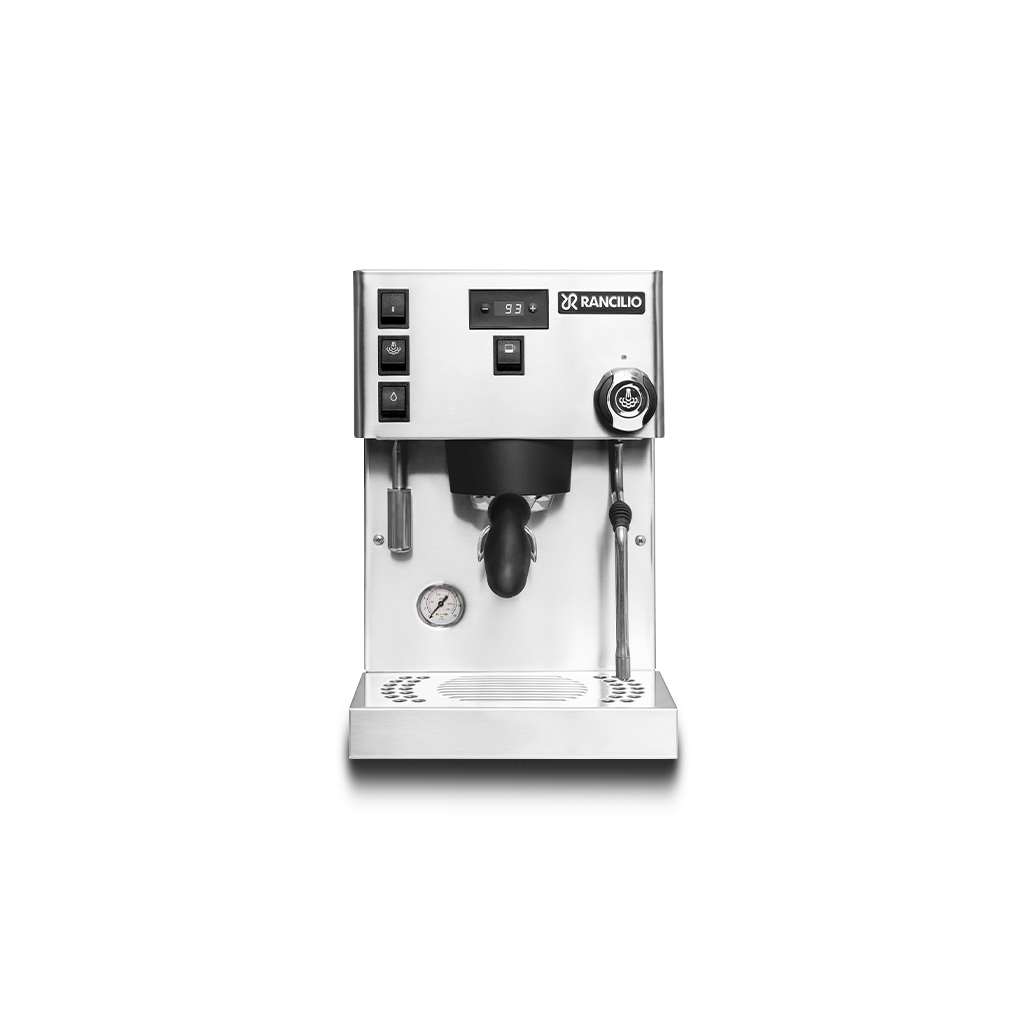
Best Overall. The Rancilio Silvia Pro X takes what the original Silvia has been doing since the 1990s (bulletproof reliability, a genuine 58mm commercial portafilter, a serviceable machine you can own for a decade) and adds the two things the original Silvia was missing: dual boilers and dual PID temperature control.
Dual boilers mean the brew boiler and the steam boiler run independently and simultaneously, you pull the shot, you steam the milk, no waiting for a boiler to swap modes. Dual PID controllers hold both boilers within ±1°C, which per The Coffee Folk’s review puts the Silvia Pro X’s temperature stability in commercial-machine territory. The 58mm portafilter is genuine commercial spec, so every basket, puck screen, and bottomless portafilter on the market fits. Soft pre-infusion, programmable shot timer, and a compact 10-inch footprint round it out.
Coffeedant’s review puts it plainly, this is a “do the fundamentals well” platform, not a novelty. Rancilio has built commercial espresso equipment in northern Italy since 1927, and the Silvia Pro X inherits the service ecosystem and long-term parts availability that platform gives you.
Pros
- Genuine dual-boiler, dual-PID workflow at the lowest price in this configuration
- Commercial 58mm portafilter with full accessory-ecosystem compatibility
- Rancilio’s commercial pedigree, 15+ year machines in daily home use are common
- Programmable shot timer and soft pre-infusion tune the shot without adding complexity
Cons
- The vibration pump is noticeably louder than the rotary pumps in some higher-tier prosumer competitors, enough that you notice it in a quiet kitchen at 6am
- No flow-control paddle for pressure profiling, so you can’t shape the shot mid-extraction the way a Lelit Bianca lets you
- Cold heat-up runs 5–15 minutes; not a fast-start machine
Best for: The home user who wants commercial-grade temperature control and a genuine commercial portafilter without leaving prosumer pricing. Also the right pick if you’re stepping up from a Bambino or a Silvia (original) and want a bigger workflow envelope without going to $3,000+ territory.
Best Prosumer Dual-Boiler: Breville Dual Boiler (BES920XL)
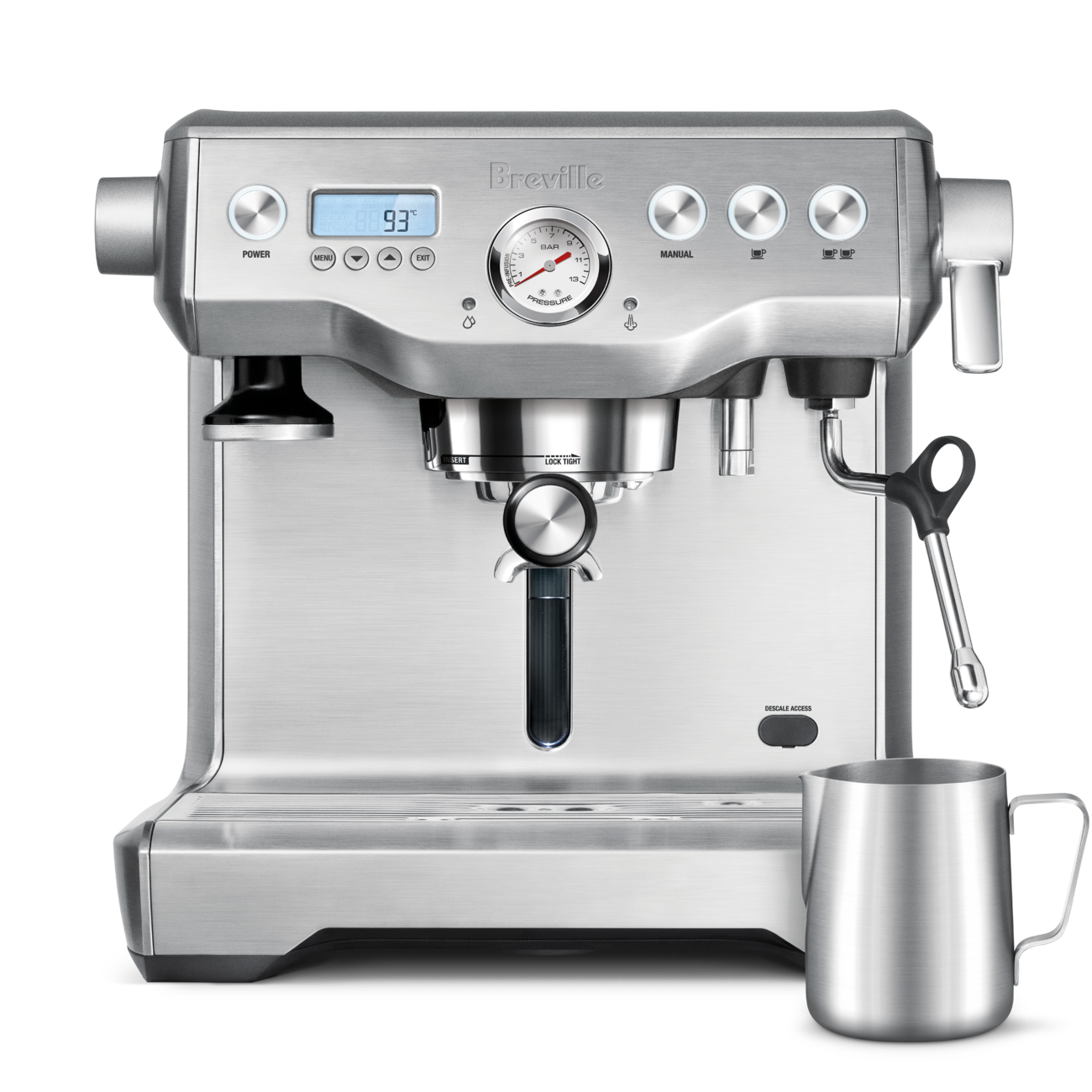
The Breville Dual Boiler BES920XL is the fastest way into dual-boiler workflow without spending prosumer flagship money. It heats up from cold to ready in about 10 minutes (Breville quotes this on the spec sheet, and Home Grounds confirmed it in their long-term review), which is the fastest we’ve seen at this price. Programmable pre-infusion pressure and duration, programmable shot length and extraction time, both boilers PID-controlled independently, 84oz water tank you can fill from the top.
We like it because it takes the dual-boiler workflow (simultaneous brew and steam, no thermal juggling) and packages it with the most flexible programmability envelope in this price band. You can build a shot profile with genuine pre-infusion pressure ramps, save it, and hit the button.
Where it falls short is the build tier. The Breville uses more plastic than the Italian-built machines a few hundred dollars up, the drip tray, the hopper, some external panels. It’s not a bad machine at all; it just feels a step down from a Rancilio or a Rocket if you’re comparing them side by side. And Breville’s 54mm portafilter isn’t the 58mm commercial spec, so your basket options are narrower than the rest of the picks here.
Pros
- Fastest heat-up in this price tier (10 minutes cold to ready)
- Most programmable pre-infusion profile envelope of any dual boiler under $2K
- Dual PID controllers on both boilers
Cons
- 54mm portafilter (not the 58mm commercial standard) narrows accessory compatibility
- Plastic drip tray, hopper, and some panels feel out-of-tier next to same-price Italian competitors
- Shot ceiling on a great grinder is a notch below the Rancilio Silvia Pro X or Rocket Appartamento
Best for: The home user who wants dual-boiler workflow, programmable pre-infusion, and the fastest heat-up in the tier, and doesn’t need the 58mm portafilter or the all-metal build.
Best Commercial-Grade for Home Use: Rocket Appartamento 2.0
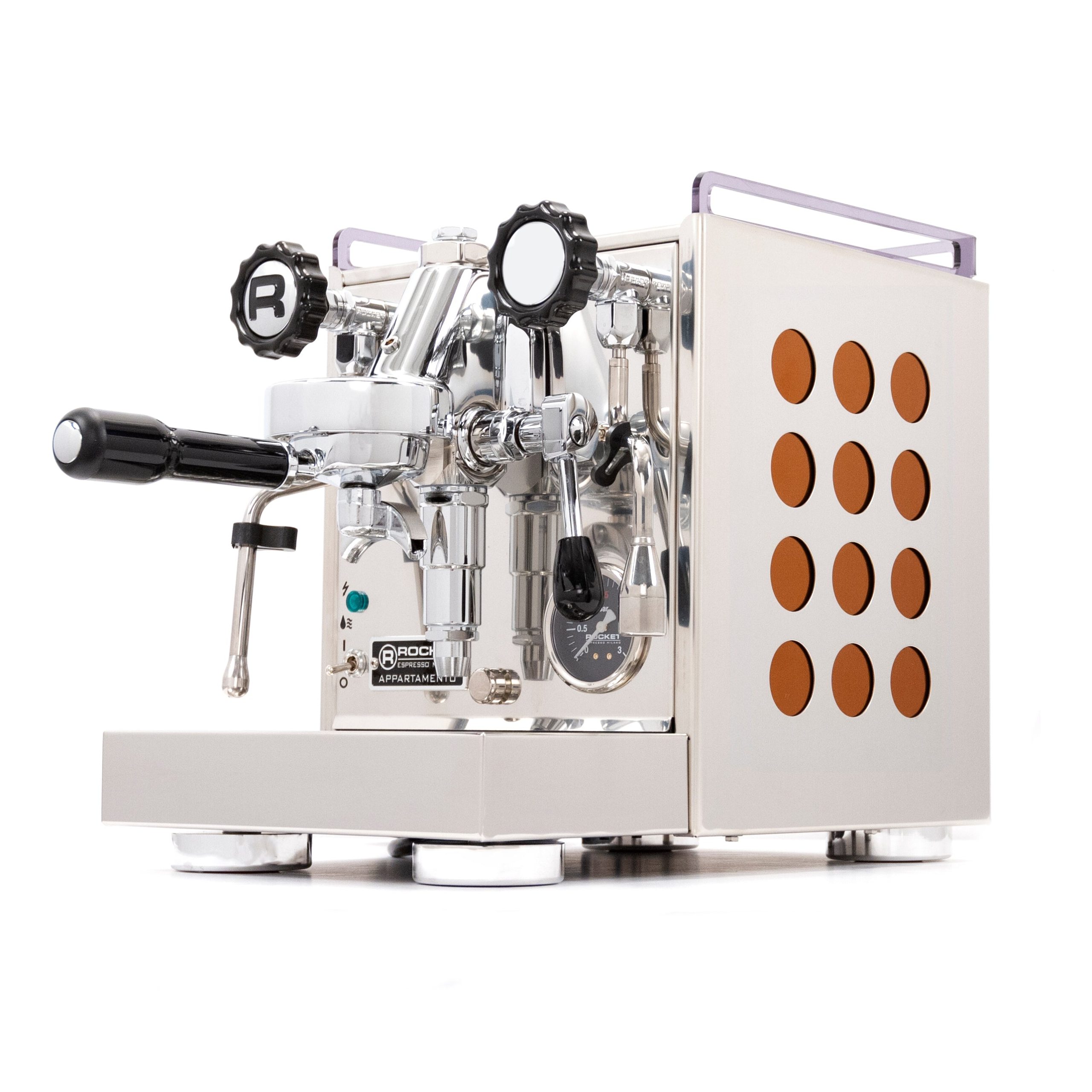
If your search was “commercial espresso machine home use” and you meant it literally, you want commercial internals in a machine that lives on a home kitchen counter, the Rocket Appartamento 2.0 is the pick.
The Appartamento uses an E61 commercial group head. This matters because the E61 is the same group installed on real commercial machines (Rocket’s own two-group bar machines, Bezzera’s commercial line, ECM, Profitec, and dozens more), and the thermosiphon design that circulates brew water through the group at all times gives the shot commercial-tier temperature stability at the puck without any electronics involved. The Appartamento pairs the E61 with a heat exchanger boiler and brass/copper internals in a 304 stainless body, all hand-built in Milan. Home Grounds’ review sums it up: the Appartamento is a “happy medium between smaller and less advanced home machines and large commercial machines used in coffee shops.”
Roasty Coffee cites 15+ years as the reasonable expectation with routine backflushing and gasket replacement. That’s not a machine you buy every five years and replace; it’s a machine you buy once.
What you don’t get: PID temperature control, a shot timer, programmable settings, or any electronics on the machine beyond the pump switch. The E61 group’s thermal mass does the temperature stability work, not a chip. That’s a feature if you want a mechanical machine you can service yourself, and a downside if you want the machine to give you data.
Pros
- Genuine E61 commercial group head and brass/copper internals in a home-counter footprint (~10.5 inches wide)
- Expected service life of 15+ years with routine maintenance
- Commercial 58mm portafilter
- Hand-built in Milan, three-year warranty
Cons
- No PID, no shot timer, no programmability, mechanical control only
- Requires you to learn E61 timing (temp surfing, flush before shot) if you want the machine’s ceiling
- Vibration pump is loud enough to notice in a quiet kitchen
Best for: The buyer who wants the actual commercial-machine experience, an E61 group and real internals, in a compact, kitchen-sized package. Also the right pick if you plan to own one espresso machine for the next fifteen years and want the parts availability that comes with the E61 platform.
Best for a Small Café or Coffee Cart: Nuova Simonelli Oscar II Direct Connect
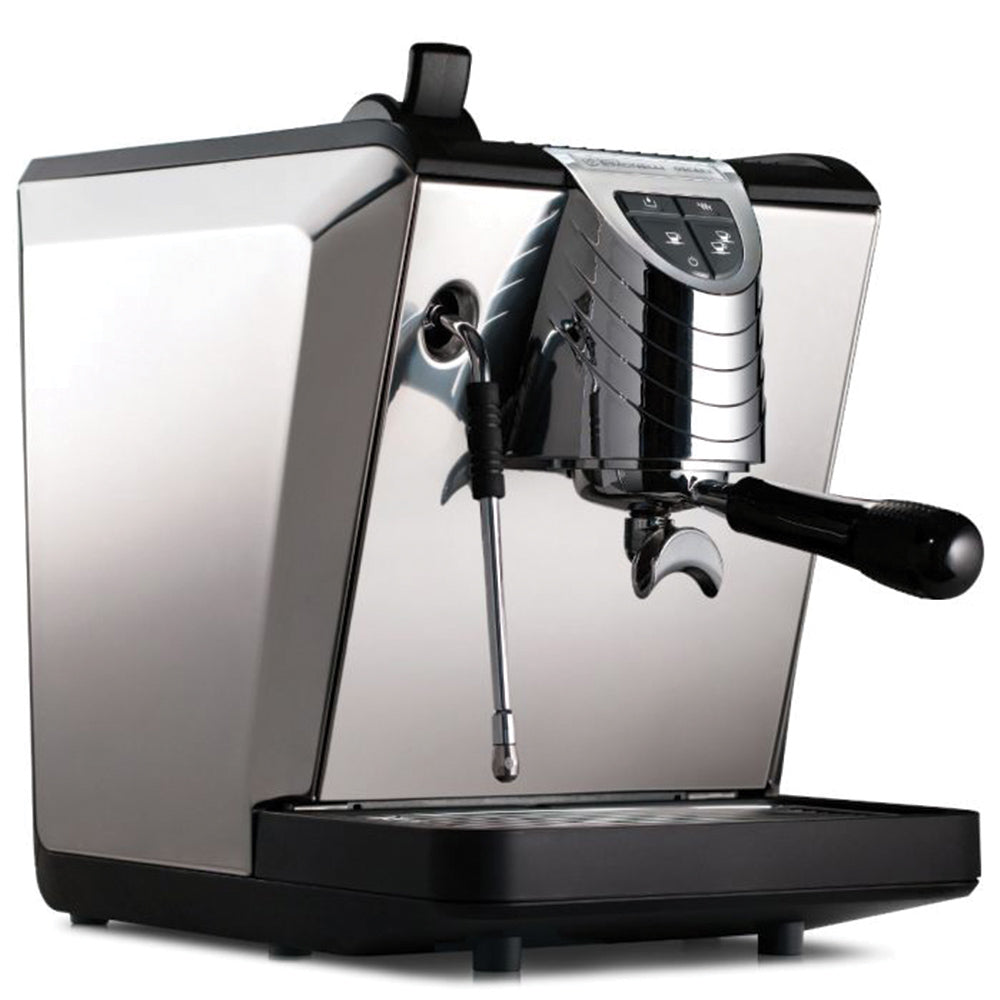
The Nuova Simonelli Oscar II Direct Connect is the only true commercial machine on our list, Visions Espresso, a commercial-equipment specialist, ranks it as roughly the smallest commercial-grade espresso machine on the market at a 16 × 12 × 16-inch footprint.
You get a real heat exchanger boiler (2L), a direct-connect plumb-in (so no tank to refill mid-service), timed dosing on a soft-touch button pad, and Nuova Simonelli’s commercial-tier construction. This is what a small coffee cart, a startup café, an office espresso bar, or a serious home enthusiast with a plumbed water line runs. Coffeedant describes it as “a compact HX with timed dosing and real steam that brings café cadence to a small bar,” which matches what we see in the machines running at coffee carts we’ve watched.
On the Oscar II, you can pull a shot, steam a pitcher of milk while the machine’s brew group is already recovering, hit the timed-dose button for the next shot, and the machine keeps up. That’s commercial workflow. A home-tier machine has to pause between drinks; this one doesn’t.
If you’re a home user considering this machine because it’s commercial-grade, pause and read the con carefully. The heat exchanger runs hot at idle and needs a cooling flush before pulling a shot after long dwell. If you make one espresso in the morning and walk away for two hours, you’ll need to flush water through the group before the next shot, or the boiler heat will scorch the puck. This is normal HX behavior; commercial baristas do it automatically because they’re always working. A home user pulling one drink a day might find it fussy.
Pros
- Genuine commercial machine at the smallest available footprint
- Direct-connect plumb-in, no tank refills during a busy service
- Real café-tier steam power for back-to-back milk drinks
- Timed dosing on the button pad gives repeatable shots without a paddle
Cons
- No PID; relies on heat-exchanger thermal management
- Needs a cooling flush after long idle before a shot (HX behavior)
- Direct-connect version requires a plumb-in water line and drain, not a plug-and-play home install
Best for: Coffee-cart operators, small-café owners, mobile-coffee entrepreneurs, and serious home enthusiasts with a plumb-in setup. Not the right pick for a home user pulling one drink a day.
Best Commercial Espresso Machine with Grinder: De’Longhi Dinamica Plus
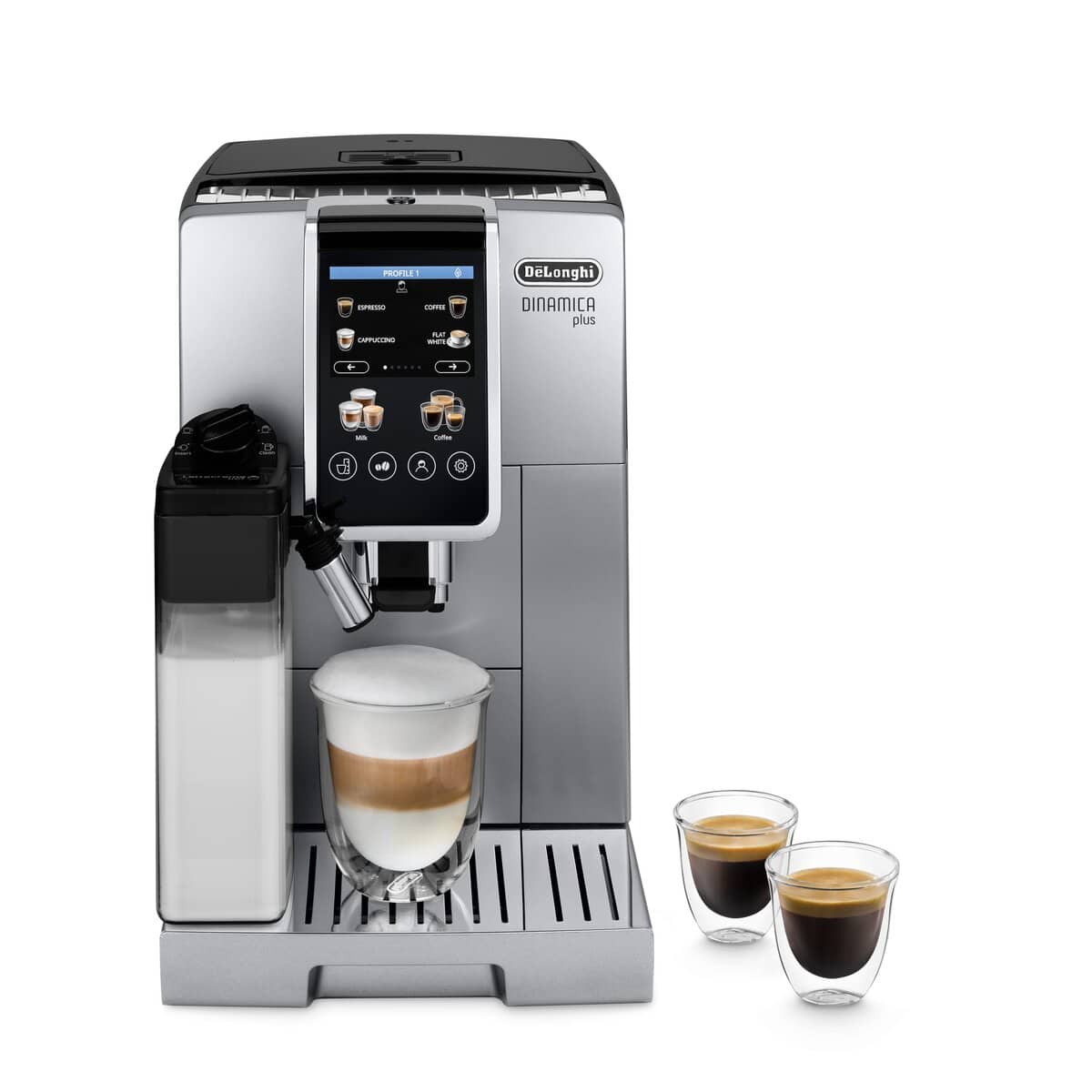
If your search phrase was actually “commercial espresso machine with grinder,” you probably want a superautomatic, a machine that grinds, doses, tamps, brews, and steams milk at the press of a button. Nobody sane calls a superautomatic a commercial-tier machine, but the search phrase covers this ground and the De’Longhi Dinamica Plus is the honest pick.
It has an integrated conical burr grinder with 13 grind settings, the LatteCrema automatic milk system with three froth modes, four user profiles for multi-drinker households, 24+ programmable recipes, and a 3.5″ TFT touchscreen with app connectivity. It’s designed for home use and low-volume office espresso, and it does what a superautomatic promises: it makes a drinkable espresso and a decent cappuccino at the touch of a button, no barista skill required.
For an office pantry serving eight people, a household where three different people drink coffee three different ways, or a Sunday-morning routine where you don’t want to touch a portafilter, this is the machine. Tom’s Coffee Corner’s review documents the LatteCrema system delivering usable milk drinks across cappuccino, latte, and macchiato modes without pitcher swaps.
A superautomatic’s best shot is worse than a manual dual-boiler’s average shot. Coffeeness’s review names it directly: the automatic milk system is a fully-sealed tube, not a barista’s steam wand, so you can’t push it toward third-wave latte art or nuanced milk texturing. And the built-in conical burr grinder is fine for consistency but not enthusiast-tier. If you want to grow into pressure profiling, latte art, or pulling shots at a coffeeshop-quality ceiling, the superautomatic is a dead end.
Pros
- Genuinely no-tinker workflow, bean hopper to milk-frothed drink in one button press
- Four user profiles and 24+ recipes handle a multi-drinker household
- Integrated grinder eliminates the separate-grinder purchase (which is a real $500–$1,000 savings)
- App connectivity and touchscreen make setup and maintenance prompts easy to follow
Cons
- Shot ceiling sits below a competent semi-automatic + separate grinder setup
- Automatic milk wand is a sealed tube, not a barista-style steam wand, no manual milk texturing
- Not a real commercial machine; wouldn’t survive daily café volume
Best for: The buyer whose search phrase was “commercial espresso machine with grinder” and who wants a full superautomatic. Also the right pick for offices, multi-drinker households, and morning routines that trade shot quality for zero-effort convenience.
Best Budget Entry: Gaggia Classic Pro (E24)
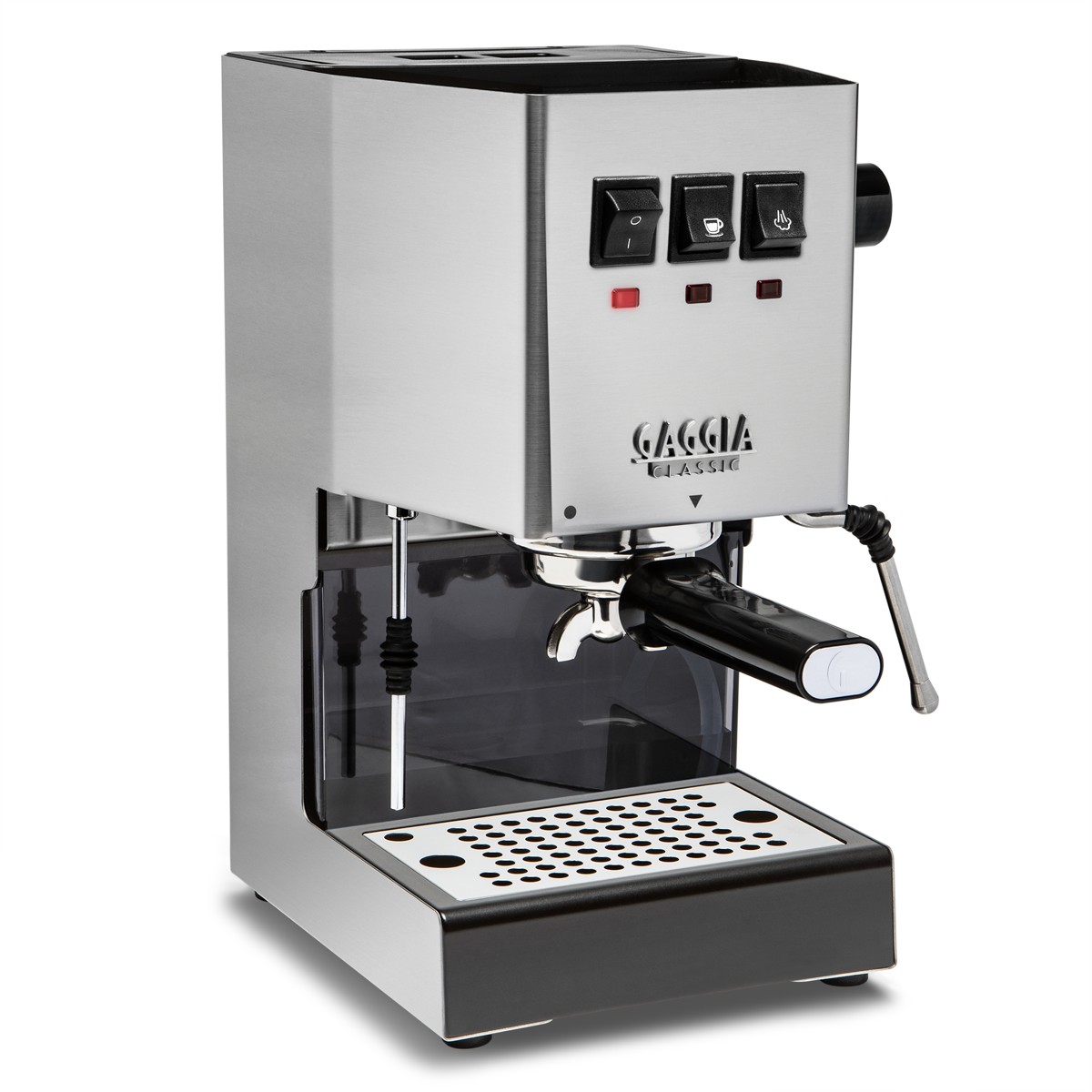
If you’re not ready to spend $1,500 on a machine but you want to buy into the 58mm commercial portafilter ecosystem, so your baskets, tampers, and puck screens transfer to whatever you upgrade to next, the Gaggia Classic Pro E24 is the honest budget entry.
It has a genuine 58mm commercial portafilter (the only machine at this price with one), a solid brass boiler (also unusual at this price, most competitors are aluminum), 9-bar brew pressure, and a commercial-style steam wand. Whole Latte Love points out that the E24’s brass boiler improves thermal stability and steaming performance meaningfully over the aluminum-boiler competitors that dominate this price band. Designed and made in Italy, backed by a modding community that has kept the Classic lineage relevant for two decades.
Single boiler means you alternate between brew and steam, you pull the shot, then wait for the boiler to swap into steam mode before you can froth milk. Stock configuration has no PID (temperature holds are approximate) and no pressure gauge. Tools and Toys documents the popular mod path (PID kit, pressure gauge, sometimes a flow-control paddle) that turns a $450 machine into something that punches above its weight, and turns it into a project. If you want to open a box and start pulling shots without also owning a soldering iron, this is not the machine for you.
Pros
- The only sub-$500 machine with a genuine 58mm commercial portafilter and a brass boiler
- Two decades of modding community, parts, guides, and a well-documented upgrade path
- 9-bar brew pressure and a commercial-style steam wand, real espresso, not weak-pressure imitation
- Designed and manufactured in Italy
Cons
- Single boiler means alternating between brew and steam, you can’t do both at once
- No PID and no pressure gauge in stock configuration; both are near-mandatory mods to hit the machine’s ceiling
- Slow steam-boiler recovery, pulling more than a couple back-to-back milk drinks gets frustrating
Best for: The budget buyer who wants a stepping-stone into the commercial-portafilter ecosystem, a project machine they can grow into, or a straightforward semi-automatic they can learn on before spending prosumer money.
Buyer’s Guide: How to Choose the Right Commercial Espresso Machine
How many drinks will you actually pull per day? One to eight is prosumer territory (Silvia Pro X, Breville Dual Boiler, Rocket Appartamento). Twenty to eighty per hour is entry-commercial single-group (Oscar II Direct Connect). Above 80 per hour at peak needs two groups and a full-commercial machine like the Nuova Simonelli Appia Life. Don’t buy above your tier because the machine looks impressive, an idle commercial machine is worse for espresso than a working prosumer, because the boiler thermal management assumes constant use.
What boiler configuration do you need? Dual boiler (independent brew and steam) is the workflow ceiling and lets you pull shots and steam milk simultaneously, that’s what the Rancilio Silvia Pro X, Breville Dual Boiler, and Lelit Bianca all give you. Heat exchanger (one boiler, thermal-siphon rig for the group) does the same job on a single boiler but needs a cooling flush after idle, the Rocket Appartamento and the Nuova Simonelli Oscar II run this way. Single boiler (Gaggia Classic Pro) makes you alternate between brew and steam. Beginners can live with a single boiler; anyone making back-to-back milk drinks wants dual or HX.
Do you have plumb-in? Real commercial machines assume a plumbed water line and a drain. The Oscar II Direct Connect can’t work without one. If you don’t have plumb-in run to your kitchen or your cart, either add it (the Oscar II also has a pour-over version with a tank, but pour-over defeats the point for a commercial install) or stay in prosumer, where every machine on this list runs on a tank.
What grinder are you pairing with it? Above the budget tier, the grinder decides more than the machine. Budget a minimum of $500 for a burr grinder if you’re buying a $1,500+ machine. $1,000+ if you’re buying a $2,000+ machine. The Coffee Machine Depot number for a commercial-grade grinder is $1,500–$4,000, and that’s if you’re actually running a business. A $150 grinder on a $2,000 machine is a common and correctable mistake, see our guide to commercial coffee grinders if you’re speccing a full setup.
PID and pre-infusion aren’t required, but they let you get to the machine’s ceiling. PID holds boiler temperature to within a degree of your setpoint; without it, you’re doing “temperature surfing” (flushing water through the group to bring the temperature down after idle heat-up). Pre-infusion (a soft ramp of pressure and water into the puck before the full 9-bar shot) reduces channeling and gives the shot more sweetness. The Rancilio Silvia Pro X, Breville Dual Boiler, and Lelit Bianca all give you these built in. The Rocket Appartamento gives you neither, because the E61 group’s thermal mass handles temperature stability without PID and the group’s pre-infusion chamber does the pre-infusion mechanically.
Portafilter size decides your upgrade path. 58mm commercial is the standard. Every good bottomless portafilter, precision basket, WDT tool, and puck screen assumes 58mm. Machines with 54mm (Breville) or proprietary sizes lock you into their ecosystem. If you plan to upgrade over time, 58mm is the format to buy into.
So Which Commercial Espresso Machine Should You Buy?
If you’re a home enthusiast, that’s most people reading this, get the Rancilio Silvia Pro X. Dual boiler, dual PID, commercial 58mm portafilter, sub-$2,000 pricing, and Rancilio’s commercial pedigree. It’s the machine that maps the “commercial-grade quality for home use” search to a defensible pick.
If you want the same commercial-grade internals in a machine built like an actual commercial espresso bar, and you can live without PID or programmability, get the Rocket Appartamento. The E61 group and brass boiler give you commercial-tier temperature stability the hard way, thermodynamics, not electronics, and the machine will last decades.
If you want the fastest heat-up and the most programmable pre-infusion envelope in the prosumer tier, get the Breville Dual Boiler. It’s not the top-tier build, but the workflow and programmability are excellent for the price.
If you’re opening a small café, running a coffee cart, or building a mobile-coffee business, get the Nuova Simonelli Oscar II Direct Connect. It’s the smallest genuine commercial machine you can buy, it plumbs in, and it has the workflow cadence commercial service actually needs.
If you want the “commercial espresso machine with grinder” search resolved with a real superautomatic, get the De’Longhi Dinamica Plus. It’s not a real commercial machine, but it’s an honest bean-to-cup workflow that solves the buying problem the search phrase is actually about.
If you’re on a budget and want to start with the 58mm commercial ecosystem, get the Gaggia Classic Pro.
Whatever tier you land on, budget more grinder than you think you need.
Frequently Asked Questions About Commercial Espresso Machines
What’s the difference between a home and a commercial espresso machine?
Boiler capacity, workflow, and durability. A commercial machine has larger boilers and higher output capacity so a barista can pull back-to-back shots and steam milk without waiting for boiler recovery. It’s built with commercial-grade components (brass boilers, stainless bodies, commercial group heads) that hold up under all-day use, and it usually plumbs into a water line rather than running from a tank. The tradeoff is size, cost, and install complexity. A real commercial machine assumes plumbed water, sometimes 220V power, and a commercial grinder to pair with it. A prosumer home machine borrows most of the internal components (58mm portafilter, PID, brass boiler) at a home-counter footprint.
Can you use a commercial espresso machine at home?
Yes, and a lot of people do. UL and NSF listings on machines like the La Marzocco Linea Mini don’t restrict home ownership, they enable commercial deployment. The real limits on home use are practical: a two-group commercial machine (like the Nuova Simonelli Appia Life) needs 220V power and a plumb-in water line, which most home kitchens aren’t set up for. A single-group commercial machine like the Oscar II Direct Connect runs on 110V and only needs a water hookup you can add without a licensed contractor. And a prosumer machine like the Rancilio Silvia Pro X gives you commercial-grade internals in a package designed for a normal kitchen counter.
How much does a commercial espresso machine cost?
The machine itself is $1,500 to $30,000 depending on tier. Coffee Machine Depot names the working range as $5,000 to $25,000 for a “quality commercial espresso machine,” plus $1,500 to $4,000 for a commercial-grade grinder and $500 to $2,000 for water filtration. Add plumbing, a licensed installer, and 220V electrical if you don’t already have it. A prosumer setup (Rancilio Silvia Pro X + Baratza Sette 270 grinder) can be done for around $2,500 to $3,000 total. A single-group commercial cart setup starts around $4,000 for machine plus grinder. A two-group café install runs $15,000 to $25,000 all-in.
Do commercial espresso machines make better espresso than home machines?
Not automatically. The machine sets a ceiling and the grinder decides how close you get to it. A commercial machine with a poorly-matched grinder makes worse espresso than a prosumer machine with a properly-matched grinder. The reason commercial machines make better espresso in a café is that they’re paired with $2,000+ commercial grinders and run by trained baristas. If you plan to run a $200 grinder alongside a $5,000 commercial machine, you’ll be paying for capacity and workflow you don’t need and not getting a better shot in the cup.
What’s the best commercial espresso machine with a grinder built in?
For the true commercial tier, integrated-grinder commercial machines exist (Jura X-series, some Nuova Simonelli superautomatic units) but they’re specialty office / corporate-catering equipment more than café gear. For the search phrase as most people mean it, a home machine with a grinder that just works, the De’Longhi Dinamica Plus is our pick. It’s a full superautomatic with a 13-setting conical burr grinder, an automatic milk system, and four user profiles.
Do I need a commercial machine to make café-quality espresso at home?
No. Every machine on this list except the Gaggia Classic Pro and the De’Longhi Dinamica Plus can pull genuinely café-quality shots. The Rancilio Silvia Pro X, Breville Dual Boiler, and Rocket Appartamento all match commercial-grade temperature stability. What separates them from a café machine is workflow, not shot quality. If you want to pull one drink at a time and have the time to dial it in, a good prosumer machine matches or beats an under-utilized commercial machine on the shot itself.
How long do commercial espresso machines last?
Longer than home machines by design. A commercial machine is built assuming eight to twelve hours of daily use, so at home use it lasts decades. The Rocket Appartamento’s expected 15+ year service life (per Roasty Coffee) is typical for the E61-group prosumer tier. Full commercial machines like the La Marzocco Linea Mini are engineered for 15–20 year service lives even at commercial volume. The wear parts (gaskets, group screens, portafilter baskets) get replaced every year or two; the machine itself outlasts most kitchens.