
Most people asking for an espresso machine with grinder aren’t really debating gear philosophy. They’re trying to fit one box on the counter without the toaster filing a restraining order. We get it, and that’s a perfectly sound reason to buy a combo.
After researching the field across hands-on reviews and long-term owner testing, our Best Overall pick is the Breville Barista Express Impress. It’s not the right answer for every kitchen, though, so we picked five more for the scenarios where it isn’t.
Quick Comparison of Our Picks
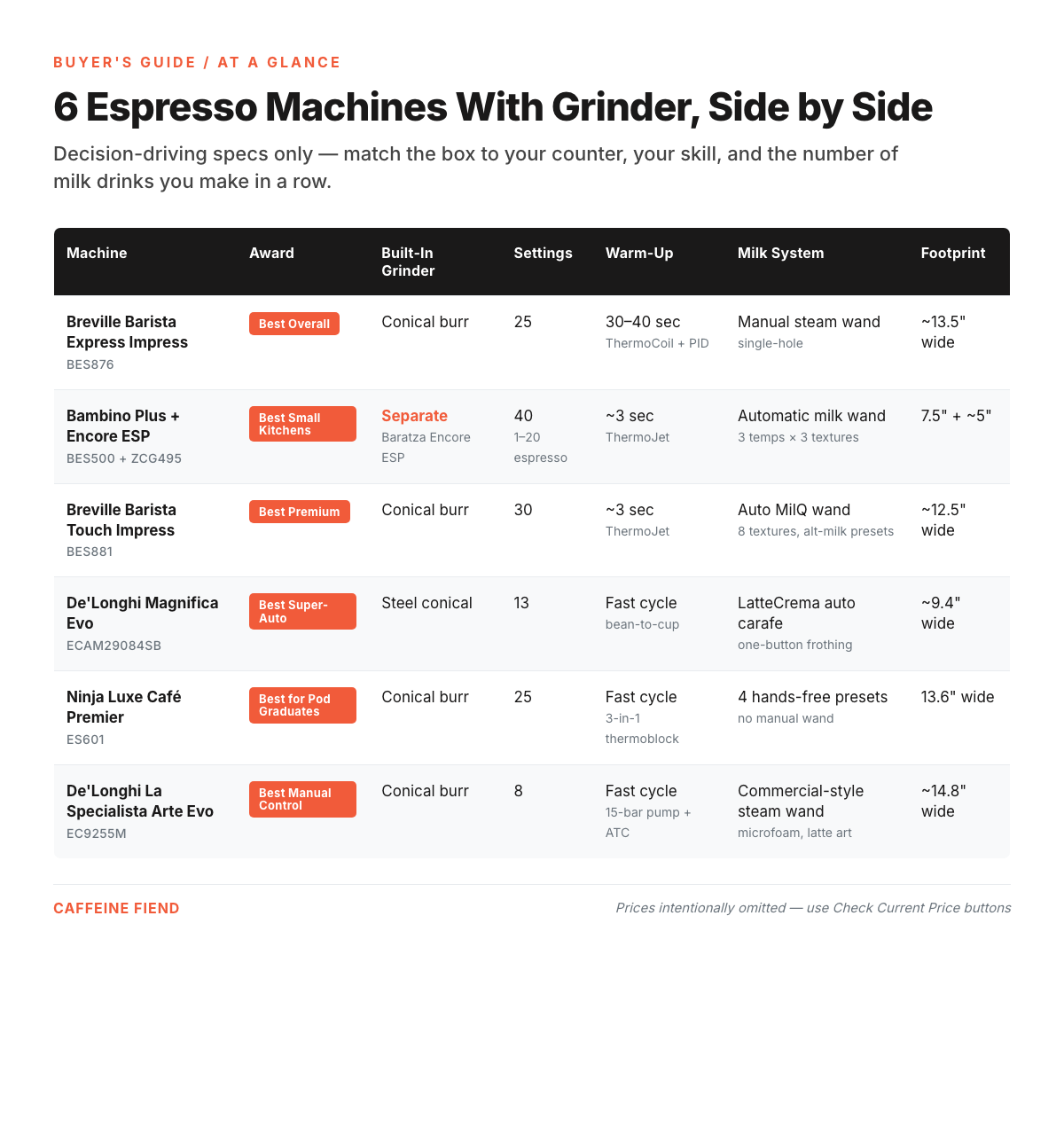
| Pick | Award | Grinder | Settings | Warm-up | Milk | Width |
|---|---|---|---|---|---|---|
| Breville Barista Express Impress | Best Overall | Built-in conical burr | 25 | 30–40 sec (ThermoCoil + PID) | Manual steam wand | ~13.5″ |
| Bambino Plus + Encore ESP bundle | Best for Small Kitchens | Separate (Baratza Encore ESP) | 40 (1–20 for espresso) | 3 sec (ThermoJet) | Automatic milk wand | 7.5″ + ~5″ |
| Breville Barista Touch Impress | Best Premium | Built-in conical burr | 30 | 3 sec (ThermoJet) | Auto MilQ wand, 8 textures | ~12.5″ |
| De’Longhi Magnifica Evo w/ LatteCrema | Best Super-Automatic | Built-in steel conical | 13 | Fast cycle (bean-to-cup) | LatteCrema auto carafe | ~9.4″ |
| Ninja Luxe Café Premier | Best for Pod Graduates | Built-in conical burr | 25 | Fast cycle | 4 hands-free froth presets | 13.6″ |
| De’Longhi La Specialista Arte Evo | Best for Manual Control | Built-in conical burr | 8 | Fast cycle | Commercial-style steam wand | ~14.8″ |
How We Picked
Espresso machines with built-in grinders are a busy category (Breville alone fills three slots on this list), so we leaned on hands-on reviews from named reviewers like Tom’s Guide, Coffeeness, CoffeeGeek, Tom’s Coffee Corner, Brew Coffee Home, and Top Ten Reviews, plus long-term owner reports and the messaging cluster we’ve already published on this site. Every spec traces to the manufacturer’s page. Every con traces to multiple reviewers using the machine, not the marketing line.
The criteria that decided the picks:
- Grinder integration that earns its slot. A built-in conical burr that holds enough range for the espresso the machine is built to pull. Cheap pressurized-only mini grinders don’t count.
- Real espresso parts where they matter. Boiler material, portafilter size, group head heat, steam wand quality. The marketing pump rating doesn’t.
- Thermal stability. PID-held brew temperature near the SCA target of 195–205°F. The Specialty Coffee Association sets the bar at 9 ± 1 bar of brew pressure and that temperature range, and we treat that as the floor for “real espresso.”
- Honest cons. No combo machine is perfect, and we don’t pretend otherwise. Every pick below carries a real, specific con.
A note on pump pressure before we get into the picks. You’ll see “15 bar” and “20 bar” splashed across espresso maker with grinder listings on Amazon. Ignore the pump rating as a quality signal. The SCA’s extraction target is 9 bar; the higher number is pump headroom to overcome flow resistance, not pressure pushed into the puck. A 9-bar machine and a 20-bar machine can pull the same shot. The grinder, the burrs, and the heat are what move the cup.
And one more frame. The grinder will make more difference to your coffee than any other piece of equipment you own. James Hoffmann says that, and it’s the strongest case both for a combo with a real burr grinder and against the cheap espresso machine grinder lookalikes that don’t have one. We baked that into every pick on this list.
The 6 Best Espresso Machines With Grinder
1. Breville Barista Express Impress — Best Overall
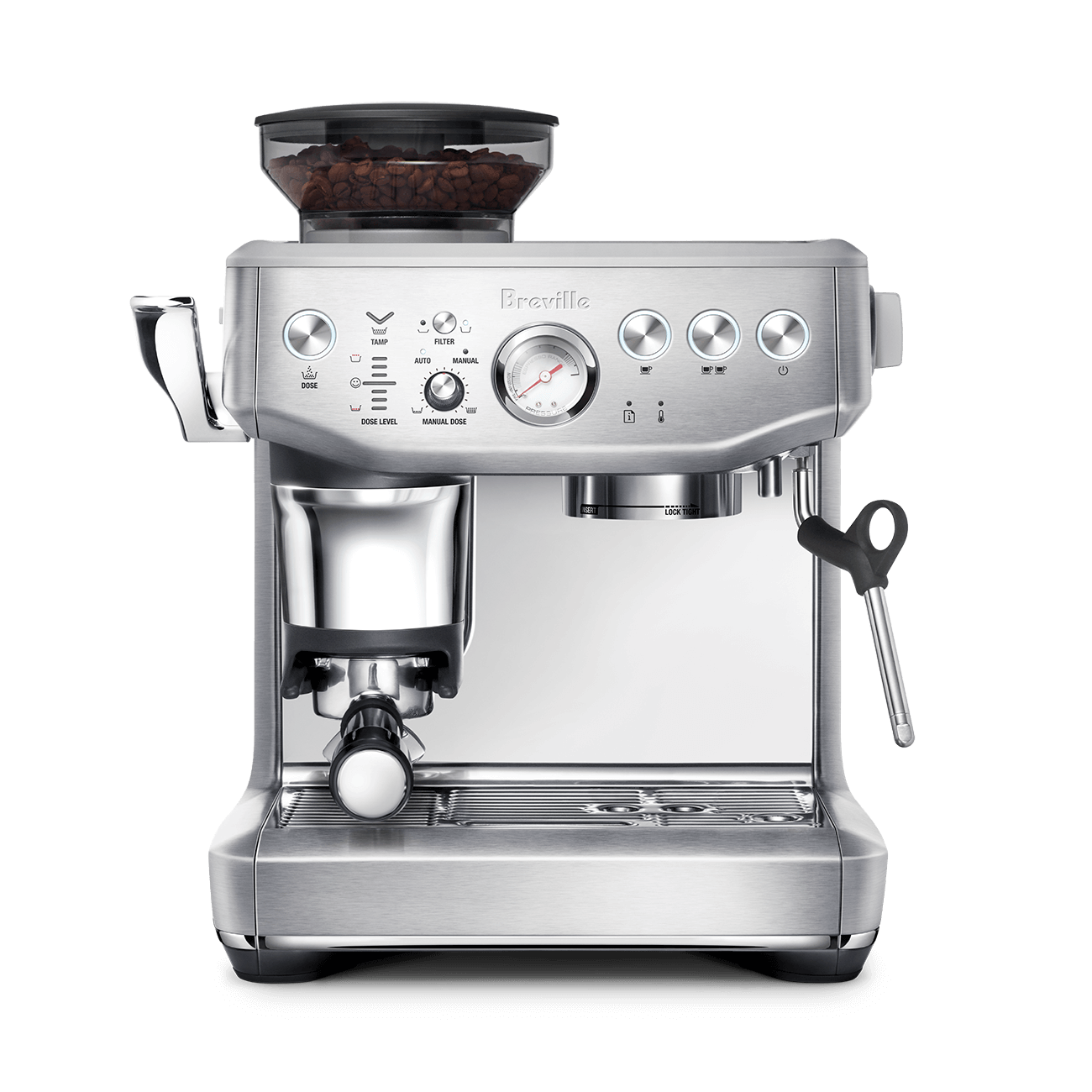
The verdict: It’s hard to go wrong with the Barista Express Impress, and we’d happily send most home buyers to it as a one-and-done pick. The Impress puck system removes the two things that defeat first-time semi-auto owners (dosing consistency and tamping evenness), and the integrated 25-setting conical burr handles the espresso the machine is built to pull. ThermoCoil heating with a built-in PID holds brew temperature near 200°F, which is where you want it.
The reason it earns the slot on this list is that it gets all of that into a single box at a mid-range price, with no day-one separate-grinder decision to make.
What stands out in use is the Impress mechanism. It applies 22 pounds of constant tamping pressure plus a 7-degree polish twist, and reviewers running shots through it for weeks (Coffeedant, Brew Coffee Home, Coffeeness) converge on the same observation: channeling becomes rare, and the dosing dials in to within about half a gram after two or three shots.
Pros:
- Assisted tamping that works: the Impress system removes the steep beginner learning curve on dosing and tamp evenness, and reviewers converge on this as the headline feature.
- Real PID-held brew temperature: ThermoCoil holds water near the SCA target, so shots are stable from one to the next.
- One-box workflow with a real burr grinder: 25 grind settings cover most espresso roasts you’d realistically buy.
- Built like a Breville: five-plus years on the market with the cluster’s most documented owner reviews.
Cons:
- Slow steam wand for back-to-back milk drinks: the single-hole wand takes around 75–90 seconds to rebuild steam between shots. Making two lattes for two people is a wait-and-watch operation. Brew Coffee Home flagged this as the weakest part of the machine, and Coffeedant said the same.
Best for: the buyer who wants one box, makes 1–2 milk drinks per round (not a four-cappuccino household), and would rather spend dialing-in time on the grinder than on tamping technique.
Price band: mid-range.
2. Breville Bambino Plus + Baratza Encore ESP — Best for Small Kitchens
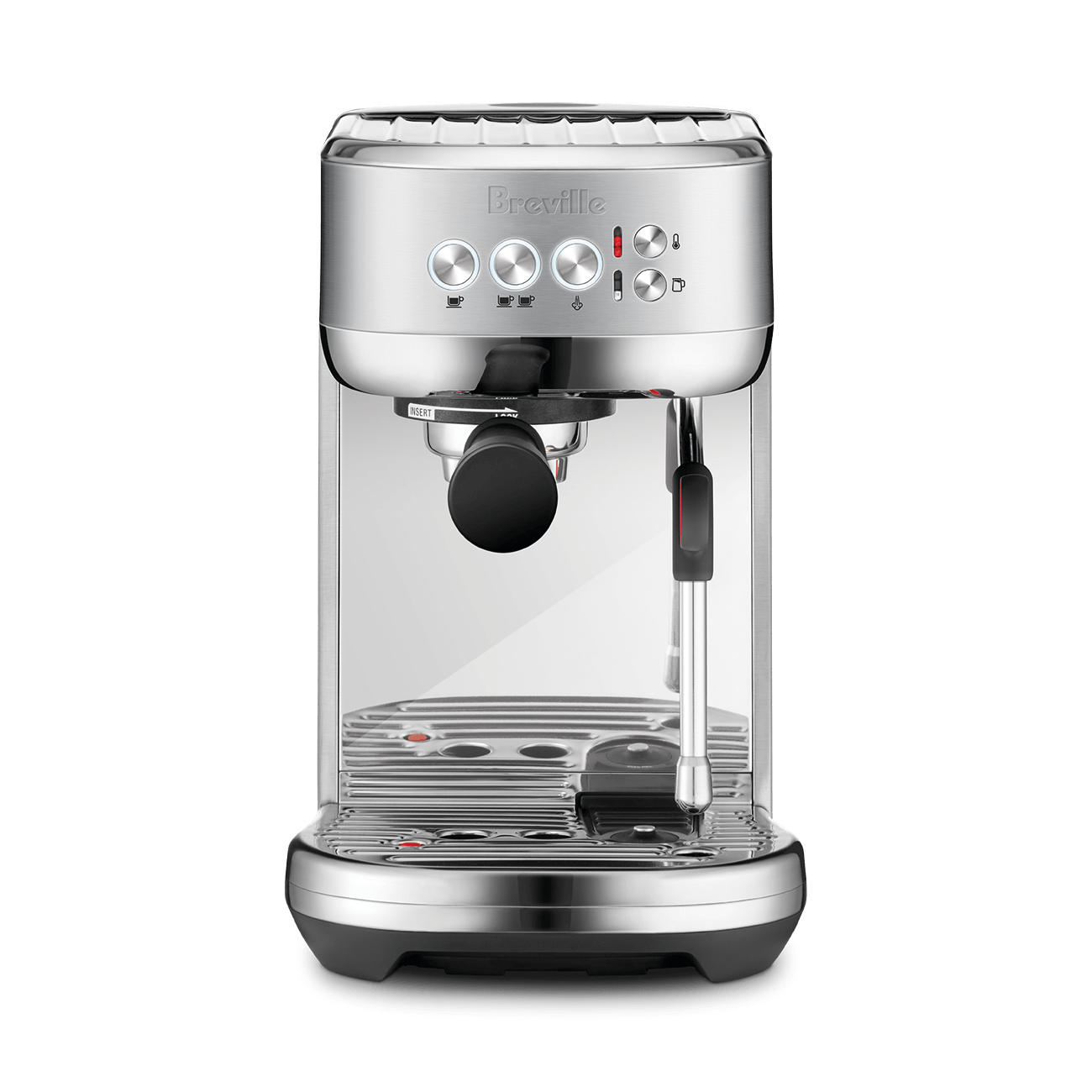
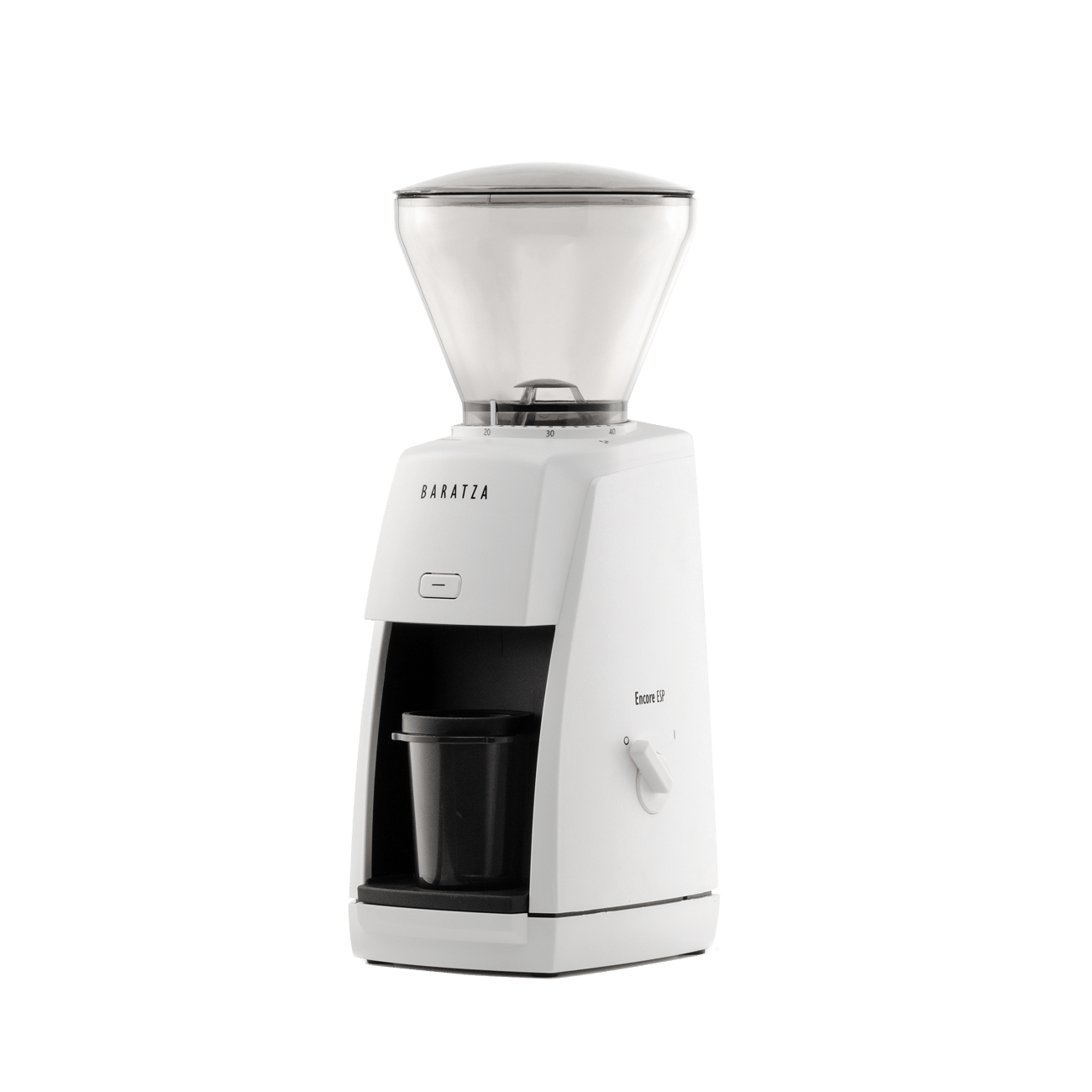
The verdict: Two narrow appliances, total cost roughly the same as a Barista Express Impress, and a noticeably better grinder than anything you’ll find built into a combo at this price. If your counter is the kind where the toaster and the kettle have territorial disputes, this is the peace treaty. The Bambino Plus is 7.5 inches wide and the Encore ESP is about 5 inches, so the combined footprint comes in under 13 inches and gives you a future-proofed grinder that’ll outlive the machine.
You’re getting one workflow, one buying decision, two boxes. The trade is that you’re plugging in twice and committing to a little more counter space than a true single-box machine demands.
The Bambino Plus is, in the words of Tom’s Guide, “the reigning entry-level champ.” That’s ThermoJet heating that hits brew temp in about three seconds, a built-in PID, low-pressure pre-infusion, and an automatic milk-texturing wand that handles the steam-wand learning curve for you. The Encore ESP is the espresso-tuned cousin of the original Encore, with 40 grind settings (1–20 micro-stepped for espresso, 21–40 for filter and French press) and 40mm M2 conical burrs. It finally dials fine enough for espresso, and the included 54mm dosing cup matches the Bambino’s 54mm portafilter without an adapter.
Pros:
- Smallest credible-espresso footprint: the Bambino Plus is the narrowest “makes real espresso” machine on the market.
- Instant warm-up: ThermoJet heating means brew temperature in around 3 seconds, not 30.
- Automatic milk wand: three temperatures × three textures, hands-free, and friendlier for the pod-graduate buyer than a manual steam wand.
- A grinder that outlives the machine: the Encore ESP is the strongest entry-level espresso grinder you can buy and will move with you if you upgrade machines.
Cons:
- It’s still two appliances: you’re plugging in twice, and the Bambino Plus’s drip tray fills fast under daily milk-drink use. Tom’s Guide reported draining it nearly every other day at four drinks a day with milk. The Encore ESP’s plastic chassis and lower burr RPM also put it behind premium electric grinders on retention and grind speed (Coffee Chronicler measured about 22 seconds for 20 grams, with roughly a gram of retention).
Best for: the pod graduate moving up, the narrow-counter household, the buyer who wants espresso machine and grinder simplicity now but plans to upgrade the machine in a few years and keep the grinder.
Price band: mid-range (combined).
Breville Bambino Plus + Baratza Encore ESP
Or grab the pre-bundled set: Check Current Price
3. Breville Barista Touch Impress — Best Premium
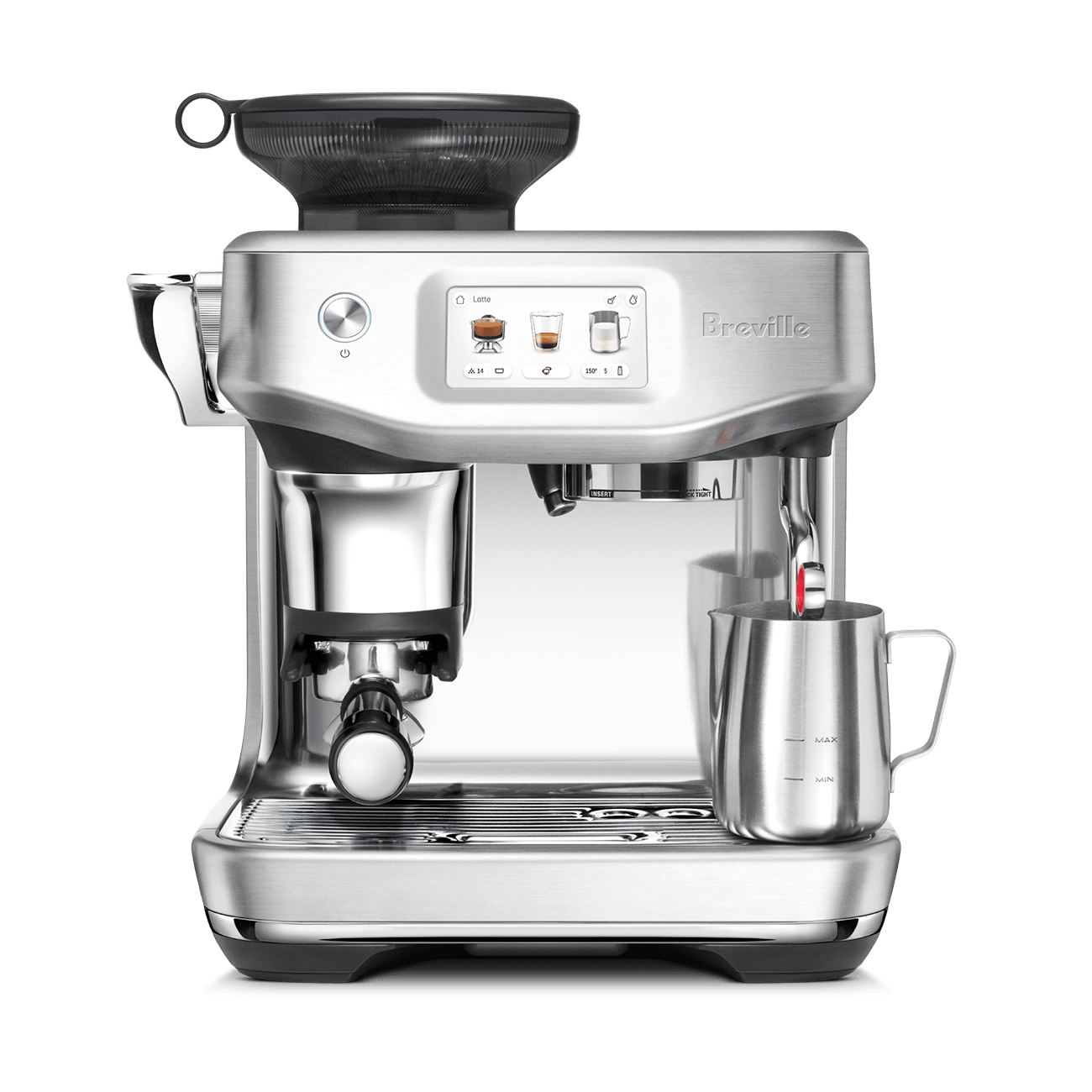
The verdict: The slickest user experience in the semi-auto category at this price, and the right pick if you want a household machine with stored drink profiles for multiple people. The Barista Touch Impress takes everything that makes the Barista Express Impress good (assisted tamping, integrated conical burr grinder, real PID brew temperature) and bolts a color touchscreen and ThermoJet heating onto it. Warm-up drops from 30-plus seconds to 3.
The headline feature is the touchscreen UX. CoffeeGeek called the interface “extremely intuitive” and confirmed the assisted tamping “works really well.” Coffeeness, who’s reviewed the previous Touch generation, said this version of the Impress system was the one that finally clicked. You can store up to six personalized drink profiles (espresso, latte, flat white, whatever) on top of 13 café preset recipes, and the Auto MilQ wand handles steam with 8 texture levels, 3 alt-milk presets, and a temperature range from 104 to 167°F.
Pros:
- The best UX in the price band: the touchscreen turns dial-in into a guided flow, and the assisted tamping handles the part that defeats most first-timers.
- 3-second warm-up: ThermoJet heating means you press a button and pull a shot, not wait.
- Stored drink profiles per person: if four people in the house drink four different things, this is the machine that remembers each one.
- Auto MilQ wand with real range: 8 texture levels and alt-milk presets handle oat, almond, and soy without you having to relearn steam technique.
Cons:
- Single-boiler, so you can’t pull a shot and steam milk at the same time. Transition between brew and steam runs around 30–45 seconds. For a machine built around “drinks for multiple people,” the back-to-back-milk-drink wait is a real friction. CoffeeGeek, Coffeedant, and Crema Lab all flagged this.
Best for: the household that makes multiple different drinks per round, wants the slickest semi-auto workflow on the market, and is willing to pay roughly double a Barista Express Impress for the upgrade.
Price band: premium.
4. De’Longhi Magnifica Evo with LatteCrema — Best Super-Automatic
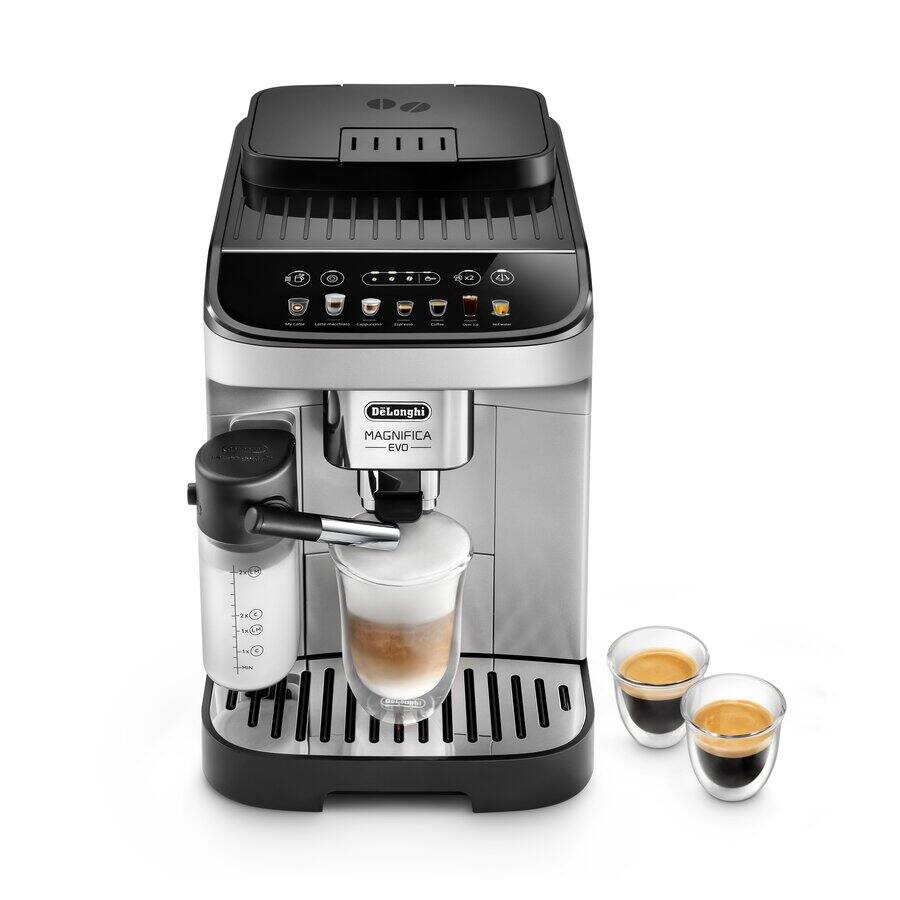
The verdict: Press a button, get a competent latte. The Magnifica Evo is the pick for the buyer who wants real espresso but won’t do the dialing-in, tamping, and weekly steam-wand cleaning a semi-auto demands. Tom’s Coffee Corner ran a 3-month, 190-plus shot long-term test on this machine and called it his go-to super-auto recommendation at the mid-tier price band, and the maintenance the auto-clean cycle nags users into is what keeps the espresso competent in year three.
Bean-to-cup means a built-in steel conical burr grinder with 13 settings, 7 one-touch beverages, and a LatteCrema automatic milk-frothing carafe that produces real foam without you holding a wand. The auto-rinse on the milk carafe is the one super-auto cleaning routine we’ve watched real owners follow through on. Dishwasher-safe detachable parts handle the rest.
The espresso itself is closer to real than super-auto skeptics expect. Coffeeness described it as “dark, chocolatey, full-bodied” out of the spout, and Tom’s Coffee Corner ranked the LatteCrema’s milk texture above the Philips LatteGo’s at the price point.
Pros:
- Real one-button espresso: bean-to-cup workflow with milk, no human input required between the bean hopper and the cup.
- LatteCrema foam at the super-auto tier: real microfoam from an auto carafe, no steam-wand skill needed.
- Auto-clean cycle owners follow: the auto-rinse nudges maintenance enough that the machine ages well.
- Genuinely compact for a super-auto: about 9.4 inches wide.
Cons:
- The grinder is audibly loud during its 5–7 second cycle. Coffeedant and Home Coffee Expert clocked it around 78 decibels, which is vacuum-cleaner level. If the kitchen shares a wall with a bedroom and the machine cycles at 6 AM, you’ll hear it. Coffeeness called it “far from the quietest grinder you’ll ever experience.”
Best for: the buyer who wants one-button espresso and lattes, won’t follow through on weekly steam-wand purging, and is willing to give up grind/extraction experimentation in exchange for a workflow they’ll still use in year five.
Price band: mid-range to premium.
5. Ninja Luxe Café Premier — Best for Beginners Moving Up From Pods
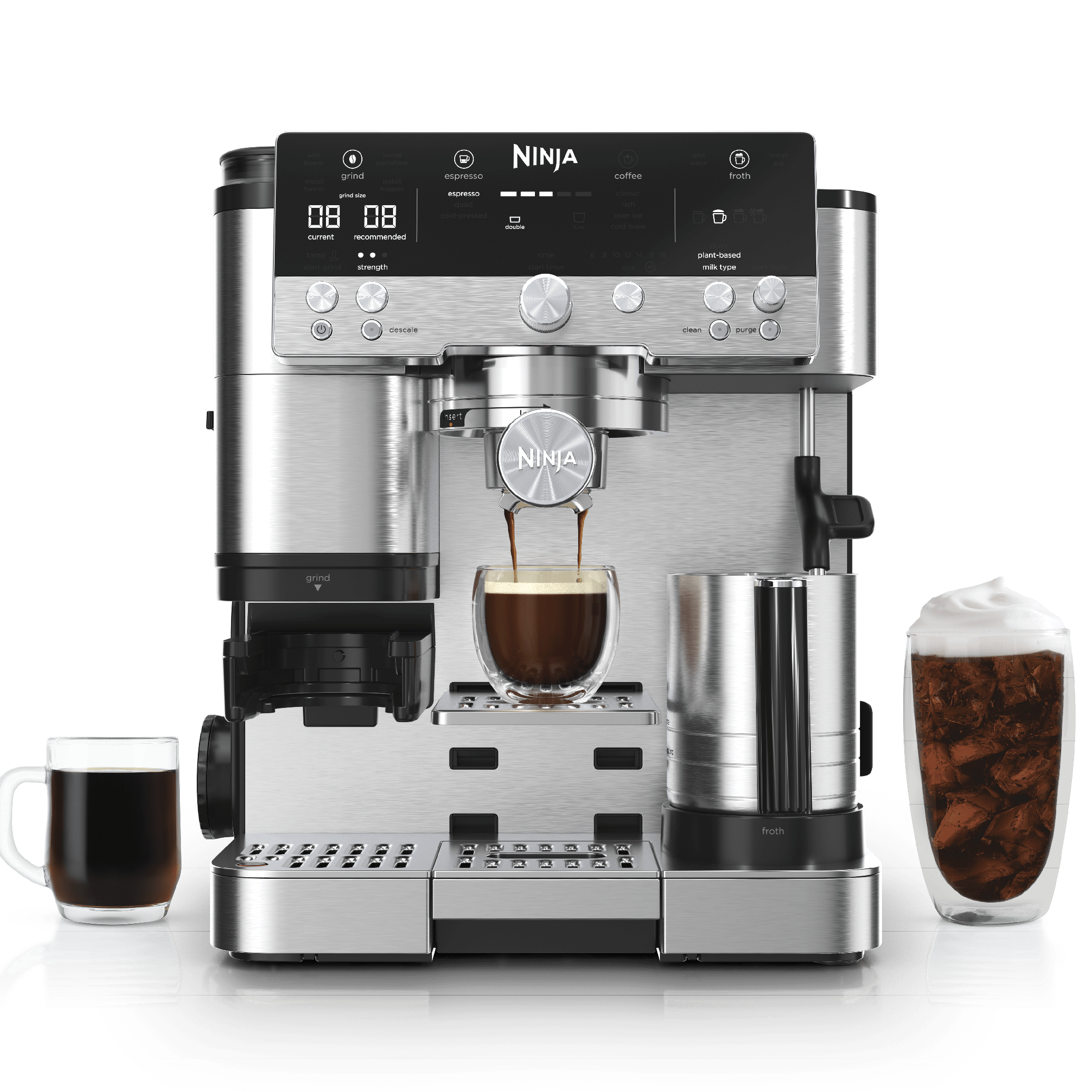
The verdict: If you’re stepping up from a pod machine and don’t want to learn manual tamping or steam-wand microfoam to get a drinkable latte, the Ninja Luxe Café Premier is the espresso maker with grinder that makes the transition easiest. It’s a 3-in-1 (espresso, drip, cold press) with a built-in 25-setting conical burr grinder, a 9-bar pump, and a Barista Assist system that auto-calibrates grind size and flow rate when you change beans. CoffeeGeek gave it a Best in Class award at 88.5 out of 100 for entry-level espresso systems.
What surprised us across the hands-on coverage is how close to spec the espresso lands out of the box. Top Ten Reviews measured around 18 grams in to roughly 36–45 grams out in 25–30 seconds, depending on the dose — a 1:2 to 1:2.5 ratio, square in the SCA window, without any manual dial-in. Barista Assist guides you when the puck reads under- or over-extracted, and the 70-ounce water tank means the machine earns its counter footprint as the household’s coffee maker, not as an espresso side gig.
The auto frothing system covers four hands-free modes (steamed, thin foam, thick froth, cold foam), and Top Ten Reviews described it as “sheer joy” to test because nothing required holding a wand.
Pros:
- In-spec espresso out of the box: auto-dials ratios around 1:2 to 1:2.5 with Barista Assist watching flow rate.
- Real coffee maker plus real espresso: drip and cold-press capability makes it earn its counter space.
- Hands-free frothing: four preset modes that don’t require steam-wand technique.
- Forgiving for a pod graduate: the on-screen guidance handles the bean-change moments that defeat first-time semi-auto owners.
Cons:
- No real manual steam wand. The automated system gets you to drinkable foam, but there’s a ceiling on milk-texture customization. You can hold START FROTH for 3 seconds as a workaround, but it’s not a true manual wand. Top Ten Reviews noted the wand didn’t perform as well as a real manual one for latte-art microfoam. If you’ll eventually want to free-pour rosettas, this isn’t the buy.
Best for: the pod-machine graduate who wants real espresso without the manual workflow, the household that drinks drip and cold brew as much as espresso, the buyer who wants their first semi-auto to feel forgiving.
Price band: mid-range.
6. De’Longhi La Specialista Arte Evo — Best for Manual Control
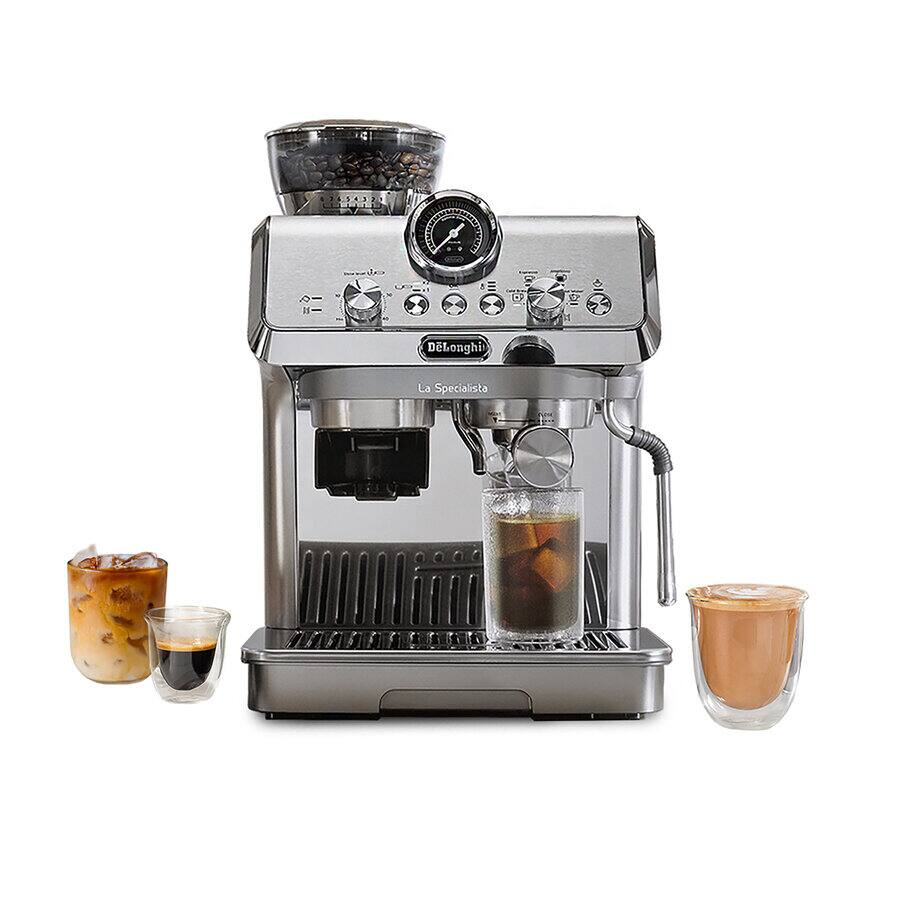
The verdict: If you want a real portafilter workflow (dosing, tamping, watching the shot pour) without buying a separate grinder, the La Specialista Arte Evo gets you there at a mid-tier price with a commercial-style steam wand thrown in. Coffeeness called the steam wand “professional” and noted it produces “silky microfoam and latte art” without a learning curve a Bambino-class wand can’t match. Three Active Temperature Control profiles give light-roast and dark-roast drinkers a real lever, which is rare at this tier.
This is the most hands-on machine on the list. You’re operating the portafilter yourself, watching the shot, finishing milk by hand. The built-in grinder handles the grinding so you don’t need a second appliance, and the 15-bar pump is tuned to extract at the SCA-target 9 bar.
The Cold Extraction Technology (developed with the SCA) makes cold brew in about 5 minutes. This is not a manual lever machine. It’s a manual portafilter machine with a built-in grinder. There’s no spring or piston group head. The “manual” is the portafilter workflow, not a lever pull.
Pros:
- Commercial-style steam wand for the price: produces real microfoam, supports latte art, and rivals wands on machines costing more.
- Three temperature profiles: Active Temperature Control gives you a meaningful adjustment for light vs. dark roasts.
- Real manual portafilter workflow: you control dosing, tamp, and timing, which is the part that makes espresso feel like espresso to enthusiasts.
- Cold Extraction Technology: 5-minute cold brew is a usable bonus.
Cons:
- The built-in grinder has only 8 settings with no fine in-between adjustment. Arne Preuss at Coffeeness called it “rather limiting” and noted you can’t fudge it by setting the selector between two settings. The grinder also lacks the torque and fineness for very light roasts. If you’re planning to chase light single origins, the grinder is the ceiling.
Best for: the buyer who wants manual portafilter control with a built-in grinder, drinks mostly medium roasts, and wants a real steam wand for microfoam without paying premium-tier prices.
Price band: mid-range.
How to Choose an Espresso Machine With Grinder
The combo question splits along four lines: what kind of espresso you want to pull, how much steam-wand work you’re willing to learn, what your counter looks like, and how long you plan to keep the machine. Here’s how to think about each.
Built-In Grinder or Buy It Separately
The default coffee-internet advice is to always buy a separate machine and grinder. We don’t agree without qualification. Most buyers shopping an espresso machine grinder combo have already decided the one-box answer is right for their kitchen and budget, and the gear-snob argument mostly applies to people who would have bought separates anyway.
That said, the case where separates clearly win is the prosumer setup. If you’ll keep upgrading machines every few years and want the grinder to outlive them, buy a separate grinder. If your roast preferences will swing across light single origins (the Arte Evo’s 8 settings won’t do it), buy a separate grinder. If you want to single-dose for multiple bean bags, buy a separate grinder. Everyone else can buy a combo and not feel guilty about it.
The bundle pick on this list, the Bambino Plus plus Encore ESP, is the closest thing to having both. Two narrow appliances, total cost roughly equal to a single-box Barista Express Impress, and the grinder is genuinely a step better than what’s built into combos at the price. If the budget is tighter than that, our cheap espresso machine rundown covers the budget tier where a separate basic grinder still makes sense.
Pressurized vs. Non-Pressurized Baskets
Every machine on this list ships with pressurized portafilter baskets, which are friendlier on day one because they tolerate a sloppy grind and a mediocre tamp. Keep those baskets for the first few weeks. The day you’ve dialed in the grinder and you’re consistently pulling shots in the 25–30 second window, swap to the non-pressurized (dual-wall off, single-wall on) baskets that came in the box. That’s when the espresso steps up from “fine” to “actually good.”
Boiler Type and Why It Matters
Three boiler patterns show up in this category:
- ThermoCoil with PID (Barista Express Impress): heats the whole brew path including the group head, holds temperature stable across back-to-back shots, but takes 30–40 seconds to warm up from cold.
- ThermoJet (Bambino Plus, Barista Touch Impress): heats brew water near-instantly (around 3 seconds), at the cost of slightly less group-head thermal mass.
- Bean-to-cup thermoblock (Magnifica Evo) and 3-in-1 thermoblock (Ninja Luxe Café): cycle-based heating tuned to the bean-to-cup workflow; warm-up time isn’t the right way to think about these because the cycle is one continuous press-and-pour.
A quick definition for the road: PID is the temperature controller that holds brew water in the SCA range of 195–205°F. Any machine with one is doing the temperature work. Any machine without one is letting the boiler decide.
Steam Wand Quality
Three flavors of milk system show up on this list:
- Manual single-hole steam wand (Barista Express Impress, La Specialista Arte Evo): the real deal. Total control over texture, the ceiling on latte art is high, and the learning curve is real.
- Auto MilQ / automatic milk-texturing wand (Bambino Plus, Barista Touch Impress): handles the steam-wand learning curve for you and gives you texture controls without requiring technique.
- Hands-free frothing carafe or system (Magnifica Evo’s LatteCrema, Ninja Luxe Café’s auto preset frother): one-button foam, no wand handling, ceiling on customization.
If you’ll never make microfoam, an auto system saves you the learning curve. If you want to free-pour latte art eventually, only a real manual wand will get you there.
Footprint and Counter Fit
Standard countertop-to-upper-cabinet clearance is 18 inches. Every machine on this list fits, but the Bambino Plus at 7.5 inches wide is the only one that gives you usable counter on either side without dedicating a full appliance station. If your counter is narrow or the toaster has nowhere to live, the Bambino Plus + Encore ESP bundle is the only pick that takes counter space seriously.
When a Manual Machine Plus a Separate Grinder Wins
There’s one off-ramp from the combo question worth naming: the Gaggia Classic Pro plus a dedicated grinder. The Classic Pro has no built-in grinder, but it’s the modding rabbit hole of the espresso world (58mm commercial portafilter, OPV spring swaps, PID kits, the Gaggiuino mod) and it’s the right answer for the buyer who’ll spend evenings tuning the machine and reading r/gaggiaclassic. If that sounds like a punishment, it isn’t your machine. If that sounds like a Friday night, you already know.
For the more mainstream “I want real manual control” buyer who doesn’t want a project, the La Specialista Arte Evo is on this list as the combo answer to that itch.
Frequently Asked Questions About Espresso Machines With Grinders
What is the best espresso machine with a built-in grinder?
The Breville Barista Express Impress is the best espresso machine with a built-in grinder for most home buyers. Its Impress puck system removes the dosing and tamping learning curve that defeats first-time semi-auto owners, the integrated 25-setting conical burr grinder covers most espresso roasts, and ThermoCoil heating with a built-in PID holds brew water at the SCA-target temperature. Five-plus years on the market and the cluster’s most documented owner reviews back the pick. The honest con is a slow steam wand for back-to-back milk drinks, so if you make four cappuccinos in a row regularly, the Barista Touch Impress is the upgrade.
Are espresso machines with grinders worth it?
Yes, an espresso machine with a built-in grinder is worth it for most home buyers, especially first-timers, narrow-counter households, and anyone who values the simplicity of one buying decision and one daily workflow. The argument against combos mostly applies to prosumer setups where the buyer will keep upgrading machines and wants the grinder to outlive them. For everyone else, a real conical burr grinder built into a credible espresso machine produces good espresso with less friction than buying separates. The trade-off is that the built-in grinder ages faster than the rest of the machine, so plan for an eventual standalone-grinder upgrade if you stay in the hobby.
Should an espresso machine have a grinder?
An espresso machine should have a grinder if you want one-box simplicity, a single buying decision, and a tighter counter footprint. The grinder makes more difference to your coffee than any other piece of equipment, so the question is really whether you want it built into the machine or sitting next to it. A built-in conical burr grinder on a credible machine (any of the picks on this list except the Bambino bundle) pulls real espresso. A separate grinder gives you finer control, longer life, and easier upgrades. For most home buyers, the built-in answer is good enough. For buyers chasing light single origins or planning to keep upgrading, separates win.
What is the best grinder for espresso coffee?
The best grinder for espresso depends on whether you want it built into the machine or standing alone. Among combo machines, the Breville Barista Express Impress’s 25-setting integrated conical burr grinder is the strongest balance of range, durability, and assisted-tamping integration on this list. Among separate grinders pairable with a non-grinder machine, the Baratza Encore ESP is the entry-level pick, with 40 grind settings and the bottom 20 micro-stepped specifically for espresso. For premium-tier separate grinders, the Niche Zero and Eureka Mignon are the names that come up most across hands-on review sites, though both cost more than several machines on this list.
Can I use any beans in an espresso machine with a built-in grinder?
You can use any whole bean coffee in an espresso machine with a built-in grinder, but bean choice matters more than the machine for the cup quality you’ll get. Use whole beans roasted for espresso (medium or medium-dark is the friendliest range for the built-in grinders on this list), and use them within about a month of the roast date. Pre-ground coffee won’t work in these machines because the grinder is the input. You can use pre-ground in the portafilter directly if the machine allows it, but you’ll give up freshness and grind-size control. Light roasts work in machines with finer grinder adjustment (the Barista Touch Impress and Barista Express Impress handle them well; the Arte Evo’s 8-setting grinder doesn’t).
How long do espresso machine grinders last?
Built-in espresso machine grinders typically last 3–7 years of daily use before the burrs wear noticeably, depending on bean volume and oiliness. Conical burrs (what every machine on this list uses) hold their edge longer than flat burrs but eventually need replacement. Breville sells replacement burr sets for the Barista Express Impress and Barista Touch Impress. Signs of worn burrs include longer grind times, inconsistent particle size, and shots that won’t dial in across grind settings the way they used to. If the machine is otherwise working fine, replacing the burrs is cheaper than replacing the machine.
Do I need a separate grinder if my espresso machine has one?
You don’t need a separate grinder if your espresso machine has a credible built-in conical burr. The picks on this list all qualify. You might want a separate grinder later if you start chasing light single-origin roasts, single-dosing across multiple bean varieties, or planning to upgrade your espresso machine while keeping the grinder. The Bambino Plus and Baratza Encore ESP bundle on this list is the answer for buyers who want a separate grinder from day one without giving up combo-machine simplicity.
So Which Espresso Machine With a Grinder Should You Buy?
For the average-case home buyer who wants one answer: the Breville Barista Express Impress. It’s the default that earns the default. Assisted tamping, a real PID, a 25-setting conical burr grinder, and a workflow you’ll still tolerate in year five. The honest con is a slow steam wand for back-to-back milk drinks. If that’s a dealbreaker, step up to the Barista Touch Impress.
Narrow kitchen or stepping up from pods and want a future-proofed grinder: the Bambino Plus and Encore ESP bundle. Two narrow appliances under 13 combined inches, the strongest entry-level espresso grinder you can buy, and a total cost roughly matching a single Barista Express Impress.
If you want the slickest premium UX and you make drinks for a household: the Breville Barista Touch Impress. Touchscreen-guided dial-in, six stored profiles, 3-second warm-up. The single-boiler back-to-back milk-drink wait is the trade.
One-button espresso and lattes for the buyer who won’t follow through on weekly steam-wand cleaning: the De’Longhi Magnifica Evo with LatteCrema. The auto-clean cycle is the one in the category that nags users into maintenance, which is what keeps the espresso competent over years.
If you’re moving up from a pod machine and want the most forgiving learning curve: the Ninja Luxe Café Premier. Barista Assist auto-calibrates grind and flow, hands-free frothing handles milk, and the 3-in-1 drip-and-cold-brew capability earns its counter space.
Manual portafilter control with a real steam wand at a mid-tier price: the De’Longhi La Specialista Arte Evo. Just know the 8-setting grinder is the ceiling. Buy for medium roasts and a commercial-style wand, not for chasing light single origins.
For the deeper category breakdown, we’ve also published the best espresso machine for home, a rundown of small espresso machines for tight counters, and a how to make espresso walkthrough for first shots.