
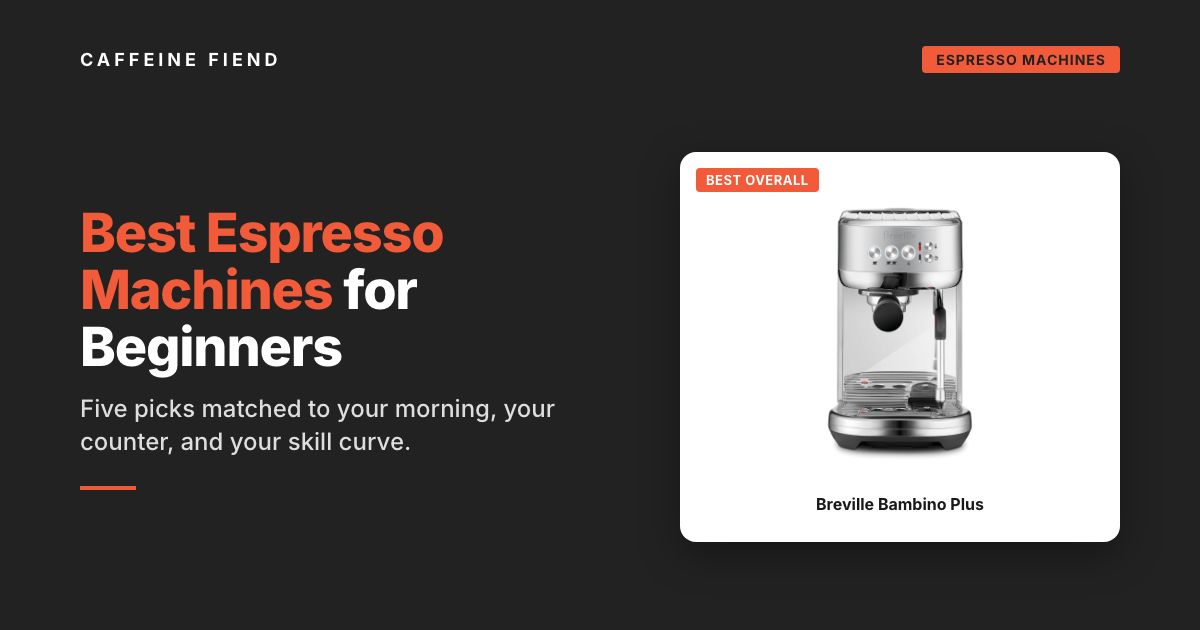
The short answer. For most first-time home-espresso buyers, the best espresso machine for beginners is the Breville Bambino Plus. A 3-second warm-up, an automatic milk-texturing wand that hides the steepest beginner hurdle, and a 7.6-inch footprint that fits where almost nothing else does.
We’ll commit to a pick in each category: a semi-auto for the convenience beginner, a one-box semi-auto with built-in grinder for the buyer who wants a single decision, a super-automatic for the press-a-button household, a sub-$150 tryout if you’re not sure you’ll stick with home espresso, and a commercial-spec workhorse for the buyer who wants the learning curve and will probably end up modding the thing on a Tuesday at 11pm.
The grinder is part of the purchase. A $200 espresso machine paired with a $30 blade grinder produces sour, channelled shots and then sits on the counter while you go back to pods. Two picks below bundle a real burr grinder; three don’t, and we name the grinder you should pair with them so the total spend math is honest.
At-a-Glance: 5 Beginner Espresso Machines
| Pick | Award | Category | Built-In Grinder | Milk System | Warm-Up | Portafilter | Learning Curve |
|---|---|---|---|---|---|---|---|
| Breville Bambino Plus (BES500) | Best Overall for Beginners | Semi-auto | No (pair with Encore ESP) | Automatic wand, 3 temps x 3 froth | ~3 sec (ThermoJet) | 54mm | Very low |
| Breville Barista Express Impress (BES876) | Best All-in-One | Semi-auto + grinder | Yes (25-setting conical burr) | Manual single-hole wand | ~30-40 sec | 54mm | Low to medium |
| De’Longhi Magnifica Evo (ECAM29084SB) | Best Super-Automatic | Super-auto bean-to-cup | Yes (13-setting steel conical) | Automatic LatteCrema carafe | One-touch | n/a (sealed brew unit) | Lowest in roundup |
| De’Longhi Stilosa (EC260BK) | Best Budget | Manual pump semi-auto | No (pair with Encore ESP) | Manual steam wand | Quick | 51mm | Medium |
| Gaggia Classic Pro (E24) | Best for Learning the Craft | Semi-auto, no PID | No (pair with Encore ESP) | Two-hole commercial wand | ~20 min total prep | 58mm commercial | Highest in roundup |
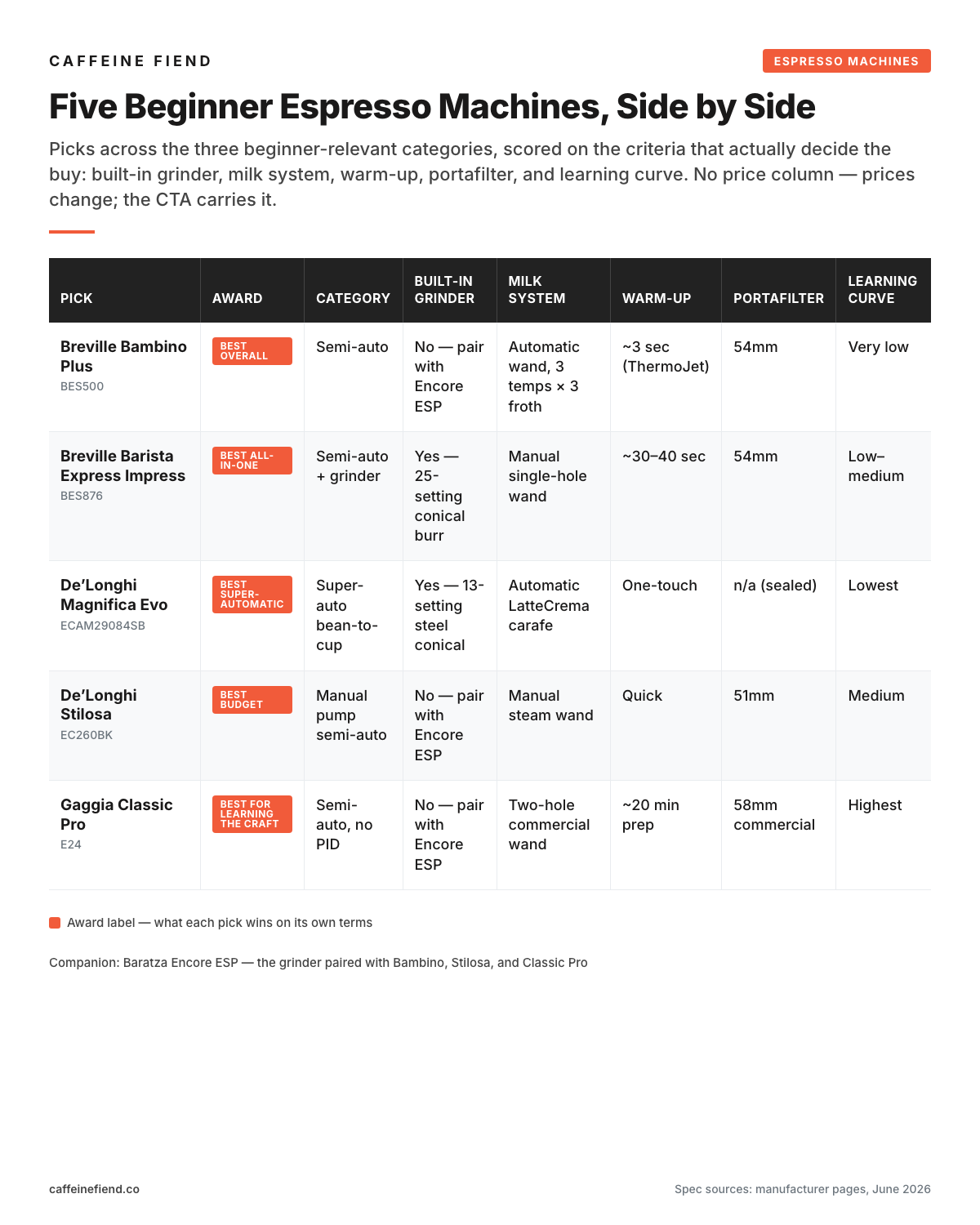
Companion pick: Baratza Encore ESP — 40mm M2 conical burrs, 40 settings (lower 1-20 micro-stepped for espresso), included 54mm dosing cup with 58mm adapter ring so it fits all three non-grinder picks.
How We Picked
We’ve spent years writing about espresso gear at every tier and have used or sat with most of the machines here at some point. For a beginner roundup, the experience matters less than the rubric. We set the rubric for a first-time owner and held every candidate against it. The picks came from a combination of hands-on time, long-term reviews from coffee writers we trust (Tom’s Guide, Coffeeness, Coffeedant, TechGearLab, Tom’s Coffee Corner, Craft Coffee Spot, Coffee Kev), manufacturer documentation on current models, and home-barista forums where owners argue six months after the unboxing.
A pick made the list only if it cleared five criteria.
- Beginner-tuned from the spec sheet up: Selected because it suits a first-time buyer on its own merits, where most “best espresso machine” roundups slot a beginner pick in as the cheapest entry on a pro-tier list.
- Milk you’ll actually steam: Either the wand is assisted/automatic, or it’s usable enough that the basics click in week one.
- A real path to the SCA 9-bar standard: The Specialty Coffee Association standard is 9 bar of extraction pressure at the puck. The “15 bar” and “20 bar” numbers on the box are pump headroom, not extraction pressure.
- Honest grinder math: If the pick has no built-in grinder, we name the grinder you should pair it with so total spend is in the open.
- Survives month three: Build quality, daily-friction details (water tank, drip tray, descaling cycle), and a workflow you’d actually do half-asleep on a Tuesday. The most expensive machine in a beginner’s kitchen is the one that turned out to be too fussy and now lives in a cabinet.
A note on prices: you won’t find any in this article. Amazon prices move and the Associates agreement frowns on us pinning them in body copy. Use the Check Current Price buttons for what each one actually costs.
Best Overall for Beginners: Breville Bambino Plus
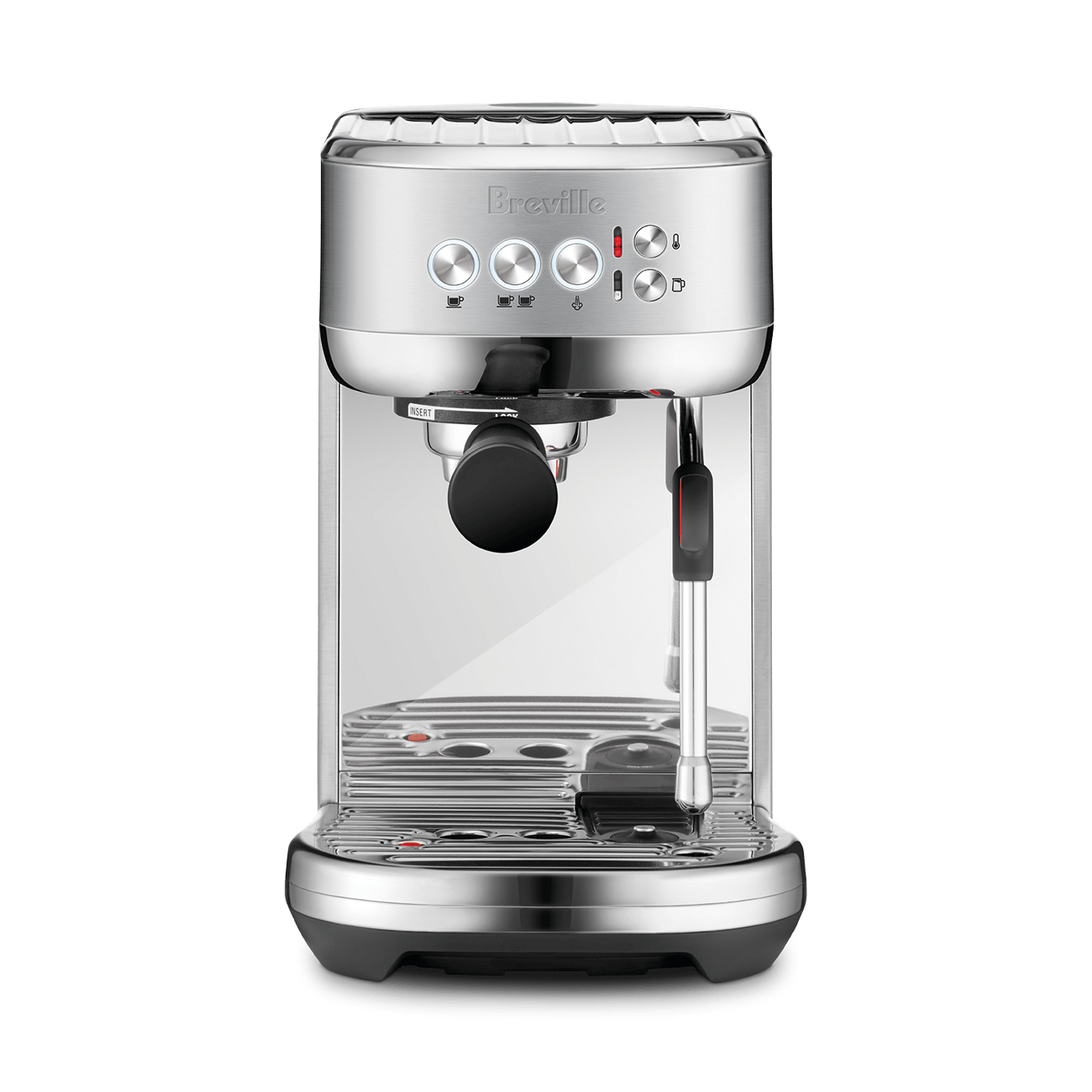
Verdict: The best espresso machine for beginners for the convenience-seeking first-time owner. Real espresso, assisted milk, the fastest start in the category, the smallest credible footprint. Price band: mid-range.
The Bambino Plus is the machine we’d hand to a friend who said just tell me what to buy and how to use it without watching YouTube for a month. The ThermoJet heater hits brew temperature in roughly 3 seconds. The automatic milk-texturing wand has three temperature settings and three froth levels. You hit the steam button, drop milk into the pitcher, and the machine handles the texturing while you pull the shot. Tom’s Guide called it “hands-down one of the best espresso machines for beginners … breathtakingly easy to use … right out of the box,” and after enough hands-on time we’d agree.
The 7.6-inch width is the other quiet superpower. It fits under a standard 18-inch upper-cabinet clearance with room to lift the steam wand, which most of the larger picks here don’t. Our best small espresso machines roundup goes deeper if counter space is the deciding constraint.
Bambino has no built-in grinder. Plan another $200 to $300 for a real burr grinder. The Baratza Encore ESP is the canonical pairing and the one we recommend below.
Pros
- 3-second warm-up via ThermoJet: Walk up cold, walk away with espresso a minute later.
- Automatic milk-texturing wand: The biggest beginner hurdle just disappears.
- 7.6-inch footprint: Fits where almost nothing else does.
- Clean upgrade path: Because the grinder is decoupled, you swap a better one in two years without replacing the machine.
Cons
- The drip tray fills fast under daily milk-drink use, the portafilter lock-in is unusually stiff, and the pump vibrates enough that you can’t stack accessories on top. Tom’s Guide and TechGearLab both flag these in their hands-on reviews. The PID is also fixed at the factory (not user-programmable), so dark-roast drinkers may find the default brew temp runs hot.
Best for: First espresso machine for a beginner who wants real espresso, assisted milk, the smallest possible footprint, and a complete setup under $700 once the grinder is added.
Or for the machine and the matching grinder in one box: the check the bundle price on Amazon.
Best All-in-One: Breville Barista Express Impress
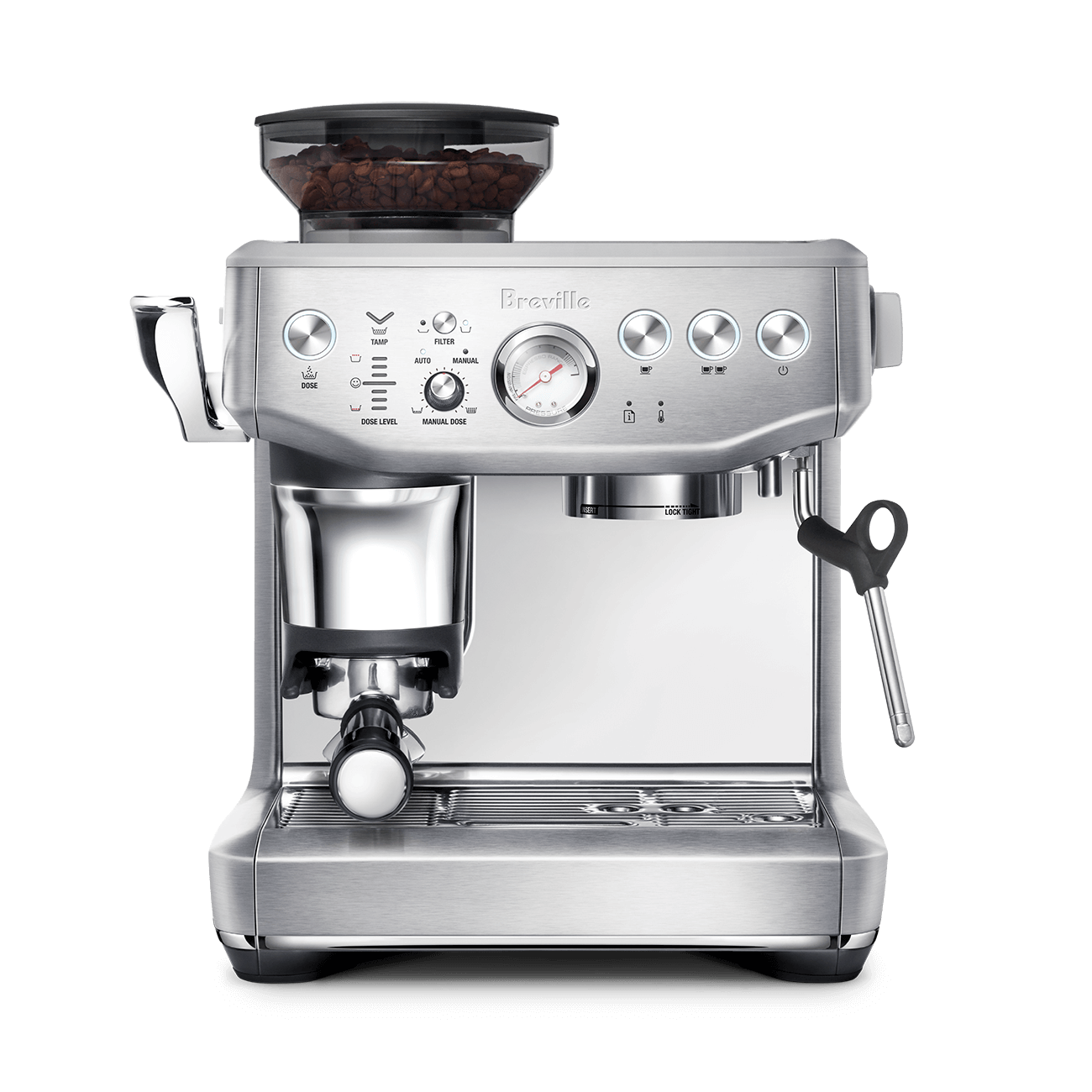
Verdict: For the buyer who wants a single purchase, the grinder built in, and the assisted-tamping system that handles the two error-prone steps that defeat most first-time semi-auto owners. Price band: premium-end of the beginner tier.
The Breville Barista Express Impress is beginner-friendly because it takes the two error-prone steps out of the daily routine. The built-in 25-setting conical burr grinder doses grounds straight into the portafilter. The Impress puck system then applies a constant 22 lbs of tamp pressure with a 7-degree polish twist when you press the lever. Consistent dosing and even tamping are the two steps that defeat most first-time semi-auto buyers, and on the Impress they happen on rails. Hands-on reviewers across Coffeedant, Coffeeness, CoffeeGeek, and Brew Coffee Home converge: channeling becomes rare and dose accuracy lands within about half a gram after two or three shots.
The 1600W ThermoCoil heater holds extraction temperature with a PID near 200°F, and the visible pressure gauge on the front functions as a teaching tool. James Hoffmann’s view that “a visible pressure gauge is the best teacher you can have” applies cleanly.
The catch is the trade-off for the bigger thermally-stable heating system. The Impress warms up in 30 to 40 seconds, where the Bambino’s ThermoJet takes 3. On a hectic Tuesday morning, that’s the difference between making a drink and grabbing a pod. The single-hole steam wand also rebuilds steam slowly between shots, so back-to-back milk drinks become a wait-and-watch operation. And the machine is the largest pick in this roundup; if your counter is tight, the Bambino is the better choice.
Pros
- Built-in 25-setting conical burr grinder: Saves the ~$200 separate-grinder purchase and a second piece of counter equipment.
- Impress assisted-tamping system: Removes the two steps that defeat most first-time semi-auto buyers.
- PID brew temperature plus visible pressure gauge: Stable extraction, plus visual feedback that lets you learn at your own pace.
- Real upgrade path: Pressurized baskets while you learn, non-pressurized once the dial-in clicks.
Cons
- The 30-to-40-second warm-up is the slowest in the roundup, and the single-hole steam wand rebuilds steam slowly between back-to-back drinks. The first is a daily-friction tax you’ll either route around with a smart plug or accept; the second matters in any household where two people want milk drinks at the same time.
Best for: The beginner who wants a single buying decision, the built-in grinder, and the assisted-tamping rails.
Best Super-Automatic: De’Longhi Magnifica Evo
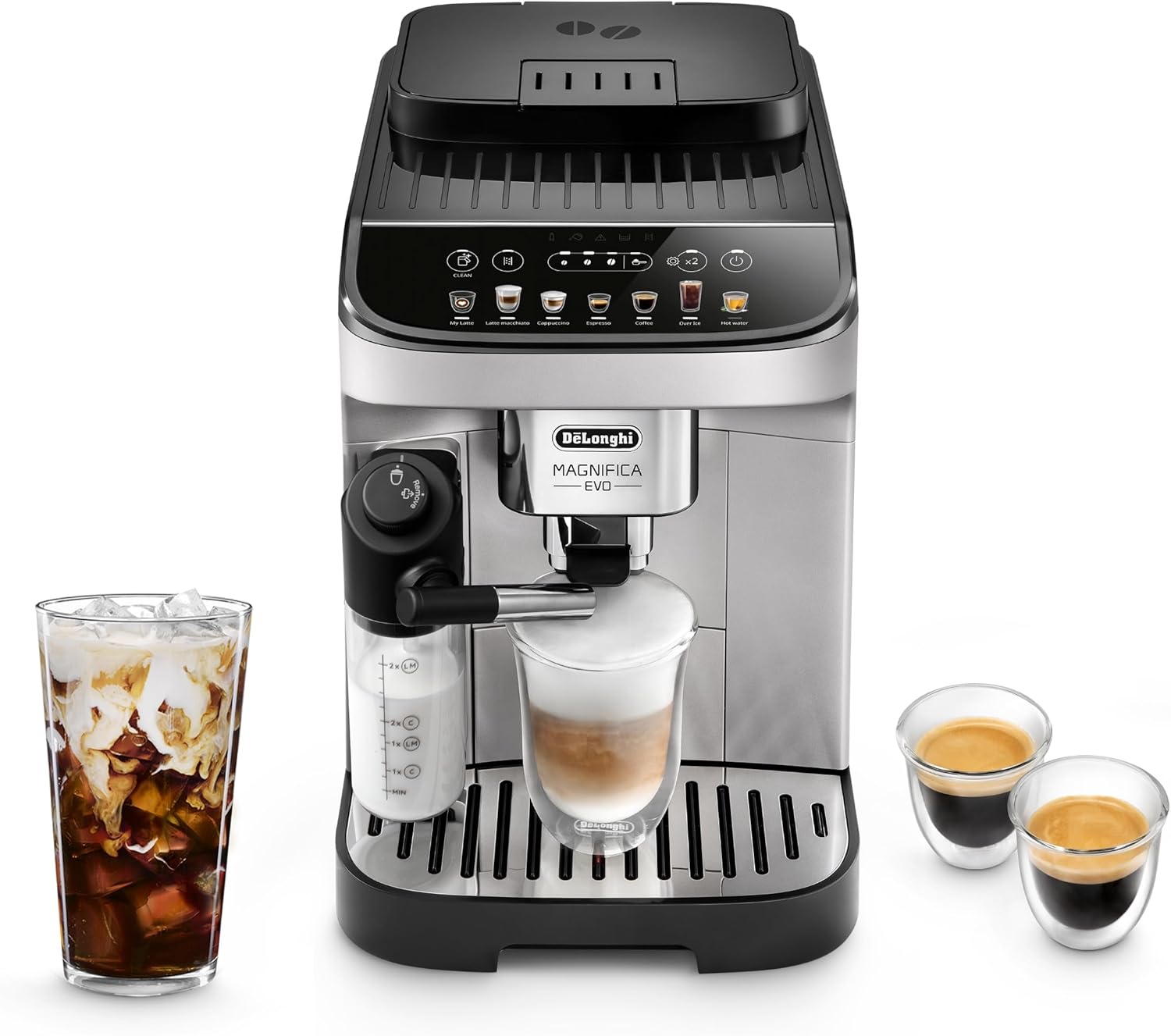
Verdict: The right pick for the beginner who wants the cup and not the ritual. One button, real espresso, real milk, no portafilter to learn. Price band: premium.
The De’Longhi Magnifica Evo is a super-automatic. Bean-to-cup with the whole brew unit sealed inside. Fill the hopper, fill the water tank, tap a drink on the on-machine menu. The 13-setting steel conical burr grinder doses and grinds; the brew unit tamps and extracts; the LatteCrema carafe snaps onto the side, draws milk, and steams it to a programmable temperature and foam level. Seven one-touch beverages cover the standard list, and the My Latte function saves personalized recipes per drinker.
Does a super-auto shot match a well-pulled semi-auto shot? Honest answer: almost, not quite, and probably close enough for most people. Tom’s Coffee Corner ran a 3-month, 190+ shot test and concluded the Magnifica produces “consistently good bean-to-cup espresso … extremely easy daily workflow, and maintenance that home users will actually follow through on.” The auto-clean cycle is why this machine is still in use at year three, while a fussier rig two counters over has descaling sludge from January because nobody got around to it.
The bean-to-cup format also locks you out of dial-in. You can’t run a non-pressurized basket, can’t experiment with grind across roasts, and the path from “I’m enjoying this” to “I want to learn the craft” doesn’t exist on this machine.
Pros
- One button, real espresso, real microfoam: LatteCrema fixed the bottleneck super-autos used to fail at.
- Auto-clean cycle home users actually follow through on: Why these machines stay on the counter past month six.
- My Latte plus seven one-touch beverages: Mixed-household compatible.
- No portafilter, no skill required.
Cons
- The built-in grinder runs loud, noticeably louder than the rest of the super-auto field. Multiple hands-on reviewers flag it. Don’t run a 6am cycle if the bedroom shares a wall with the kitchen. Deeper trade-off: the sealed bean-to-cup format locks you out of dial-in. No upgrade path from this machine into learning espresso.
Best for: The press-a-button beginner who wants real espresso and real milk drinks without becoming a hobbyist, and mixed households where multiple people want different drinks.
Best Budget: De’Longhi Stilosa
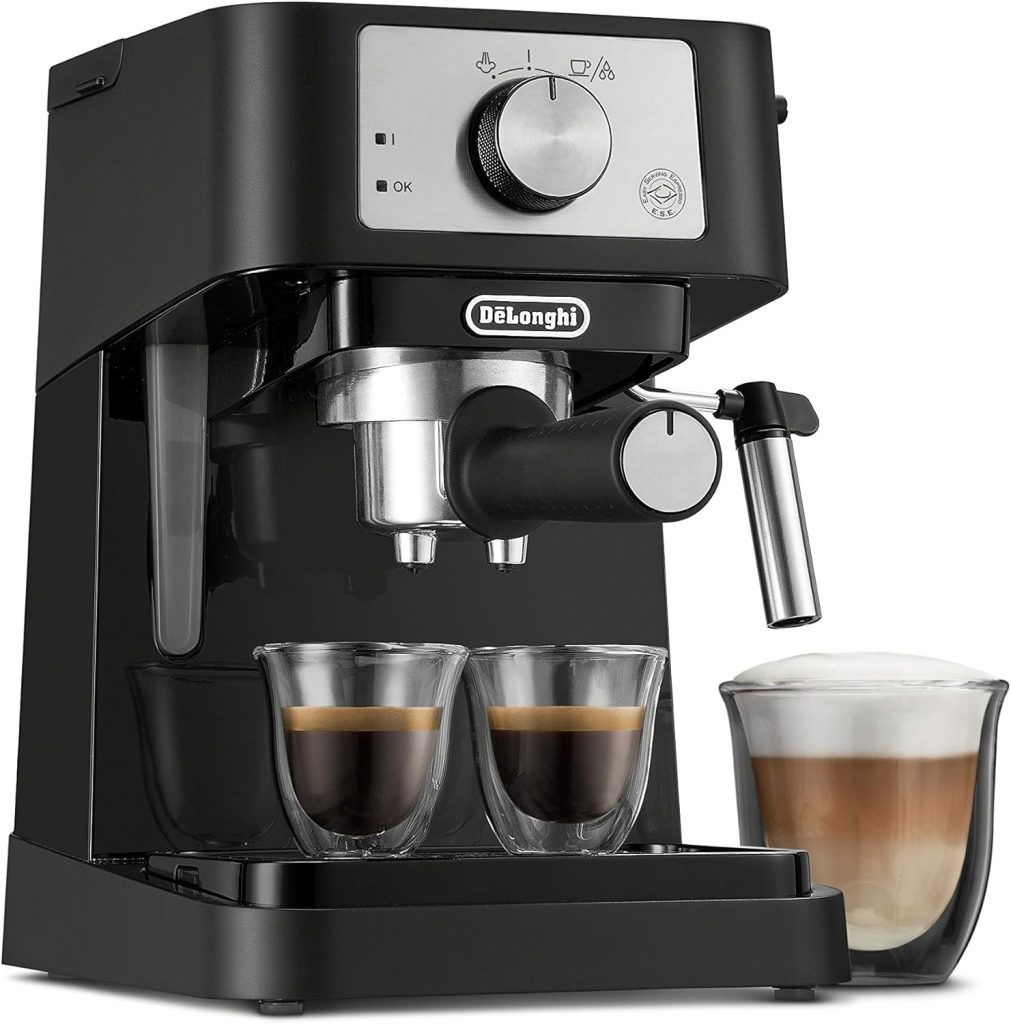
Verdict: The honest sub-$150 tryout pick. Real boiler, real steam wand, the basics done correctly in a price bracket where most machines are barely better than pod machines. Right for the cautious beginner who’s not sure they’ll stick with home espresso and doesn’t want to spend $500 to find out. Price band: budget.
The De’Longhi Stilosa is what we’d send a college roommate, a first-apartment buyer, or anyone who wants to test home espresso without a meaningful commitment. What separates it from its sub-$150 competitors is a stainless steel boiler. That’s rare at this price, where most machines use a thermoblock that struggles with brew-temperature consistency. The manual steam wand has a full range of motion (uncommon at this tier), the 15-bar pump regulates extraction down to the 9-bar SCA target through the OPV, and the build is honest metal-and-plastic. Tom’s Guide concluded the Stilosa “performs like an espresso machine double the price.”
The Stilosa ships with pressurized filter baskets only. The dual-wall kind artificially generate pressure regardless of grind quality and produce a fake-crema shot from almost any input. The Stilosa + Baratza Encore ESP + an aftermarket non-pressurized basket is the cheapest working beginner setup. The Stilosa alone with whatever grinder you already own is not. Our best cheap espresso machines roundup goes deeper on the sub-$200 tier.
The 51mm portafilter is also non-standard, so upgrade-path accessories are limited. You take it home, you find out if you like the thing, and if you do, you go buy the real one.
Pros
- Stainless steel boiler at the budget tier: Better brew-temperature stability than thermoblock units at this price.
- Usable manual steam wand: Full range of motion at a price tier where most $99 machines ship a fixed panarello.
- 9-bar extraction via OPV: Hits the real SCA standard at the puck, the spec that defines espresso.
- Low-risk tryout: Out about a hundred bucks instead of five hundred if you decide home espresso isn’t for you.
Cons
- Ships with pressurized baskets only. Fake crema until you swap in non-pressurized baskets ($15 aftermarket). The 51mm non-standard portafilter limits upgrade-path accessories, and the plastic body components show their price.
Best for: The cautious beginner trying home espresso on a low-risk budget, and the buyer who wants the cheapest working setup once paired with a real burr grinder.
Best for Learning the Craft: Gaggia Classic Pro
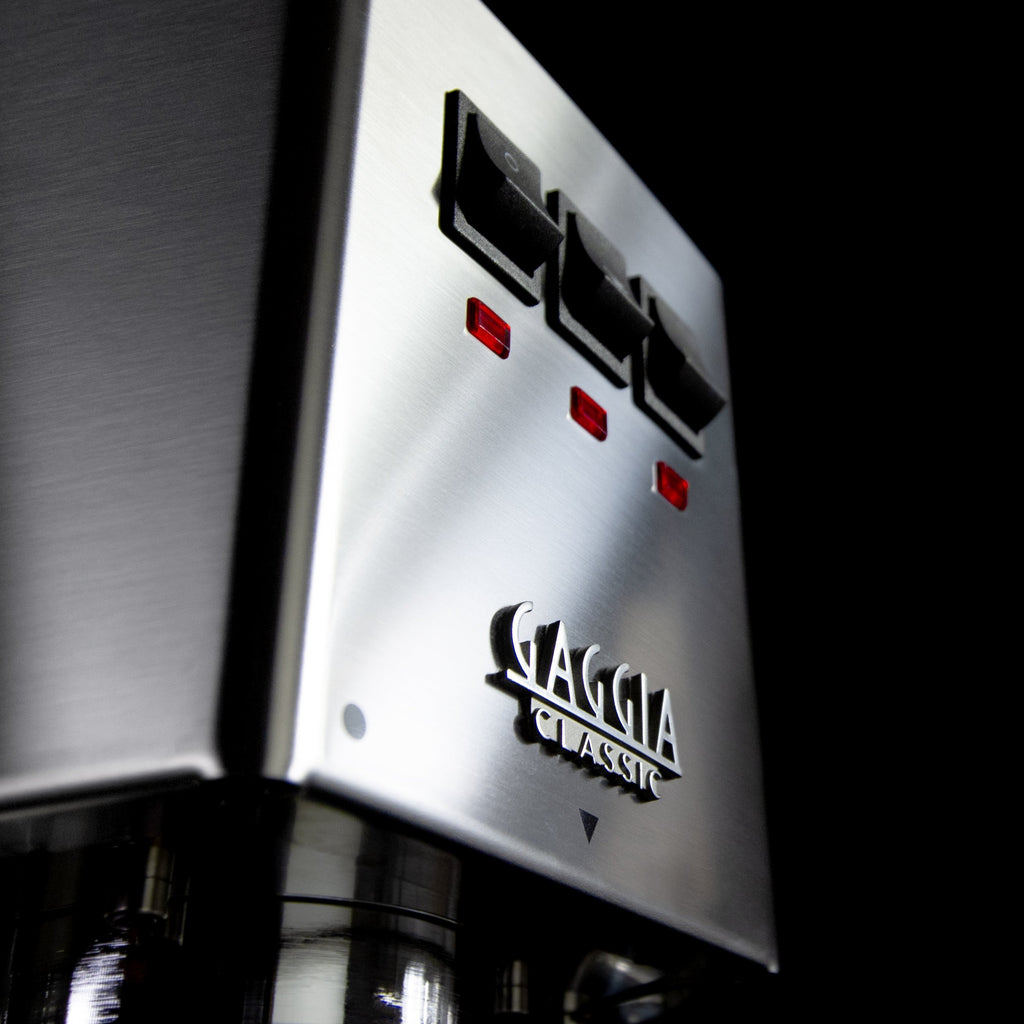
Verdict: For the beginner who wants the learning curve. Commercial-spec hardware at sub-$500 — 58mm portafilter, brass boiler, deepest modding ecosystem of any home machine. Not a median-beginner pick. Right only for the buyer who already knows that’s true. Price band: mid-range as the machine; premium effective cost-of-entry once a grinder is added.
The Gaggia Classic Pro gets recommended in every r/espresso thread that includes the words “long-term” or “modding.” 17-gauge stainless steel body, brass boiler, brass group head, and a 58mm commercial-style stainless portafilter plus a two-hole commercial steam wand. Everything that touches the puck or the milk is the same spec as a coffee-shop machine. At sub-$500, that’s an outlier. Most beginner machines at this price use a 54mm consumer portafilter, plastic group internals, and a panarello wand. Coffeeness frames the audience-fit honestly: the Classic Pro is for buyers who want “a proper old-school home barista machine they can learn to use, maintain, and potentially mod,” and they explicitly recommend the Bambino Plus instead for the convenience-seeker.
Out of the box, the OPV ships at ~12 bar (above the 9-bar SCA standard), and the machine has no PID and no pressure gauge. The brew temperature wanders enough that the most-commonly-recommended first mod is a PID kit. The OPV swap is a 30-minute job with a screwdriver and a $15 spring; the PID kit is an hour with a soldering iron or a $50 add-on board. Once you do both, you have a machine that genuinely competes with the Bambino Plus on shot quality, with commercial-spec hardware underneath. Coffee Kev calls it “one of the most modded espresso machines on the planet.”
Pros
- Commercial-spec hardware at sub-$500: 58mm portafilter, brass boiler, two-hole commercial steam wand.
- Modding ecosystem extends the machine’s life a decade or more.
- Holds resale value on the used market: Buy one, mod it, sell it five years later for what you paid.
- Teaches real espresso skill that transfers to any future machine.
Cons
- Real learning curve. Manual operation throughout, no PID and no pressure gauge from the factory, stock OPV releases above 9 bar until adjusted, and roughly 20 minutes of total prep including warm-up. Effective cost-of-entry is $550 to $700 once a dedicated burr grinder is added.
Best for: The beginner who self-identifies as a future tinkerer, wants commercial-spec hardware at sub-$500, and accepts the learning curve.
The Grinder You Pair with the Bambino, the Stilosa, or the Classic Pro: Baratza Encore ESP
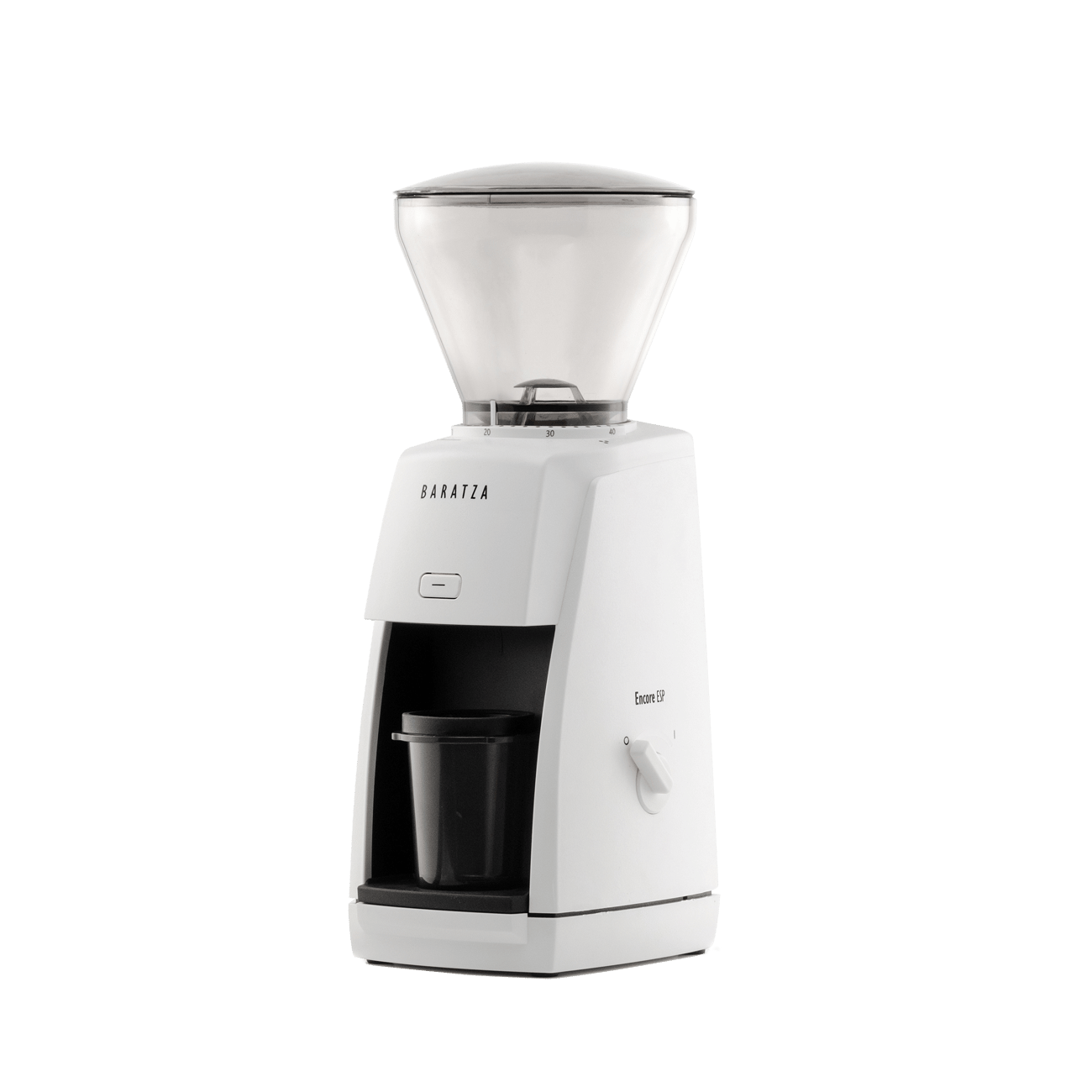
If you picked the Bambino Plus, the Stilosa, or the Gaggia Classic Pro, the next thing you need is a real espresso grinder.
The Baratza Encore ESP is the canonical pairing for all three. 40mm M2 conical burrs, 40 grind settings with the lower 1-20 micro-stepped specifically for espresso, and an included 54mm dosing cup with a 58mm adapter ring so the same grinder fits all three. It’s the strongest entry-level espresso grinder at the price, and Baratza’s burr-replacement parts ecosystem will outlive the machine you’re pairing it with. The catch: plastic chassis and lower burr RPM put it behind premium electric grinders on retention (~1g) and grind speed (~22 seconds for 20g). At the price, those are the right compromises. If you’d rather go manual, our best manual coffee grinder roundup covers the hand-grinder alternative.
Buyer’s Guide: How to Pick a Beginner Espresso Machine Without Regretting It
Decide What You Want from the Machine Before You Decide on a Model
James Hoffmann once described espresso as “probably the most intolerant method of food preparation of any food or drink in the world,” and he wasn’t being dramatic. Grind, dose, distribution, tamp, brew temperature, extraction pressure, milk technique: the variables stack. The real question is how many of those variables you want to manage yourself. Three honest answers map to three categories.
- “I want it to do the milk for me, and I don’t want a hobby.” Super-automatic. The Magnifica Evo.
- “I want to learn just enough to make a latte, but I don’t want to free-pour microfoam.” Semi-auto with an automatic milk wand. The Bambino Plus.
- “I want to learn the craft, and I’d actually enjoy modding the thing.” Semi-auto with manual steam wand and commercial-spec hardware. The Gaggia Classic Pro.
Budget the Grinder Into the Machine Price
The grinder is half the shot. A Bambino Plus paired with a $40 blade grinder produces watery, channelled shots. A Stilosa paired with a $200 Baratza Encore ESP produces tight, syrupy espresso the Bambino-with-blade-grinder owner won’t believe came out of a sub-$150 machine. Same beans, same water, same hands. The grinder is the variable. Treat your budget as a machine + grinder budget. The Barista Express Impress and the Magnifica Evo bundle that purchase into the box price; the Bambino, Stilosa, and Classic Pro need another $200 to $300 added to the headline number.
Don’t Be Fooled by 15-Bar and 20-Bar Pump Ratings
The SCA-defined espresso standard is 9 bar of extraction pressure at the puck (attributed to the Specialty Coffee Association, SCA-350). “15 bar” or “20 bar” on a marketing page means the pump can produce up to that much pressure if needed. It tells you nothing about what’s happening at the puck. Every machine here extracts at or near 9 bar through an OPV (over-pressure valve) that regulates it down.
Pressurized vs. Non-Pressurized Basket
A pressurized basket has a small hole at the bottom that artificially generates pressure regardless of grind or tamp quality, producing fake crema from any input. Beginner-friendly, real-espresso-incompatible. A non-pressurized basket is what real espresso wants, and it requires a proper burr grinder. Every pick here ships with non-pressurized baskets except the Stilosa, which is pressurized-only out of the box. A $15 aftermarket basket sorts that out. The honest beginner play is to start on the pressurized basket while you’re learning, then swap once you have a real grinder and the dial-in clicks.
Counter Space and Footprint
Standard countertop-to-upper-cabinet clearance is 18 inches. The Bambino Plus at 7.6 inches wide is the smallest credible machine here and the only one that fits comfortably under-cabinet with room to lift the steam wand. The Barista Express Impress is the largest pick.
Beginner vs. Future Tinkerer
A beginner’s machine should remove dial-in problems. The Bambino Plus, Barista Express Impress, and Magnifica Evo all skew this way. A tinkerer’s machine should reward dial-in. The Gaggia Classic Pro is the only pick here that punishes lazy prep and pays off careful prep.
So Which Espresso Machine Should You Actually Buy?
For most beginners, the Breville Bambino Plus is the right starting point. The 3-second warm-up and the automatic milk-texturing wand handle the morning friction and the milk-steaming skill so completely that you can pull a real espresso drink on day one. Pair it with the Baratza Encore ESP for the complete sub-$700 setup, or grab the pre-bundled box if you’d rather make one decision and be done.
If you want the grinder in the machine and the assisted-tamping that flattens dial-in, the Breville Barista Express Impress is the one-box answer. If you want one button and no portafilter to learn, the De’Longhi Magnifica Evo is the super-automatic that fixed the bottleneck super-autos used to fail at. If you’re not sure home espresso is for you, the De’Longhi Stilosa is the honest low-risk tryout. And if you already know you want the learning curve and the modding ecosystem, the Gaggia Classic Pro is the commercial-spec machine you’ll keep for a decade.
If you want the deeper roundup once you’ve decided you’re in, our best espresso machine for home guide covers eight picks across every price tier. And once the gear arrives, our how to make espresso beginner guide gets you from box to first shot.
The best espresso machine for beginners is the one you’ll actually use on a Tuesday at 6:50am. Match the machine to the morning you actually have, not the Saturday fantasy of it, and you’ll be a thousand dollars richer and a lot more caffeinated.
Frequently Asked Questions About Beginner Espresso Machines
What is the best espresso machine for beginners?
The best espresso machine for beginners is the Breville Bambino Plus for most first-time buyers. The 3-second warm-up and the automatic milk-texturing wand remove the two hurdles (the morning friction and the milk-steaming skill) that defeat most novice owners. If you want the grinder built into the machine, the Breville Barista Express Impress is the one-box pick instead. If you want the machine to do the milk and the espresso, the De’Longhi Magnifica Evo is the press-a-button pick.
How much should a beginner espresso machine cost?
A beginner espresso machine should cost between $150 and $800 for the machine itself, plus another $200 to $300 for a real burr grinder if the machine doesn’t include one. Below $150 you’re in tryout territory (the De’Longhi Stilosa is the honest pick at this tier). Between $400 and $700 is the sweet spot for the first real machine. Above $1,000 you’re paying for super-automatic convenience or features that don’t matter at the beginner stage. Market Growth Reports’ 2026 home-espresso data shows roughly 44% of buyers cluster in the $150 to $300 band, but the total spend including a grinder typically lands closer to $500 to $700. If your machine cost more than your grinder, you’re holding it wrong.
Do I need a separate grinder for an espresso machine?
You need a separate grinder unless your espresso machine has a built-in burr grinder. A blade grinder will not work for espresso; the grinds are too inconsistent to extract evenly. Two picks on this list have built-in burr grinders (the Barista Express Impress and the Magnifica Evo); the other three (Bambino Plus, Stilosa, Gaggia Classic Pro) need a paired grinder, and the Baratza Encore ESP at around $200 is the canonical companion. Budget the grinder into the total machine price from day one.
What is the most reliable espresso machine for home use?
The most reliable espresso machine for home use is the De’Longhi Magnifica Evo for super-automatic owners and the Gaggia Classic Pro for semi-automatic owners. The Magnifica’s auto-clean cycle is the one in the super-auto category buyers actually follow through on, which is why these machines stay on the counter past year three. The Classic Pro has been in production for over two decades with a modding ecosystem that keeps it serviceable for a decade or more. Used Classic Pros from the early 2000s are still pulling shots.
Should I buy a semi-automatic or super-automatic espresso machine as a beginner?
Buy a super-automatic if you want the cup and not the ritual; buy a semi-automatic if you want to be involved in the shot. Super-automatic (the Magnifica Evo) handles grinding, dosing, tamping, brewing, and milk-frothing on one button press. Semi-automatic (the Bambino Plus, Barista Express Impress, or Gaggia Classic Pro) gives you a portafilter, a steam wand, and the ability to learn the craft over time. The real decider is how much daily effort you want to put in.