
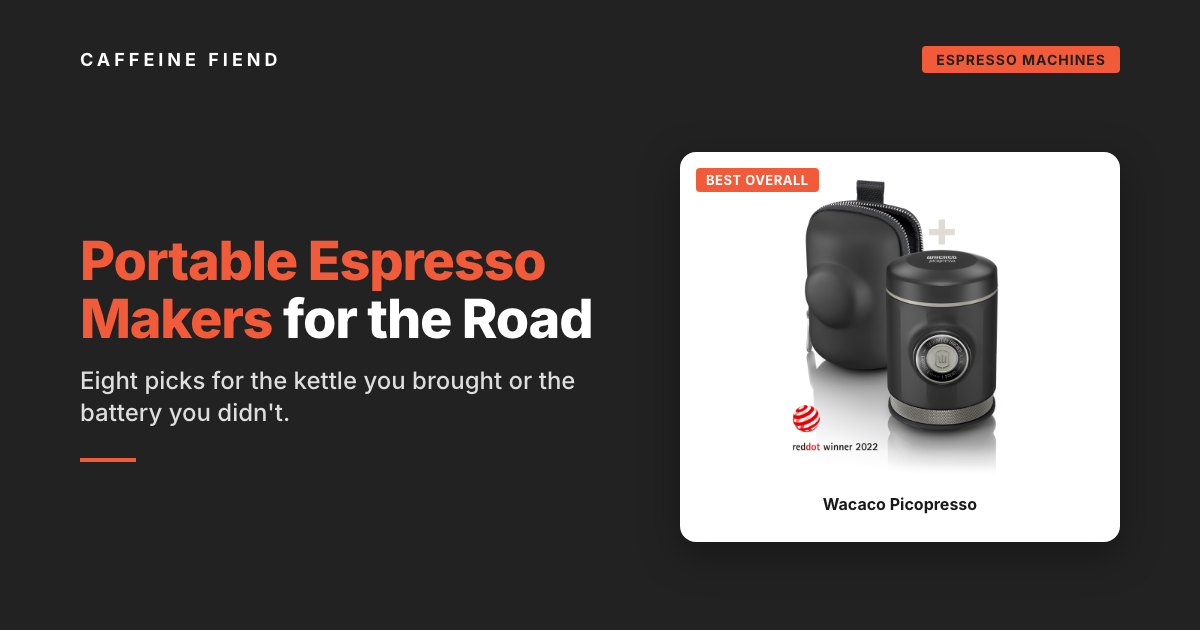
For most readers, our pick is the Wacaco Picopresso. It fits in a jacket pocket, uses a full 52mm commercial-spec basket, and pulls dense, real crema most portable rigs only fake with a pressurized basket.
The 8 Best Portable Espresso Makers at a Glance
Hand-pump specialty makers like the Picopresso pull specialty-grade shots if you bring hot water and grind fresh. Self-heating electrics run their own water off a rechargeable battery. That’s the one shortcut hand-pump makers can’t offer. If a kettle is a dealbreaker, skip to the Outin Nano. The right pick depends on whether you’d rather carry a kettle or a battery.
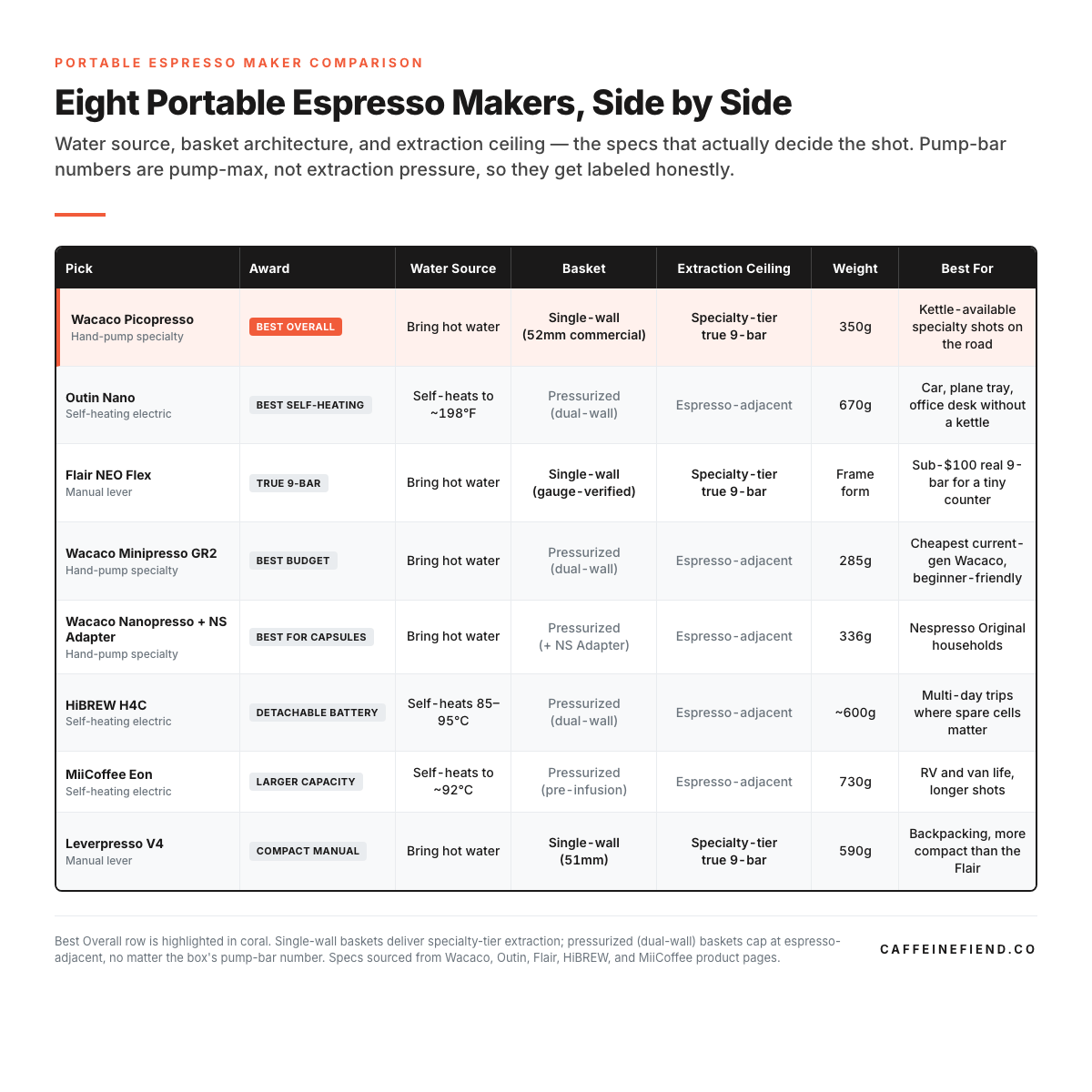
| Pick | Award | Family | Basket | Weight | Best For |
|---|---|---|---|---|---|
| Wacaco Picopresso | Best Overall | Hand-pump specialty | Single-wall (52mm commercial) | 350g | Specialty-grade shots on the road, kettle available |
| Outin Nano | Best Self-Heating | Self-heating electric | Pressurized | 670g | Car, plane tray, office desk, no kettle |
| Flair NEO Flex | Best for True 9-Bar Espresso | Manual lever | Single-wall | Frame form | Apartment or tiny counter, sub-$100 real espresso |
| Wacaco Minipresso GR2 | Best Budget | Hand-pump specialty | Pressurized | 285g | Cheapest current-gen Wacaco, beginner-friendly |
| Wacaco Nanopresso + NS Adapter | Best for Capsule Users | Hand-pump specialty | Pressurized (+ NS Adapter for capsules) | 336g | Nespresso households wanting portable capsule espresso |
| HiBREW H4C | Best Detachable-Battery Electric | Self-heating electric | Pressurized | ~600g | Multi-day trips where a spare battery matters |
| MiiCoffee Eon | Best Larger-Capacity Self-Heating | Self-heating electric | Pressurized | 730g | RV and van life, longer shot capability |
| Leverpresso V4 | Best Compact Manual Alternative | Manual lever | Single-wall (51mm non-pressurized) | 590g | Backpacking, more compact than the Flair |
Portable espresso demand keeps climbing. According to the National Coffee Association’s Spring 2026 NCDT report, past-week espresso-based beverage consumption among US adults hit 45%, up from 40% in 2022.
How We Picked
A transparency note first. We researched these picks rather than running every one through our own kitchen for this roundup. The Picopresso is the only pick that lives at Caffeine Fiend HQ, and we weren’t about to fake in-use notes on the other seven. Every in-use observation below cites a named hands-on reviewer: Coffee Chronicler on the Outin Nano and MiiCoffee Eon, Home Coffee Expert on the Picopresso and Nanopresso, BIKEPACKING.com on the Picopresso, CoffeeGeek and Coffeedant on the Flair NEO Flex, and HiBREW’s own product test on the H4C.
Splitting the category on basket architecture, framing water source as the forking question, and calling out the extraction ceiling honestly per pick is the work our reader shows up for.
- Extraction pressure that lands at the puck. The Specialty Coffee Association pegs the extraction target at 9 ± 1 bar. Most portables advertise “18 bar” or “20 bar.” Those numbers describe the pump’s maximum output. What happens at the puck during extraction is a different measurement — the 9-bar target. As Instacuppa’s 20-bar-vs-9-bar explainer lays out, the higher pump rating is engineering headroom; the shot quality still comes from what happens at the puck at 9 bar.
- Basket type, honestly labeled. A single-wall (non-pressurized) basket lets you pull specialty-grade espresso if your grind and dose are dialed. A pressurized (dual-wall) basket uses a second wall with a single exit hole to fake back-pressure. That’s forgiving of pre-ground supermarket coffee, but capped at espresso-adjacent. Breville’s explainer is the clearest breakdown we’ve read. Each pick below is tagged with which side of the line it’s on.
- Water source as the forking question. Self-heating electric makers solve the kettle problem; hand-pump specialty makers demand it. We weighted this above bar-ratings because it decides where in a day the maker fits.
- A specific, named in-use observation per pick. Asserted testing (“we tried many”) is the floor. Named, falsifiable observations (a temperature measurement, a per-charge shot count, a pressure-gauge reading) are the bar. We flag any pick whose independent-review layer is thin.
- Currently sold on both the manufacturer’s site and Amazon. Every pick was verified live on 2026-07-04. We swapped the original Wacaco Minipresso GR for its current-gen successor. Wacaco marks the original “OUT OF STOCK,” and a superseded SKU as a “current” pick is a freshness defect.
The Best Portable Espresso Makers, Reviewed
1. Wacaco Picopresso, Best Overall
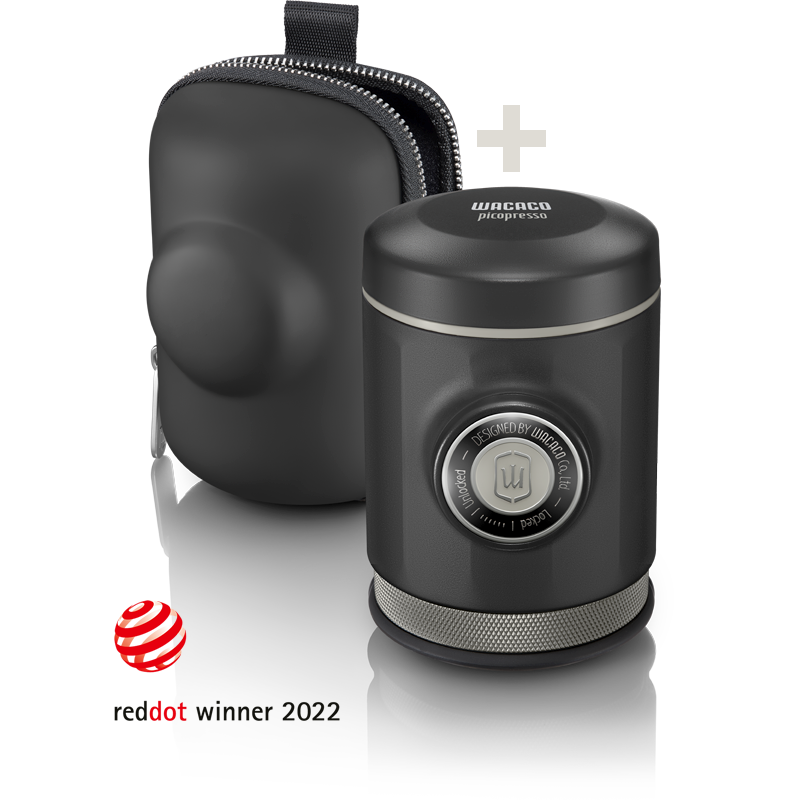
Verdict: The Picopresso is a jacket-pocket-sized specialty espresso maker with a 52mm commercial basket and a naked bottomless portafilter. Bring hot water and a burr grinder, and it produces the kind of dense crema and body a home Bambino Plus would nod at. It’s the only hand-pump portable on this list running full commercial-spec extraction hardware.
Matt Woodburn-Simmonds’ hands-on review at Home Coffee Expert calls the shot “remarkably smooth and rich with a good amount of texture … as authentic as you’d expect from an expensive high-end machine.” Lucas Winzenburg at BIKEPACKING.com wrote that he was “frankly blown away by the quality of espresso this little thing can produce,” then added the warning that decides whether you’ll get that shot. “Even a one-gram variation can make a difference.”
Pros:
- Real 52mm commercial basket: takes up to an 18g double dose, no pressurized-basket illusion.
- Naked bottomless portafilter: you see the extraction happen; channeling has nowhere to hide.
- Pocketable: 350g, packs down small enough for a jacket pocket.
Cons:
- Grind-sensitive to the gram: without a quality burr grinder and a consistent dose, the shot goes sideways fast.
- No built-in water heating: you’re carrying a Thermos, borrowing a kettle, or planning around a hotel-room coffee maker.
- Thorough pre-heat required: cold metal robs shot temp; skip it and you’ll pull a lukewarm espresso.
Best for: The reader who wants specialty-grade espresso somewhere a countertop machine can’t go, and who’ll bring hot water and grind fresh on the spot.
2. Outin Nano, Best Self-Heating
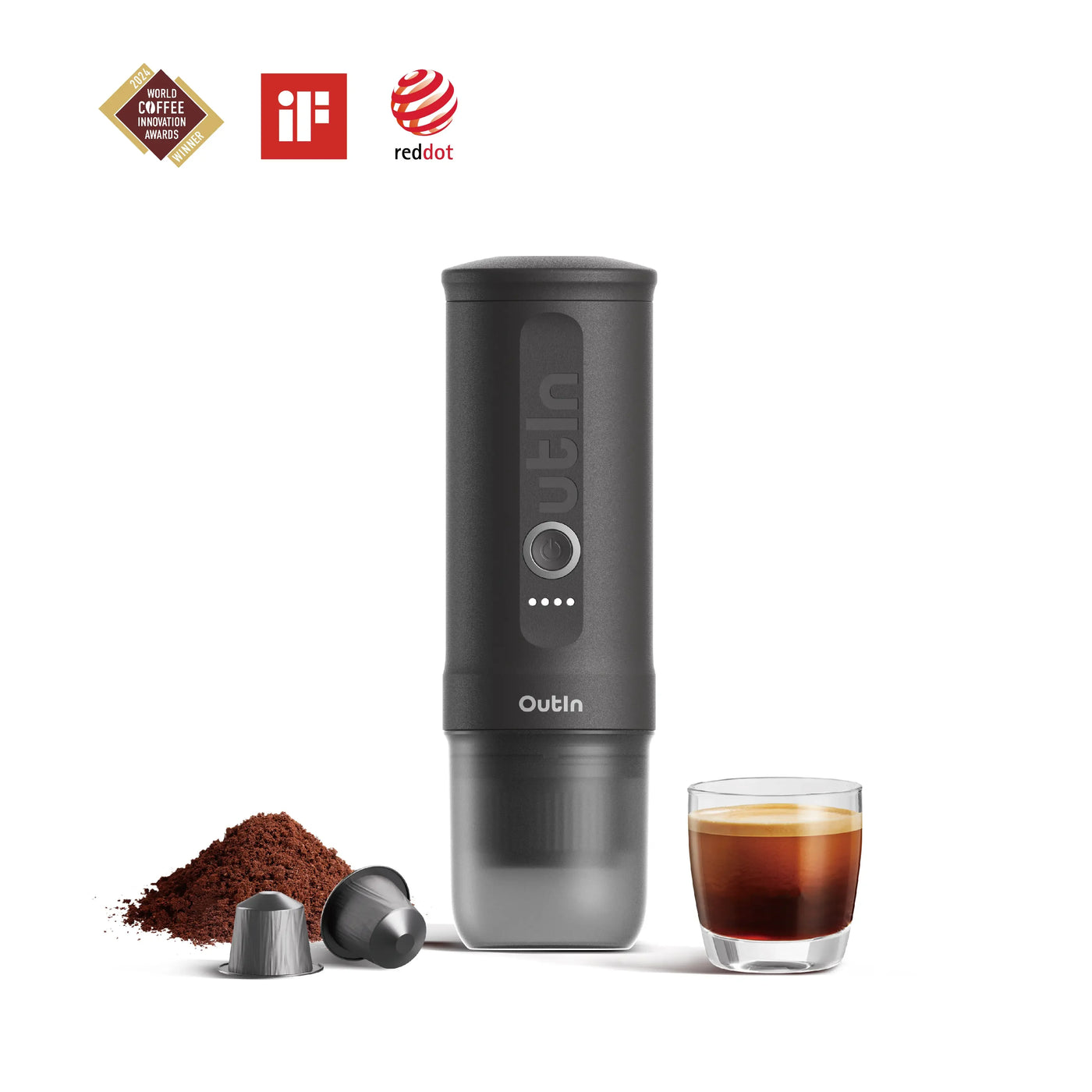
Verdict: The Outin Nano is the category-defining “no kettle needed” pick. It heats 50ml of room-temperature water to about 198°F in three minutes off a rechargeable battery, then pulls a shot on a 20-bar pump.
The Nano trades the kettle problem for a charging problem, and Coffee Chronicler’s hands-on review is where the honest cost shows up. The same charge that yields 200+ shots on pre-heated water gets you around five brews when the machine is doing the heating. Our reader guides for battery operated coffee makers and portable coffee makers that heat water show the same cold-water penalty across the category. Coffee Chronicler also observed that Nespresso Original capsules deliver more consistent shots from the Nano than fresh grounds do. The pressurized basket is doing more work than the grind is, so the capsule shortcut fits this machine better than it fits the Picopresso.
Pros:
- Self-heats room-temperature water: the one shortcut no hand-pump maker offers.
- Ground-coffee or Nespresso Original capsule compatibility: switch modes depending on the day.
- ~5 brews per charge (cold-water) / 200+ per charge (pre-heated water): the second number is the office-desk lifetime if a kettle sits next to your monitor.
Cons:
- Cold-water battery drain is severe: plan around USB-C recharge time on any multi-day trip.
- Capsule shots beat ground shots for consistency: if you refuse to touch capsules, you’re giving up part of what makes the Nano worth its premium.
- Pressurized (dual-wall) basket: extraction lands at espresso-adjacent. The specialty-tier ceiling belongs to the single-wall picks (Picopresso, Flair NEO Flex, Leverpresso V4). The 20-bar pump number is a pump ceiling; actual extraction is 9-bar target, same as everything else.
Best for: The reader who needs espresso in a car, on a plane tray, or on an office desk without access to a kettle. Grab-and-go convenience beats last-percent shot quality here.
3. Flair NEO Flex, Best for True 9-Bar Espresso
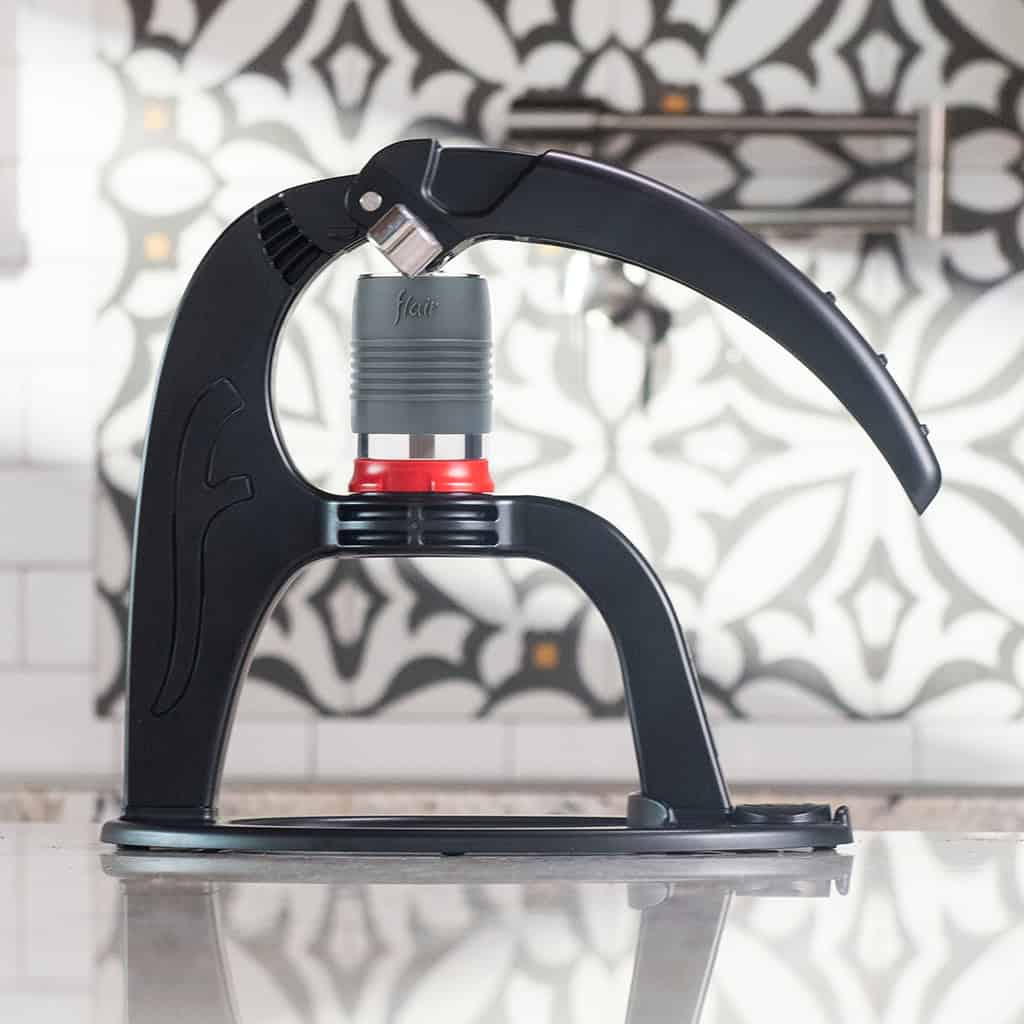
Verdict: The NEO Flex is a manual direct-lever maker with an integrated pressure gauge, and it’s the cheapest legitimate path to real 9-bar single-wall espresso we know of. You supply the pressure with your arm. The gauge tells you when you’re at 9 bar so it’s not a guessing game. No motor, no battery.
Coffeedant’s hands-on frames it as the best sub-$100 path to real 9-bar espresso for cramped kitchens. CoffeeGeek’s snapshot review corroborates the true-9-bar claim and calls out the 2024 pressure-gauge relaunch as the update that finally makes a lever maker teachable. You can see the pressure now, which turns the shot from a proprioception guess into a visible measurement.
The polymer frame does feel cheaper than the metal-bodied Flair 58 tier.
Pros:
- Genuine 9-bar espresso, verified on the gauge: no pump-max marketing, no pressurized-basket shortcut.
- Integrated pressure gauge (post-2024 relaunch): the shot becomes a visible measurement.
- Ships with both flow-control and bottomless portafilters: dial in with flow control, then run bottomless for channeling checks.
Cons:
- Setup and breakdown time per shot: this isn’t grab-and-go. Pull the frame out, warm the cylinder, brew, disassemble, wash.
- Requires a separate kettle for hot water: same “bring the kettle” problem the Picopresso has.
- Polymer body feels cheaper than the Flair 58 metal-body tier: it works, but the tactile signal doesn’t match specialty-cafe hardware.
Best for: The apartment-dweller or tiny-counter reader who wants real 9-bar espresso for under a hundred bucks. If the Picopresso’s grind demands scare you off, the NEO Flex is the safer path to the same shot quality. The lever mechanism is more forgiving than a hand-pump, and the gauge shortens the learning curve.
4. Wacaco Minipresso GR2, Best Budget
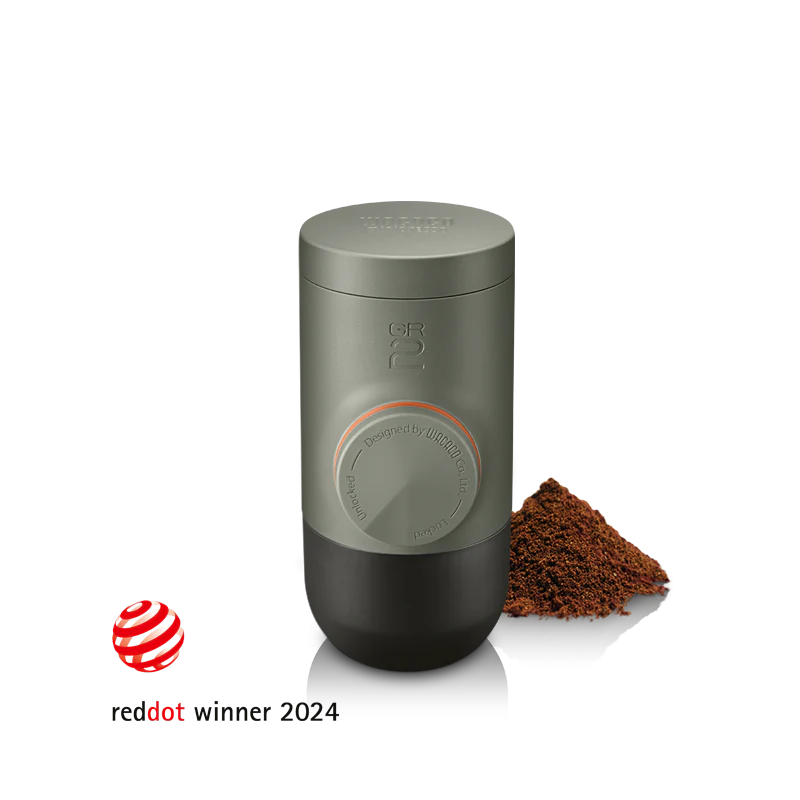
Verdict: The GR2 is the cheapest current-gen Wacaco espresso maker, redesigned smaller and lighter than the original Minipresso GR (which Wacaco.com now marks “OUT OF STOCK” — the entry-tier goodbye party). It’s a pressurized-basket hand-pump maker built to forgive beginner grind, pre-ground supermarket coffee, and general roughness. The extraction ceiling lands at espresso-adjacent, and the pressurized basket doesn’t pretend otherwise. The price and the forgiveness make it the right first portable for a gift buyer or someone who won’t dwell on the pressurized-basket line.
Wacaco explicitly notes on the Minipresso GR2 spec page that “in order to drink a hot espresso you will have to fill the water tank with hot water.” No self-heating. The GR2 also takes an adjustable 8–12g dose the original GR didn’t.
Pros:
- Cheapest current-gen Wacaco espresso maker: under $60 MSRP, budget-tier without being a discontinued SKU.
- Adjustable 8–12g basket: dose flexibility the original GR lacked, useful when you switch beans.
- Pressurized basket forgives beginner grind: you can pull something drinkable off pre-ground supermarket coffee, which most of this list won’t.
Cons:
- Pressurized (dual-wall) basket caps the extraction ceiling: espresso-adjacent coffee with artificial back-pressure crema. Picopresso and Flair NEO Flex produce the specialty-tier version with a single-wall basket.
- User-supplied hot water only: same kettle-required constraint as the rest of the hand-pump family, without the higher shot quality it buys with the Picopresso.
- Grow-out ceiling: the reader who upgrades to specialty beans will hit the pressurized-basket wall inside a season.
Best for: Gift buyers, first-portable buyers, and anyone whose “portable espresso” bar is “hot, strong, roughly the right size.” Also anyone who won’t budge on pre-ground supermarket coffee. The forgiving basket saves that shot in a way a single-wall basket won’t.
5. Wacaco Nanopresso (with NS Adapter), Best for Capsule Users
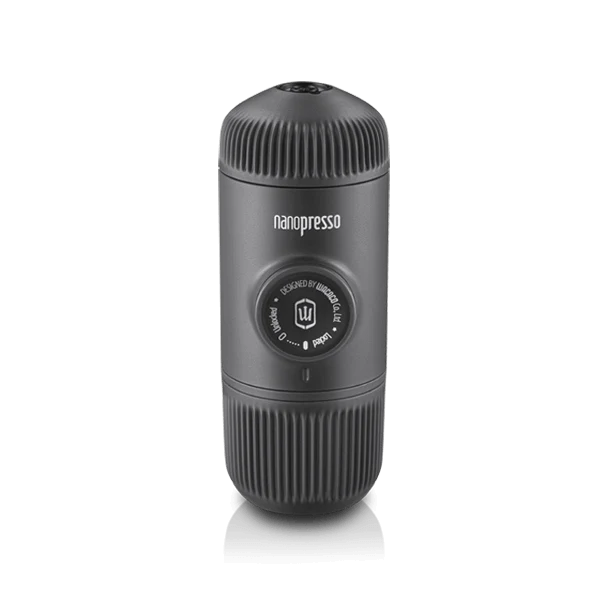
Verdict: The Nanopresso is the lightest hand-pump portable in this roundup at 336g, and the NS Adapter bundle unlocks its most useful trick. It takes Nespresso Original capsules out of the box. Default basket for fresh-ground coffee, NS Adapter for a capsule shot. It’s one device that handles both the enthusiast and the get-me-caffeinated modes at sub-12-oz weight.
Matt Woodburn-Simmonds’ Nanopresso review at Home Coffee Expert frames the shot honestly. It “makes good espresso with ease. Built for the casual espresso drinker, the pressurized basket helps to even out any issues so you almost always get a good shot.” He also names the pressure-marketing trap plainly. “18 Bar of pressure is the maximum that you are able to create at the pump.” That’s the pump’s ceiling; actual extraction still lands around the 9-bar target, same as everything else in the roundup.
One capsule caveat worth naming: the NS Adapter fits Nespresso Original capsules only. Vertuo capsules don’t fit any portable in this roundup, and Vertuo shoppers are on the wrong list.
Pros:
- Lightest hand-pump portable here at 336g: best portability-per-dollar in the roundup.
- NS Adapter opens Nespresso Original capsules: portable capsule espresso without buying an electric machine.
- Newly patented pump requires 15% less pump force than the original Minipresso: noticeable on back-to-back shots.
Cons:
- External heat source required: kettle, Thermos, or campfire; you’re carrying hot water somehow.
- 20–30 pumps per shot tires your arm: solo café mornings are fine; a family of four is a workout.
- Pressurized basket caps the extraction ceiling: the Nanopresso hits the same espresso-adjacent ceiling as the Minipresso GR2 in a lighter body. Portability is what earns this pick its slot.
Best for: The Nespresso Original-capsule household that wants portable capsule espresso without buying a battery-powered machine. Also for the traveler who wants the lightest hand-pump on the market.
6. HiBREW H4C, Best Detachable-Battery Electric
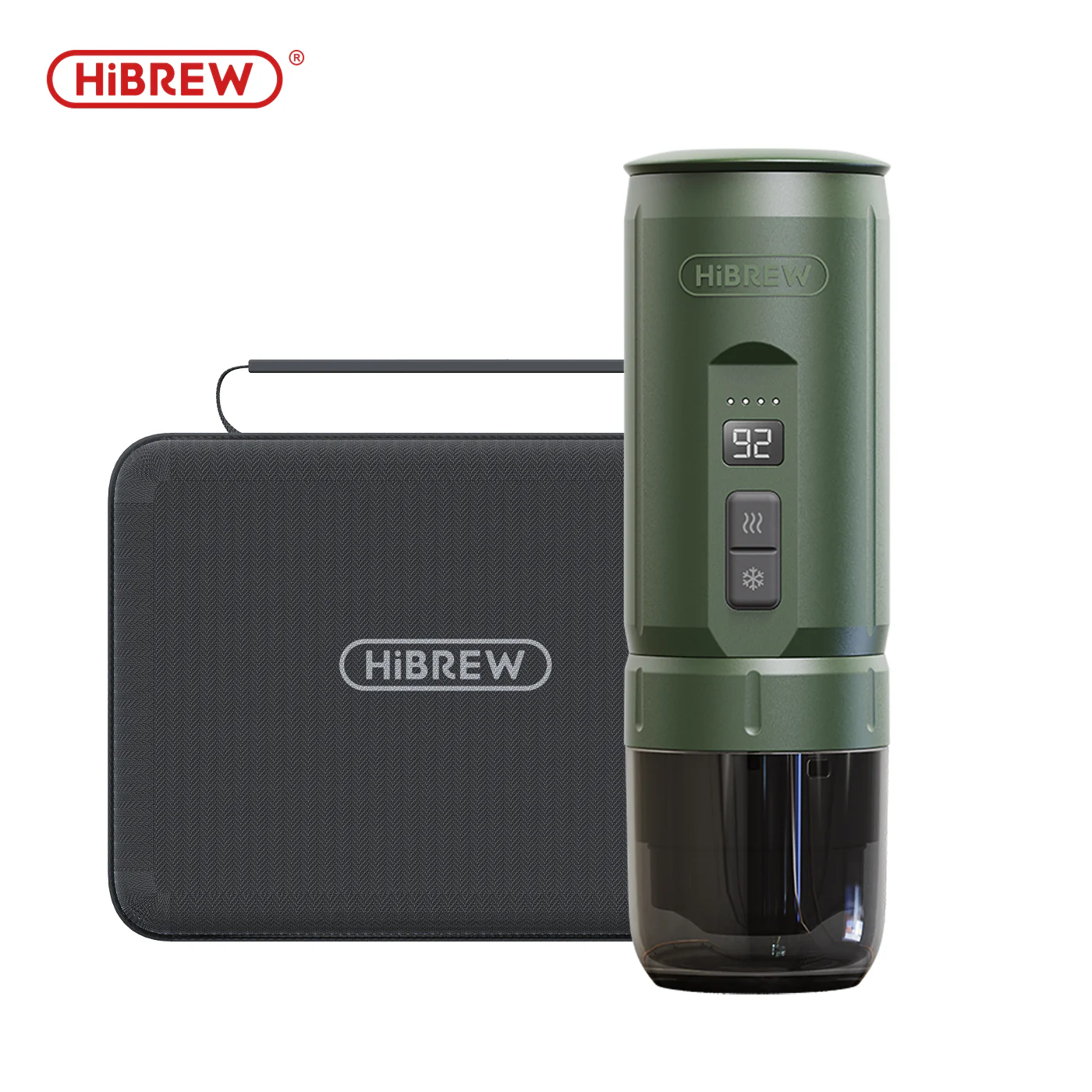
Verdict: The H4C’s headline feature is what the Outin Nano doesn’t have. A detachable 18650 battery. When the pack dies mid-trip, you swap in a spare cell and keep making shots. That one design decision makes the H4C the better multi-day trip pick, even if the Nano has more independent-review pedigree. The H4C also lets you tune brew temperature between 85–95°C and extraction time between 25–75 seconds, which the Nano’s fixed profile doesn’t allow.
Bulla Márton J.’s hands-on test hosted on HiBREW’s own blog measured “a maximum of 4–6 espressos or 2–3 Lungos from a single battery charge” and flagged that the machine “gets quite hot” during operation. Recharge is about three hours per battery.
That source lives on the manufacturer’s own domain, so we’re flagging it rather than dressing it up as third-party validation. The observations match the spec-sheet math, but the independent-review layer on the H4C is thin.
Pros:
- Detachable 18650 battery: carry a spare cell and the “battery died mid-trip” scenario is solved.
- Adjustable brew temperature (85–95°C) and extraction time (25–75s): tune the shot in ways the Nano doesn’t allow.
- Compatible with ground coffee or Nespresso Original capsules: same dual-mode flexibility as the Nano.
Cons:
- 4–6 espressos per charge is meager: even with a spare battery, back-to-back-day trips need charging discipline.
- Machine gets hot during operation: capsule changes get uncomfortable; use a cloth or wait it out.
- Independent-review layer is thin: the strongest hands-on test we found is on the manufacturer’s own domain (flagged above).
Best for: The reader who wants self-heating electric convenience but can’t accept the Outin Nano’s fixed-battery single-point-of-failure on a multi-day trip. The spare-cell workaround earns the pick.
7. MiiCoffee Eon, Best Larger-Capacity Self-Heating
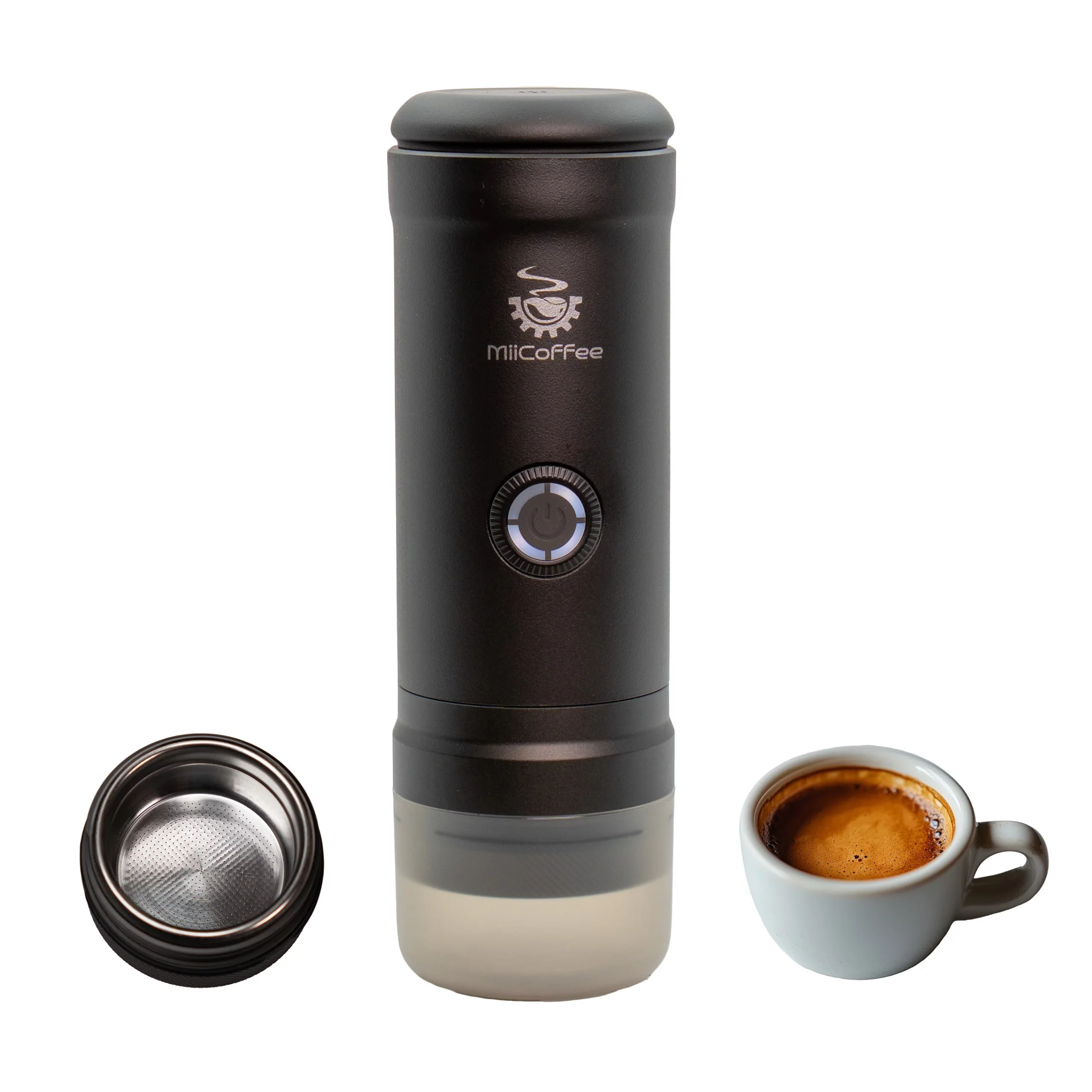
Verdict: The Eon is the self-heating electric for the reader who wants more than the Outin Nano’s 50ml water capacity to work with. It holds 80ml, self-heats to around 92°C in one to two minutes, and adds built-in pre-infusion. That’s a genuine extraction-quality feature the Nano and H4C don’t offer. Pre-infusion wets the puck before the pressure ramp, which evens out extraction and improves cup clarity. It makes the Eon the most extraction-thoughtful self-heating pick here, even though its basket is still pressurized.
Coffee Chronicler’s Eon review frames it as a larger-capacity Nano alternative rather than a Nano-killer. The Nano’s independent-review footprint is deeper, and its 670g weight is lighter than the Eon’s 730g by a real margin.
Availability note. MiiCoffee moved from miicoffee.com to miicoffee.shop earlier this year, and older roundups flag the Eon as discontinued because they didn’t catch the domain change. As of 2026-07-04 the Eon is still sold on miicoffee.shop and on Amazon.
Pros:
- 80ml water capacity vs. Nano’s 50ml: longer shots, or two shots back-to-back without a refill.
- Built-in pre-infusion: the extraction-quality feature the Nano and H4C skip.
- Room-temp water heats to ~92°C in 1–2 minutes: as fast as the Nano’s self-heating, in a slightly bigger body.
Cons:
- Heaviest self-heating pick in the roundup: 730g vs. the Nano’s 670g. The larger capacity carries a real weight penalty.
- Pressurized (dual-wall) basket: same ceiling as every other self-heating pick. Extraction-adjacent, capped below the specialty-tier ceiling of the single-wall picks.
- Thinner independent-review footprint than the Outin Nano: the Nano remains the category-defining self-heating pick on hands-on evidence volume.
Best for: RV, van life, and longer road trips where two shots back-to-back without a refill matters. Also the reader who wants pre-infusion in a portable. The Eon is the only pick here that offers it.
8. Leverpresso V4, Best Compact Manual Alternative
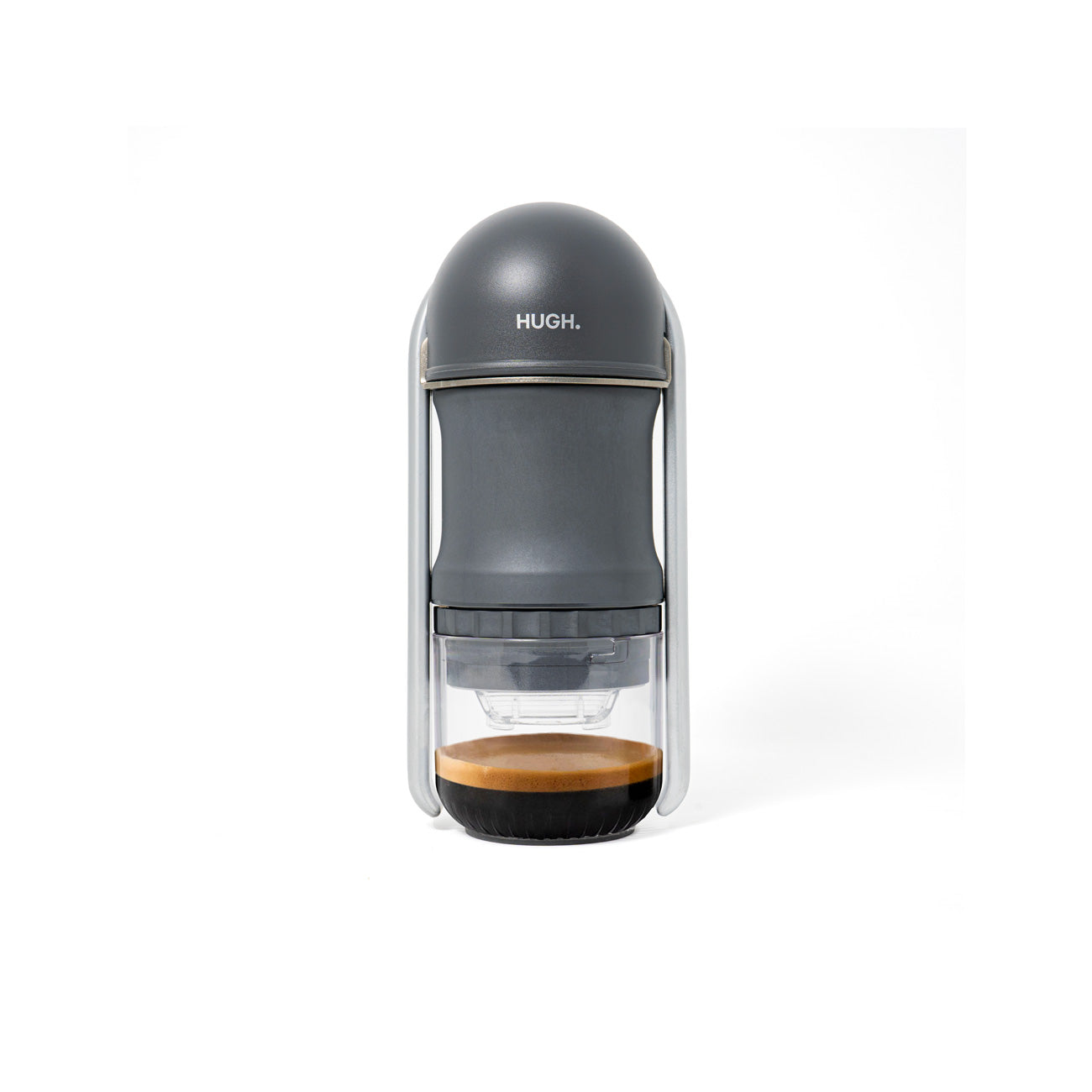
Verdict: The Leverpresso V4 shrinks the Flair NEO Flex’s true-9-bar single-wall idea into a self-contained device that fits in a backpacking kit. The non-pressurized 51mm basket delivers real specialty-tier extraction, and the dual-lever pumping mechanism gets you to 9 bar without a motor or battery. The whole package is more compact than the Flair’s countertop frame, better suited to bike touring or minimalist travel where the Flair is bulky.
Honest disclosure on the evidence gap. The independent-review layer on this pick is thin. Verification runs through the HUGH Inc. Amazon storefront and aggregated Amazon reviewer observations rather than the CoffeeGeek/Coffeedant-tier coverage the other seven picks carry. Weigh the mechanism claim against the coverage gap and decide accordingly.
Pros:
- True single-wall 9-bar espresso from a compact lever: same extraction ceiling as the Flair NEO Flex, in a more travel-friendly form.
- No electricity, no batteries: the only water-source variable is a kettle.
- 51mm ridgeless portafilter basket: commercial-adjacent architecture, closer to cafe hardware than a shrunk-down gimmick.
Cons:
- Independent editorial coverage is thin: no CoffeeGeek or Coffeedant equivalent. Most hands-on signal comes from aggregated Amazon reviewers under the HUGH storefront.
- Manufacturer web presence is broken: no live product page to verify against, and warranty routing goes through Amazon.
- Setup and breakdown time per shot: same lever-mechanism ritual as the Flair NEO Flex. Not a grab-and-go pick.
Best for: The reader who liked the Flair NEO Flex’s “true 9-bar under $100” pitch but wants something smaller for backpacking, bike touring, or minimalist travel.
How to Choose a Portable Espresso Maker
Skip the pump-bar numbers. Answer these five questions instead.
Are You Bringing a Kettle, or Not?
This is the question. Kettle, or battery? Every other spec follows from the answer.
If you have easy access to hot water at your destination (a hotel kettle, a camp stove, a coffee shop with a cup of hot water on request), a hand-pump specialty maker like the Picopresso or Flair NEO Flex gets you specialty-tier shot quality. If your kettle plans involve a Thermos in a rental car, you’re already halfway to hand-pump territory. If none of those exist in your day, a self-heating electric (Outin Nano, HiBREW H4C, or MiiCoffee Eon) is what you’re shopping for.
Do You Care About “Real” Espresso, or Just Espresso-Shaped Coffee?
Basket architecture decides the shot ceiling. Single-wall (non-pressurized) baskets on the Picopresso, Flair NEO Flex, and Leverpresso V4 pull specialty-grade espresso with real crema built from extracted coffee oils. Aromatic complexity, syrupy mouthfeel, a lingering sweet-bitter finish. Pressurized (dual-wall) baskets on the Minipresso GR2, Nanopresso, and every self-heating electric here produce espresso-adjacent coffee with faux crema created at the exit hole. That cup arrives thinner in aroma, lighter on the palate, and drops off cleaner in the finish. A pressurized-basket shot still beats gas-station drip on a Tuesday morning, but readers who grow into fresh-ground specialty beans hit the pressurized-basket wall inside a season.
How Committed Are You to a Real Grinder?
Portable rigs are more grind-sensitive than home rigs. With no PID, no pre-infusion (except the Eon), and no headroom to forgive channeling, the smaller the machine, the more the grind has to carry. As the Perfect Daily Grind team noted in a Jan 2026 interview with Outin marketing manager Jess Jia and 2024 World Coffee in Good Spirits runner-up Sandro Roth, “if there is one non-negotiable variable in espresso quality, it’s arguably grind size.” If you’re not willing to bring a burr grinder along (see our portable coffee grinders guide for the field-friendly picks)
How Long Is the Trip?
Battery life decides whether an electric portable works for you. The Outin Nano yields around five hot shots per charge on cold water, and around 200 on pre-heated water. The HiBREW H4C hits four to six espressos per charge and takes a spare 18650 cell if you carry one. The Eon lands in the same range as the Nano. A multi-day trip needs a hand-pump maker or the H4C plus a spare 18650 in a pocket, which is the workaround the Nano doesn’t offer.
Espresso, or Filter?
If you want filter coffee on the go, this isn’t the roundup. Our portable coffee makers guide covers drip, pour-over, French press, and the moka-pot stovetop path for campers.
Frequently Asked Questions About Portable Espresso Makers
What is the best portable espresso maker?
The Wacaco Picopresso is the best portable espresso maker for most people. It uses a full 52mm commercial-spec basket, a naked bottomless portafilter, and delivers specialty-grade extraction from a device that fits in a jacket pocket. The one prerequisite is that you supply hot water and grind fresh on-site. If that’s a dealbreaker, the self-heating Outin Nano is the honest alternative.
Is there a portable espresso maker that heats water?
Yes. The Outin Nano, HiBREW H4C, and MiiCoffee Eon all self-heat room-temperature water off a rechargeable battery, so no external kettle is needed. Expect around five hot shots per charge on cold water across the category, and roughly 200 per charge if you supply pre-heated water. All three use pressurized (dual-wall) baskets, so the extraction ceiling is espresso-adjacent rather than specialty-tier.
Is a portable espresso maker really espresso?
Some of them are. Real espresso is defined by extraction at 9 ± 1 bar through a fine puck of ground coffee, per the Specialty Coffee Association standard. Picks with single-wall (non-pressurized) baskets (the Picopresso, Flair NEO Flex, and Leverpresso V4) deliver that. Pressurized-basket picks (Minipresso GR2, Nanopresso, Outin Nano, HiBREW H4C, MiiCoffee Eon) use a second wall with an exit hole to create back-pressure, which produces espresso-adjacent coffee with artificial thick crema. Both are legitimate; only one is technically espresso.
What does “20-bar” pump mean on portable espresso maker specs?
“20-bar” describes the maximum pressure the pump can generate. The pressure at the puck during extraction is a separate measurement — the SCA target of 9 bar. The higher pump-max number gives the pump headroom to overcome flow resistance and deliver 9 bar consistently. It’s not a signal of shot quality. A “20-bar” portable and a “15-bar” portable target the same 9-bar extraction; the extra headroom is engineering margin.
Do you need a burr grinder to use a portable espresso maker?
Yes for any of the single-wall picks, and yes for best results even on pressurized ones. Portable rigs have no PID temperature control, no pre-infusion on most models, and no headroom to forgive an inconsistent grind. Pressurized-basket picks like the Minipresso GR2 will pull something drinkable off pre-ground supermarket coffee; single-wall picks like the Picopresso won’t. If your total budget is $150, we’d rather see you buy a $60 hand grinder and a $90 pressurized-basket portable than a $150 specialty portable you can’t feed correctly.
What is the smallest portable espresso maker?
The Wacaco Nanopresso is the smallest hand-pump portable in this roundup at 336g and 6.14 inches long. The Minipresso GR2 is slightly lighter at 285g but similar in overall size. For self-heating electrics, the Outin Nano at 670g and about 9 inches tall is roughly a large water-bottle form factor. Pocket-adjacent, though not jacket-pocketable the way the hand-pumps are.
Which Portable Espresso Maker Should You Buy?
If you want specialty-grade espresso and can bring hot water and a burr grinder, the Wacaco Picopresso is our pick. It’s the closest thing to a real espresso setup in a jacket pocket.
If a kettle is a dealbreaker, buy the Outin Nano and accept the pressurized-basket ceiling.
If you want real 9-bar espresso for under $100 and you have counter space, the Flair NEO Flex is the cheapest legitimate path to it.
If you’re not fully committed to a portable rig and want to see whether a small countertop machine solves your problem better, our small espresso machines roundup is one door down.