
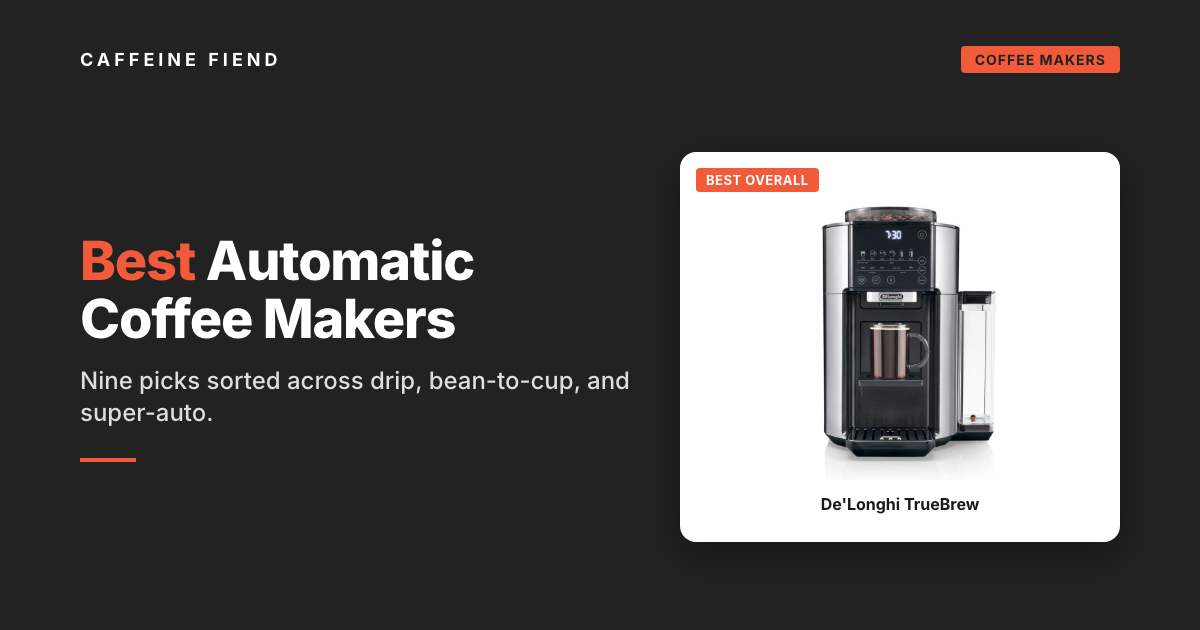
Best automatic coffee maker overall: the De’Longhi TrueBrew (CAM51025MB), a bean-to-cup drip machine that grinds whole beans, doses per cup, and brews directly into your mug at one button.
The TrueBrew is the automatic coffee maker with grinder that the “with grinder” refinement points at. Programmable drip machines don’t have grinders, so those two words have already ruled out half the category.
But “automatic coffee maker” hides three different products. Type it into Google and the shopping row shows a $25 push-button drip brewer, a $500 bean-to-cup drip machine, and a $2,000 super-automatic espresso maker (whole beans in, milk drink out at one button) in the same carousel.
The TrueBrew isn’t the right buy for everyone. If a 12-cup carafe matters more than single-cup freshness, the Breville Grind Control wins. If you’d rather run a plain programmable drip, the Technivorm Moccamaster is what every editorial reviewer agrees on. If the “automatic” you meant was a café-style cappuccino at one button, the De’Longhi Magnifica Evo is the sweet-spot super-auto.
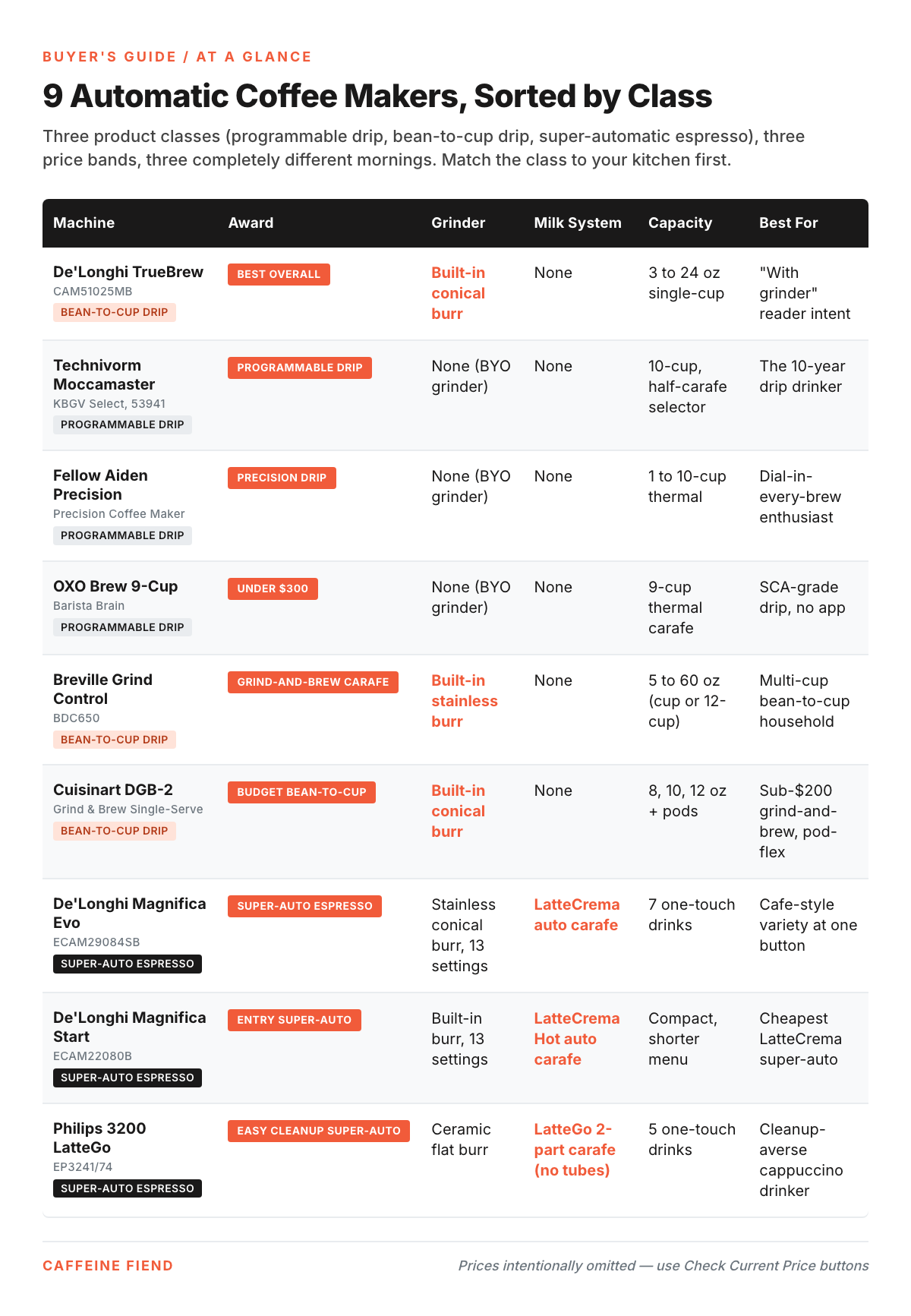
The Best Automatic Coffee Makers at a Glance
| Machine | Award | Class | Grinder | Milk System | Capacity |
|---|---|---|---|---|---|
| De’Longhi TrueBrew (CAM51025MB) | Best Overall | Bean-to-cup drip | Built-in conical burr | None | 3 to 24 oz single-cup |
| Technivorm Moccamaster KBGV Select | Best Programmable Drip | Programmable drip | None (BYO grinder) | None | 10-cup / 40 oz, half-carafe selector |
| Fellow Aiden Precision | Best Precision Drip | Programmable drip | None (BYO grinder) | None | 1 to 10-cup thermal carafe |
| OXO Brew 9-Cup | Best Drip Under $300 | Programmable drip | None (BYO grinder) | None | 9-cup thermal carafe |
| Breville Grind Control (BDC650) | Best Grind-and-Brew with Carafe | Bean-to-cup drip | Built-in stainless burr | None | 5 to 60 oz (cup to 12-cup carafe) |
| Cuisinart DGB-2 Grind & Brew | Best Budget Bean-to-Cup | Bean-to-cup drip | Built-in conical burr | None | 8, 10, 12 oz single-serve + pods |
| De’Longhi Magnifica Evo | Best Super-Automatic Espresso | Super-auto espresso | Built-in stainless burr, 13 settings | LatteCrema auto carafe | 7 one-touch drinks |
| De’Longhi Magnifica Start | Best Entry Super-Automatic | Super-auto espresso | Built-in burr, 13 settings | LatteCrema Hot auto carafe | Compact, shorter menu |
| Philips 3200 LatteGo | Best Easy-Cleanup Super-Auto | Super-auto espresso | Ceramic flat burr | LatteGo two-part carafe | 5 one-touch drinks |
A note on prices. No price column, here or anywhere else in this guide. Amazon prices for these machines move fast (sometimes daily), and the Amazon Associates agreement is direct about not pinning them. What you’ll get is a qualitative band (budget, mid-range, premium) plus a Check Current Price button under each pick.
How We Picked
We’re covering three product classes, and no single reviewer team we know of has tested every current machine in all three. Serious Eats, Food & Wine, and The Spruce Eats each stayed in one lane, which leaves the with-grinder reader unserved by all three. We combined hands-on findings from long-term reviewers we trust with manufacturer specs verified against current SKUs and owner-review consensus. Where we lean on someone else’s long-term test, we name them: The Tested Hub on the Fellow Aiden; Coffeeness on the OXO Brew 9-Cup and the TrueBrew; Tom’s Coffee Corner on the Magnifica Evo; Tom’s Guide on the TrueBrew grounds-mess con; Coffeedant on the Philips 3200 LatteGo; Bon Appétit on the Moccamaster.
The criteria that decided the picks:
- Brew temperature. The SCA Golden Cup band is 197.6 to 204.8°F held across the brew. For drip picks, hitting that window matters. Super-autos extract at 195 to 205°F under 9 bars of pressure.
- Grinder integration and freshness handling. Bean freshness is the ceiling on any bean-to-cup or super-auto pick. A machine that grinds on demand is only as fresh as the hopper’s last top-up, so we flag hopper size and staling risk where it matters.
- Milk system. Only super-auto picks have one. If cappuccinos and lattes are the morning, drip doesn’t serve you.
- Daily workflow and cleanup. A machine that annoys you after week two gets shelved. Auto-clean cycles and grounds-handling ergonomics decide whether it stays on the counter.
- Footprint. Standard US countertop-to-upper-cabinet clearance runs about 18 inches (NKBA kitchen-planning guideline). Every full-size super-auto and the TrueBrew ships close to that.
- Honest con requirement. Every pick, Best Overall included, carries a specific real downside. A roundup where every machine is amazing reads as paid placement.
De’Longhi TrueBrew Automatic Coffee Maker with Bean Extract Technology — Best Overall
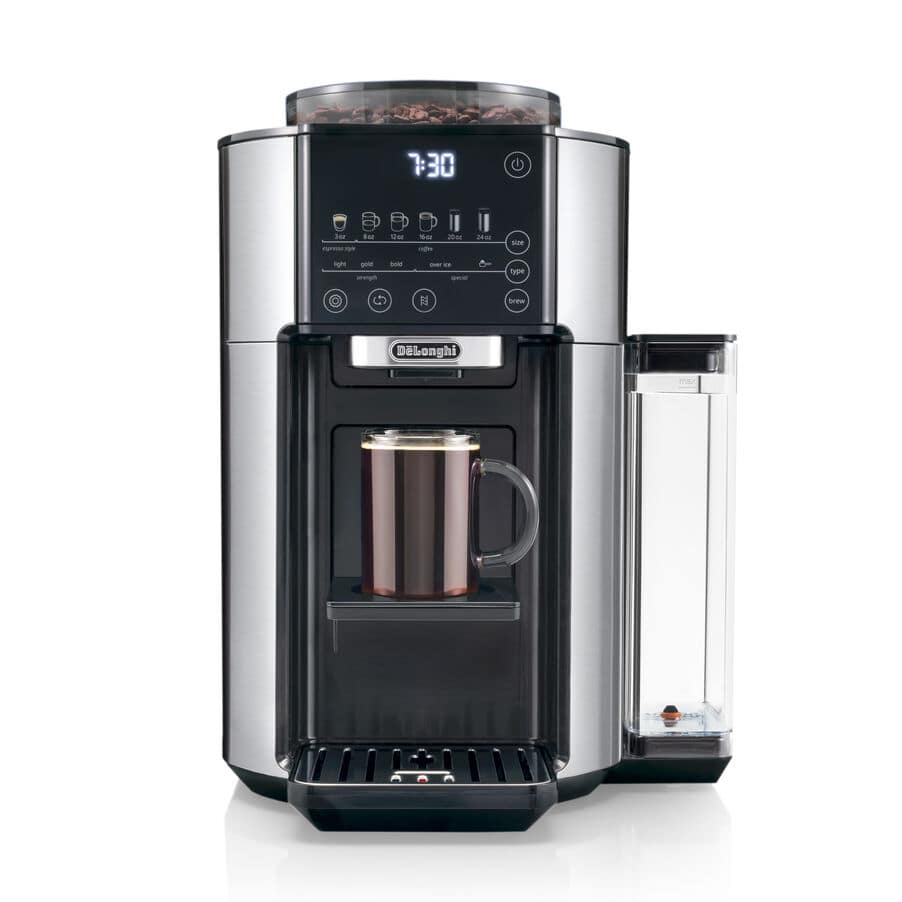
The De’Longhi TrueBrew is the most literal answer to “automatic coffee maker” you can buy. One box, whole beans in the hopper, freshly ground drip coffee into your cup at one button. It’s the pick for the reader who typed “automatic coffee maker with grinder” and meant every word: no manual grinder on the counter, no espresso rituals, no pods.
The full brand name is the De’Longhi TrueBrew Automatic Coffee Maker with Bean Extract Technology, which is just De’Longhi’s name for the auto-grind, auto-dose, auto-brew drip workflow. The branding steers some buyers into the espresso lane by mistake, so worth naming clearly. Six brew sizes (3, 8, 12, 16, 20, and 24 ounces) cover a short pour to a travel-mug fill, plus an over-ice mode. No milk frother, no carafe.
Three cups back to back on a Sunday is slower than a batch drip filling a 12-cup carafe. Arne Preuss at Coffeeness lands on “you can have one-touch convenience and still use high-quality coffee beans,” which is the pitch in one sentence. Tom’s Guide’s hands-on flags the con we’d echo: the integrated grinder throws dry grounds around the housing during brewing, so expect a weekly wipe-down. Roughly 16 by 15.5 inches; measure your counter.
Pros:
- One box, one button, whole beans to drip coffee. The most literal answer to “automatic coffee maker with grinder.”
- Six brew sizes from 3 to 24 ounces. Short pour, mug, or travel cup without a carafe.
- Auto-grinds and auto-doses per cup. No manual dose, no tamping.
- Over-ice mode. A useful summer preset most grind-and-brew rivals skip.
- Three-year warranty. Longer than most machines in the tier.
Cons:
- Single-cup only, no carafe. No batch-drip workflow.
- Grinder throws dry grounds around the housing. Tom’s Guide documents this specifically; expect a weekly wipe-down.
- Bulky footprint. Roughly 16 by 15.5 by 12 inches.
- No milk frother. Wrong category if cappuccinos are the goal.
Ideal for the reader who’s been putting off a burr grinder for years because it means one more box on the counter. The TrueBrew makes the decision unnecessary. For carafe alternatives and older SKUs to avoid, see our grind-and-brew guide.
Technivorm Moccamaster KBGV Select — Best Programmable Drip
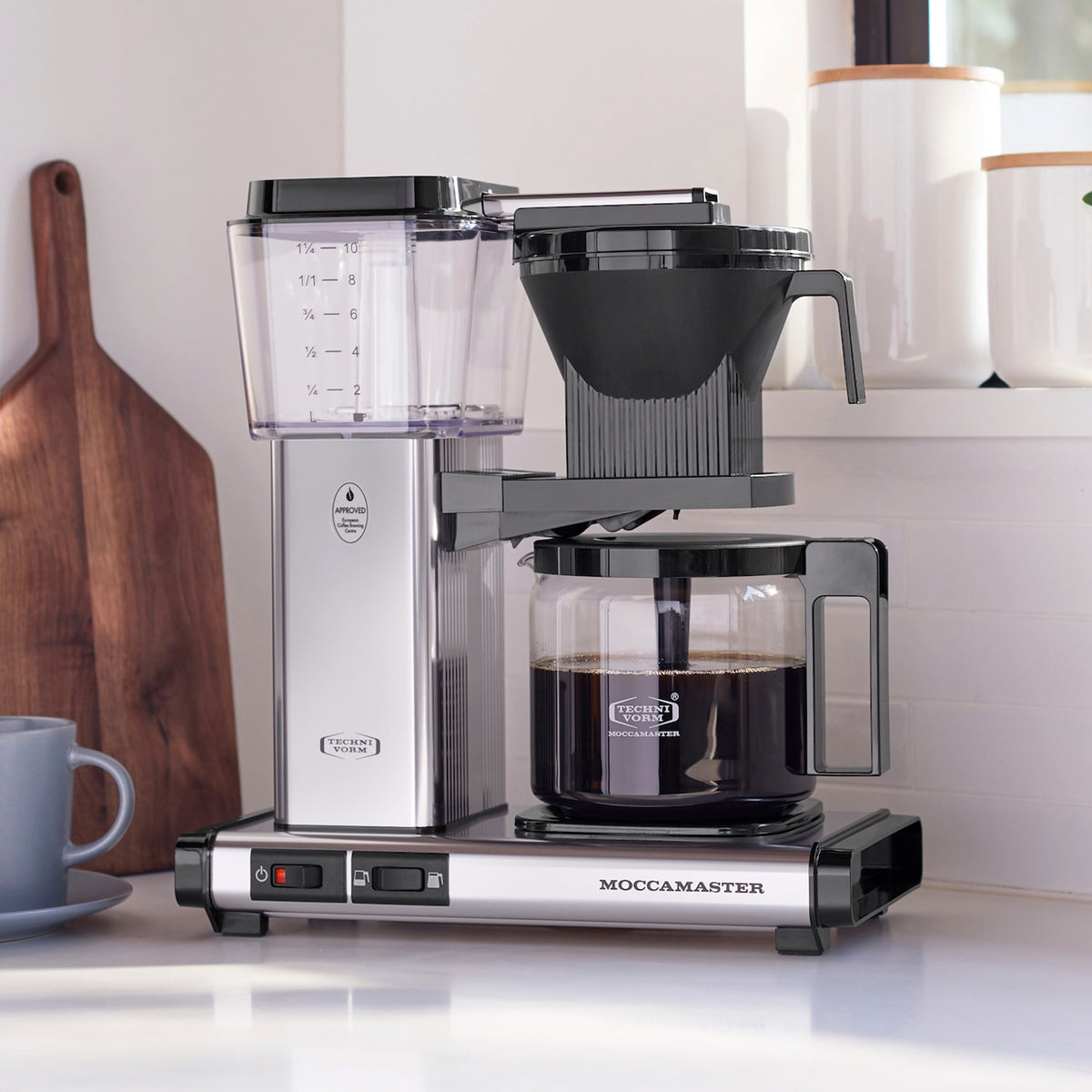
The Technivorm Moccamaster KBGV Select is the drip machine every editorial reviewer we’ve read agrees on. Buying one is a bet on a decade of coffee rather than a machine that’ll be dead by 2029. The pick for the drip drinker who prefers simplicity to firmware and provenance to features.
The Moccamaster is the coffee world’s Land Rover Defender. A copper heating element holds water at 196 to 205°F for a four-to-six-minute brew, right inside the SCA Golden Cup band. It’s the only home brewer we know of certified for both half-carafe and full-carafe compliance. Handmade in the Netherlands, backed by a five-year warranty plus a lifetime repair promise. Bon Appétit currently has it as their #1 drip pick.
The trade is a glass carafe on a hot plate, no beep at brew-end, and plastic-forward removable components at a price where you’d expect metal. The premium buys longevity and provenance more than any brew-quality delta over SCA-certified drips at half the money.
Pros:
- SCA Golden Cup certified on both half and full carafes. Unique in the home-brewer category.
- 5-year warranty plus lifetime repair. The manufacturer expects it to outlive most kitchens.
- Handmade in the Netherlands. Provenance you can feel in the build.
- Simple two-switch UX. No app, no menus, no firmware.
- Half-carafe selector. A smaller batch without dropping out of the SCA temperature window.
Cons:
- No brew-done beep.
- Default carafe is glass on a hot plate. A thermal-carafe variant exists but the mainline is what most buyers get.
- Some removable components feel plastic-forward for the price. Filter holder and water container are the giveaways.
- Premium buys aesthetics and provenance more than brew delta. Not meaningfully better than SCA-certified drips at half the price.
Buy once and be done. Readers who want brew profiles or an app should skip ahead to the Fellow Aiden.
Fellow Aiden Precision Coffee Maker — Best Precision Drip
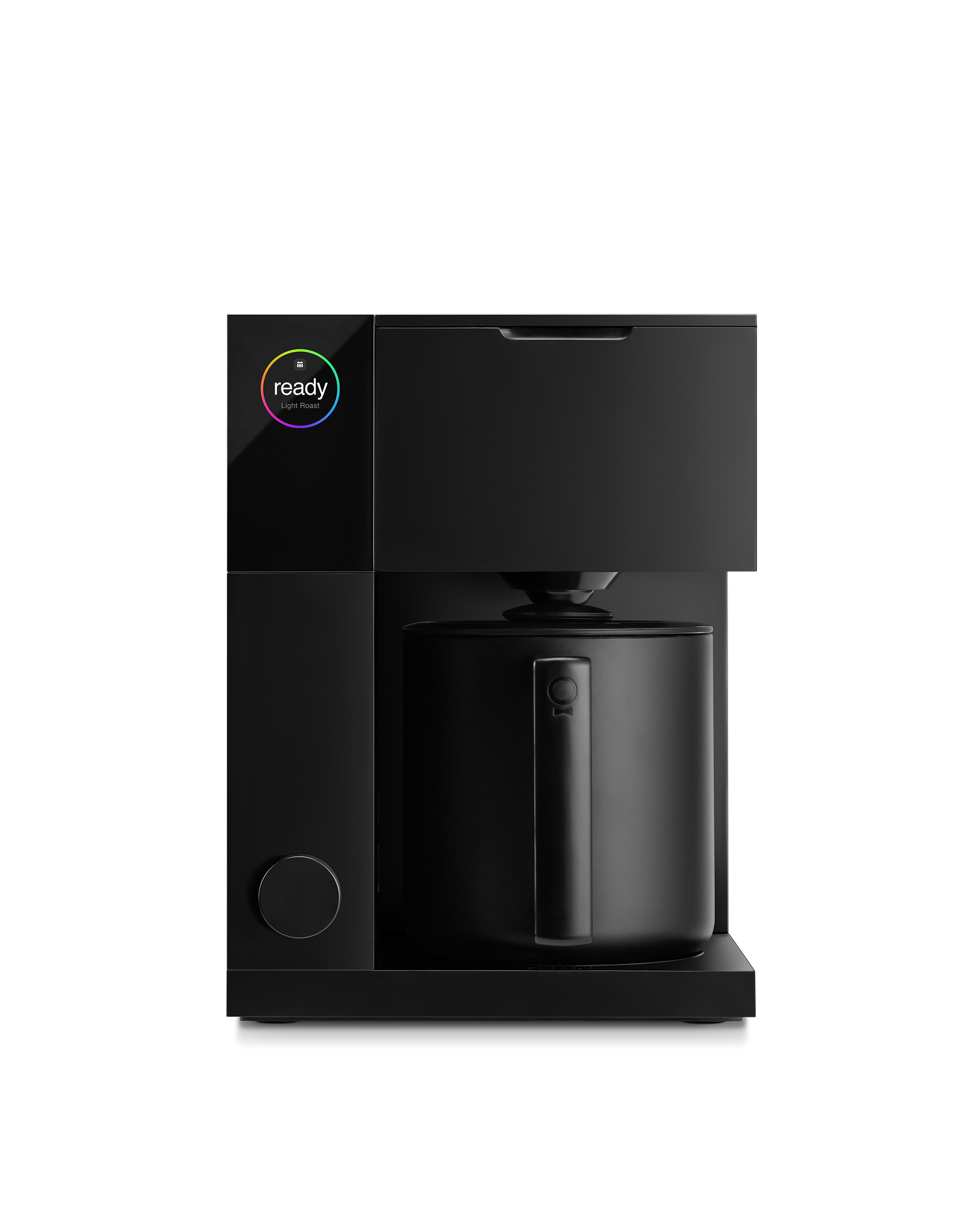
The Fellow Aiden is the drip machine for enthusiasts who dial bloom time and brew temperature to the degree and who genuinely use a phone app. The pick for the reader who chooses beans by origin and saves brew recipes per bag.
PID temperature control lets you set brew temperature to the exact degree between 185 and 212°F, and no other consumer drip we’ve read about matches that resolution. The Tested Hub ran the Aiden through seven months and roughly 1,200 brews with a thermocouple in the basket, and found it’s the only consumer drip they’ve verified to hold the 195 to 205°F Golden Cup band across the entire brew. Six programmable brew profiles save a recipe per bean: a Kenyan single origin at 202°F with a 45-second bloom, a darker blend at 198°F with no bloom.
If you don’t dial recipes and don’t want to touch an app, you’re overpaying for capabilities you won’t use. The thermal carafe holds heat about an hour, which The Tested Hub flags. This machine expects you to drink the coffee when it’s ready.
Pros:
- PID temperature control to the degree. Set brew temperature exactly between 185 and 212°F.
- SCA Golden Cup band held across the full brew. The only consumer drip The Tested Hub has verified to do this across 1,200 brews.
- Six saved brew profiles. Recipe per bean, scheduled brews, cold-brew preset.
- Companion app with real functionality. Bloom time, temperature, ratio saved per recipe.
- Dual showerhead and interchangeable baskets. Clean extraction from 1 cup to 10.
Cons:
- Thermal carafe holds heat about an hour. Drink it when it’s ready.
- Water-fill tray splashes. Owners report occasional water-sensor misreads.
- You’re paying for the app. Skip it and you’re overpaying by $100+ versus the Moccamaster or OXO.
- Premium price for a drip machine. Fellow builds premium; Fellow pricing follows.
Recipe-dialers get a drip machine that punches at an espresso hobbyist’s level of control. Everyone else should buy the OXO below and put the delta into beans.
OXO Brew 9-Cup — Best Drip Under $300
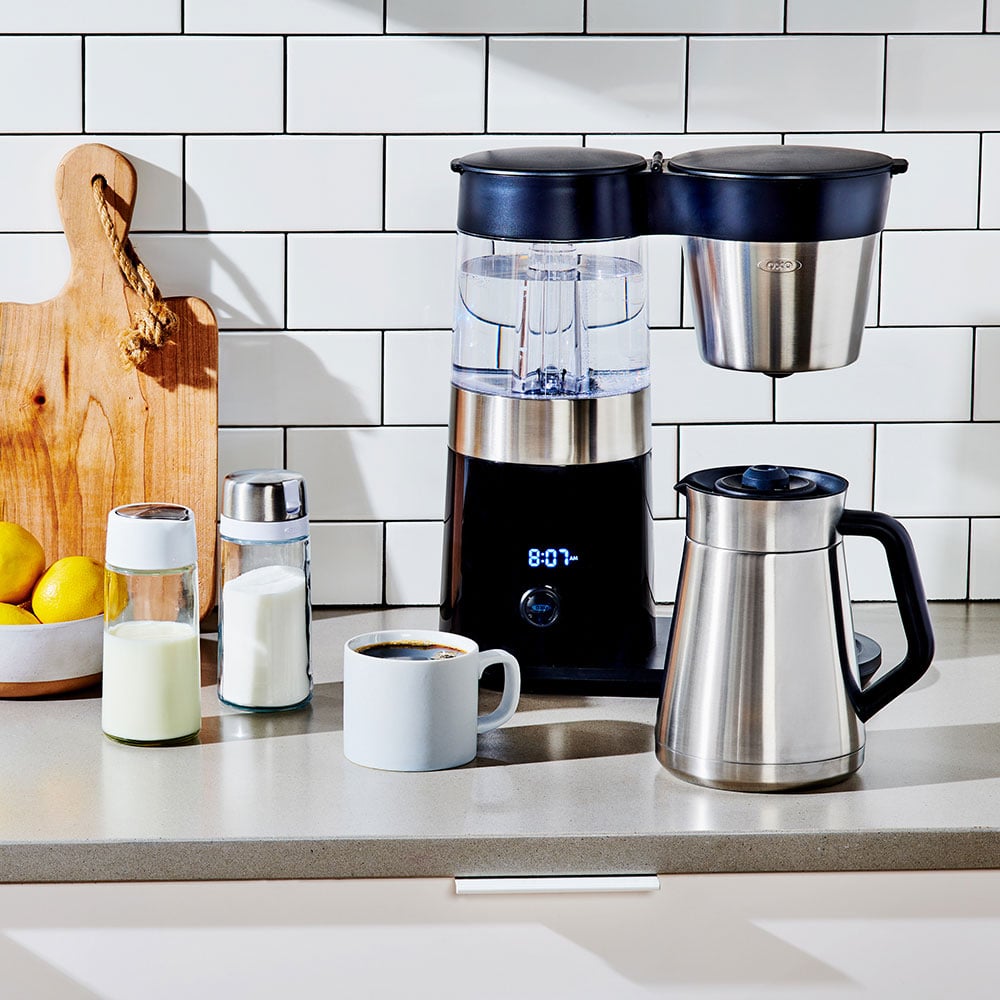
The OXO Brew 9-Cup is the SCA-certified drip that costs half the Moccamaster money, runs a one-dial UX, and hits the same temperature window. The pick for the buyer who wants a machine that just works, doesn’t want an app, and refuses to spend $400 on a coffee maker on principle.
Coffeeness’s 2026 hands-on stuck a thermocouple in the brew basket, ran 50-plus brew cycles, and measured 197 to 204°F consistently. Same SCA-certified window as the Moccamaster, at well over a hundred dollars less. The Rainmaker showerhead spreads water evenly across the bed, and the whole machine runs from a single dial.
The knock is small-batch behavior. On a two-cup or four-cup partial, flow slows noticeably versus a full cycle to compensate for saturation on a partial bed. The double-wall thermal carafe holds heat close to four hours per the same Coffeeness test.
Pros:
- SCA-certified brew temperature verified under lab test. 197 to 204°F across 50-plus cycles per Coffeeness.
- Single-dial UX. No app, no menu tree, no firmware.
- Double-wall thermal carafe holds heat close to four hours.
- Standard Melitta #4 cone filters. Widely stocked, no proprietary shape.
- Well under Moccamaster and Fellow pricing.
Cons:
- Slow flow on 2 to 4-cup partial brews. Wait an extra minute on small batches.
- Purely functional design. Next to a Moccamaster or Aiden, it looks like the coffee maker your CFO would buy.
- 2-year warranty. The Moccamaster’s five-year cover is the tell.
You get the temperature window a Moccamaster hits, without the Moccamaster premium.
Breville Grind Control BDC650 — Best Grind-and-Brew with Carafe
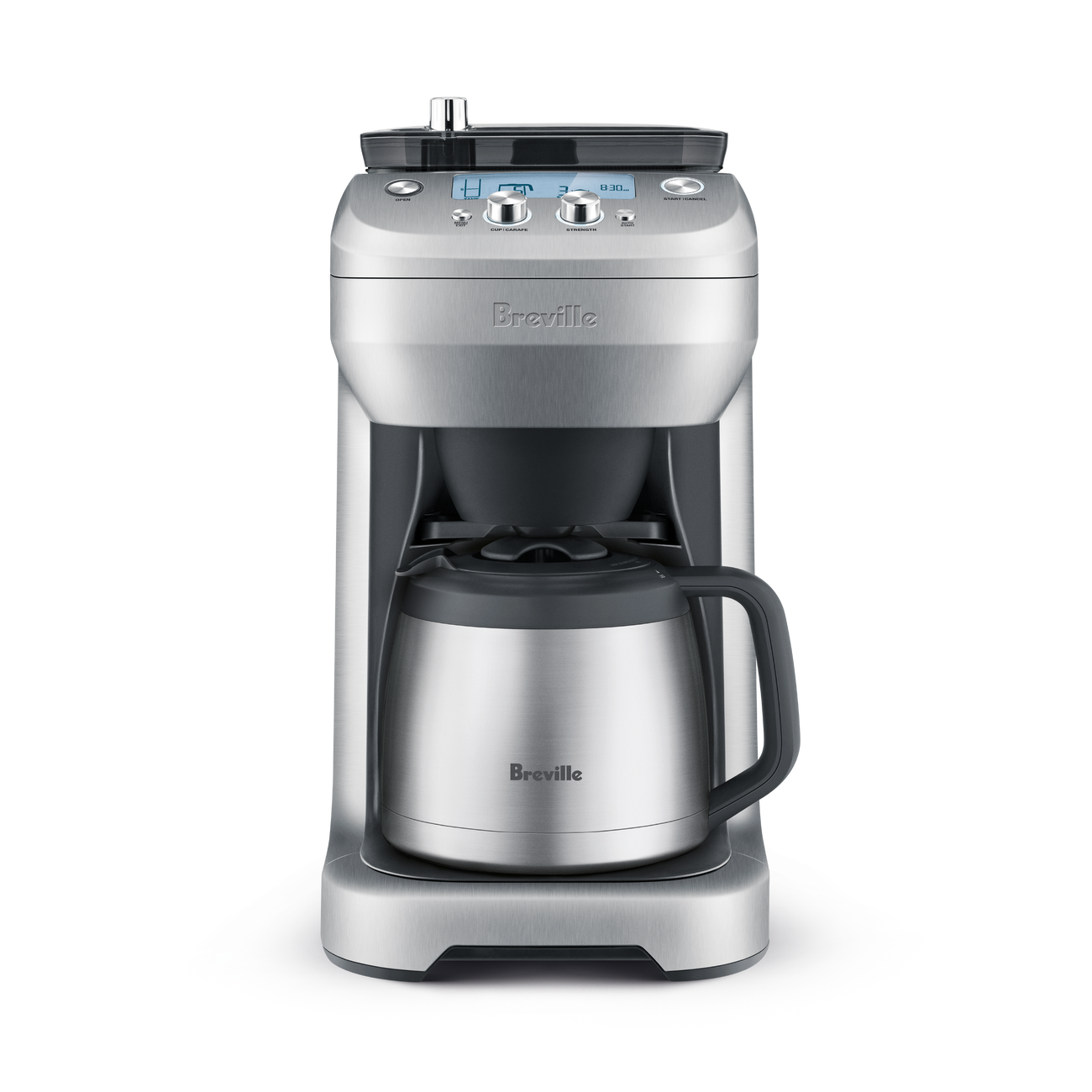
The Breville Grind Control BDC650 is the answer for the household that wants bean-to-cup freshness AND a carafe volume the single-cup TrueBrew can’t do. The pick for two or three coffee drinkers who all want a fresh cup within ten minutes of each other.
This is the only current-generation grind-and-brew that scales from a single 5-ounce cup to a full 60-ounce (12-cup) thermal carafe. The integrated stainless burr has eight grind settings and eight strength settings, a genuine dial-in range at this tier. A Steep-and-Release bloom cycle wets grounds before extraction, and the machine brews into whichever vessel is under the spout.
The honest downside is grinder ergonomics. Coffeeness documents the recurring issue: grounds blown sideways into the basket rather than falling clean, beans that don’t always drop into the hopper (you’ll rock it), and a brew basket that must be emptied after every pot. It’s also not SCA-certified, so brew temperature isn’t guaranteed to hold the Golden Cup band the way the Aiden or OXO does. What you’re buying is workflow flexibility.
Pros:
- Scales 5 to 60 ounces. Single cup up to a 12-cup carafe from one machine.
- 8 grind settings plus 8 strength settings. Real dial-in room across two dimensions.
- 12-cup dual-wall thermal carafe. Batch workflow the TrueBrew can’t do.
- Brews directly into cup or carafe.
- Steep-and-Release bloom cycle. Wets grounds before extraction.
Cons:
- Grounds thrown sideways rather than falling clean. Coffeeness’s hands-on flags this specifically.
- Beans don’t always drop cleanly into the hopper. Expect to rock it on refill.
- Brew basket must be emptied after every pot.
- Not SCA-certified. Brew temperature isn’t guaranteed.
The TrueBrew’s workflow, scaled to a 12-cup carafe. Readers who don’t want to deal with the grinder mess should buy the Moccamaster and a separate burr grinder instead.
Cuisinart DGB-2 Grind & Brew Single-Serve — Best Budget Bean-to-Cup
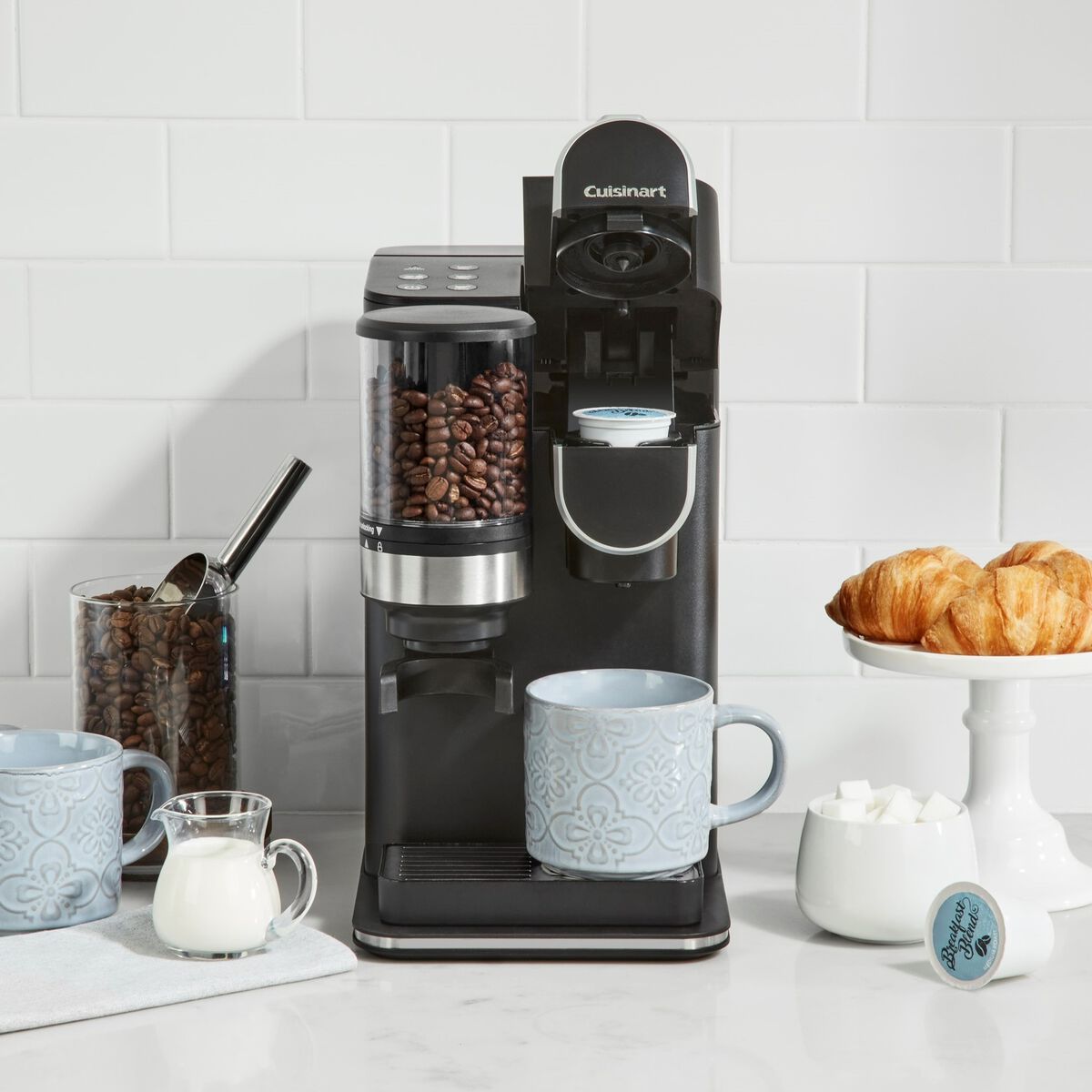
The Cuisinart DGB-2 is the sub-$200 way into fresh-ground bean-to-cup. It grinds whole beans on demand AND accepts K-Cup pods, which makes it the honest answer for the mixed-drinker household where one person wants specialty beans and the roommate keeps a pod stash in the drawer they think you don’t know about.
Buy the DGB-2 by name. The older DGB-800 12-cup grind-and-brew is officially discontinued and still surfaces in third-party listings as if it were current. The 48-ounce reservoir handles a week of single cups without a refill, three sizes (8, 10, 12 oz) cover standard mugs, and the pod tray takes both Keurig K-Cups and a reusable filter cup.
The trade-off is single-serve only. A two-cup morning waits, and the reusable-cup workflow adds a rinse step versus paper-filter drip. First-hand review density is also thinner than the premium picks above (owner-review consensus plus Cuisinart’s spec sheet, cross-checked against the DGB-2 Amazon listing).
Pros:
- Sub-$200 street price. Half the TrueBrew’s band.
- Whole-bean grind AND pod compatibility. No second appliance for guest coffee.
- 48-ounce removable reservoir. A week of single cups without a refill.
- Three brew sizes (8, 10, 12 oz). Covers standard mugs.
- Sealed bean hopper. Slows staling versus an open one.
Cons:
- Single-serve only, no carafe. A two-cup household waits.
- Reusable filter cup adds a rinse step. Paper-drip cleanup is faster.
- Lower first-hand review density than premium picks. Leaning on owner-review consensus more than we’d like.
- Real SKU confusion in shopping. Do not buy the discontinued DGB-800.
Fresh-ground bean-to-cup on a budget, without dropping to plain drip. It also covers the whole-bean-Sunday, K-Cup-Wednesday-at-6:15 household without a second appliance on the counter.
De’Longhi Magnifica Evo — Best Super-Automatic Espresso
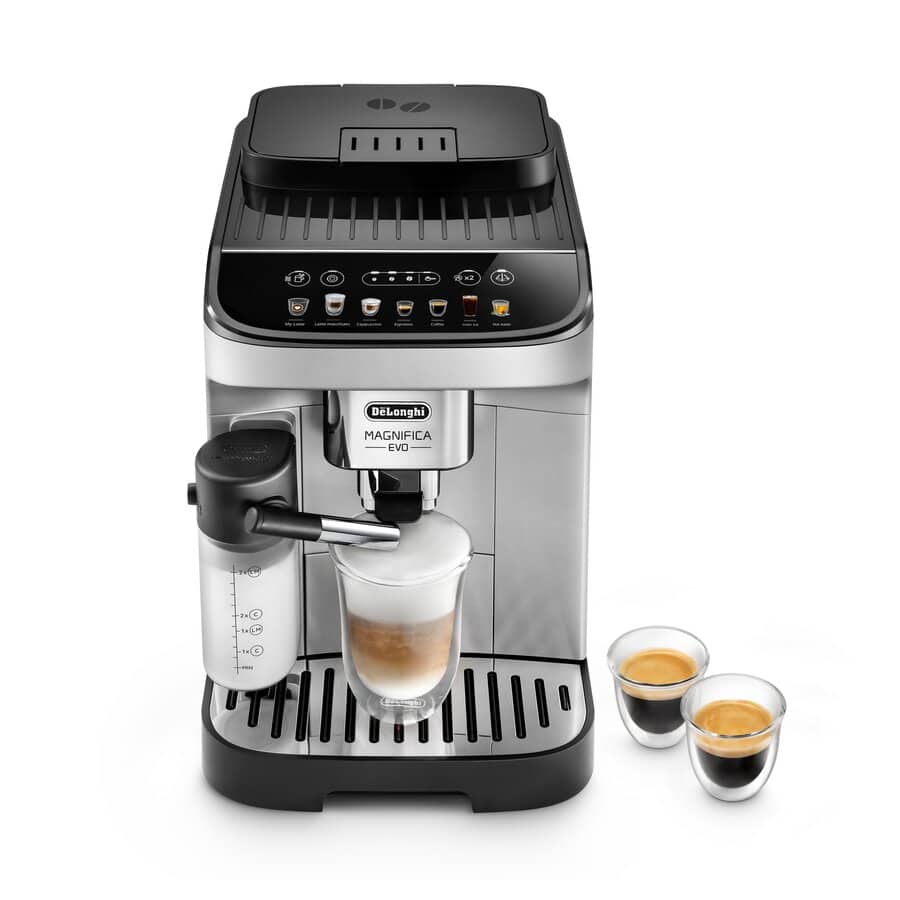
The De’Longhi Magnifica Evo is the safest sweet-spot super-automatic espresso pick around the $800 mark. Café-style espresso, cappuccino, and latte macchiato at the touch of a button, without steam-wand skill, without $2,000, and (critically) with a maintenance cadence home users will actually follow. If you were about to add a Jura E8 to your cart because it “just looks like a proper machine,” this is your intervention.
Under the hood: a 15-bar pump, a 13-setting stainless conical burr grinder, and a LatteCrema automatic milk-frothing carafe with dishwasher-safe parts. Seven one-touch beverages, auto-clean cycle on the milk system. Tom’s Coffee Corner ran the Evo through three months and roughly 190-plus shots and landed on “consistently good bean-to-cup espresso, extremely easy daily workflow, and maintenance home users will actually follow through on.” Coffeedant reached the same verdict on daily reliability. That’s the moat: a super-auto that gets descaled is a five-year machine; one that doesn’t is a two-year one.
Two cons every long-term reviewer flags: the built-in grinder is loud (vacuum cleaner in a five-to-seven-second burst) and the polycarbonate build feels a step below the machines above it in the line. You’re paying for the LatteCrema system and the drink presets. Housing quality is where De’Longhi trimmed to hit the price.
Pros:
- LatteCrema auto milk carafe with auto-clean. One-touch cappuccino, cleanup you’ll actually do.
- Built-in 13-setting stainless conical burr grinder. Real dial-in room for the tier.
- 7 one-touch beverages. Espresso, cappuccino, latte macchiato, Americano, over-ice, hot water.
- Long-term reliability track record. Tom’s Coffee Corner and Coffeedant land on the same verdict.
- Sub-$1,000 pricing. Value inflection point in the super-auto category.
Cons:
- Loud grinder. The recurring complaint across every long-term review.
- Polycarbonate build feels less premium than the tier above.
- Bean hopper freshness ceiling is set by your habit. Load only what you’ll pull through in a week.
The Evo is what we recommend to the friend who wants café-style espresso at one button and doesn’t want to build technique. If you’d rather learn to pull shots on a semi-automatic and own the grinder decision yourself, see our home espresso guide.
De’Longhi Magnifica Start — Best Entry Super-Automatic
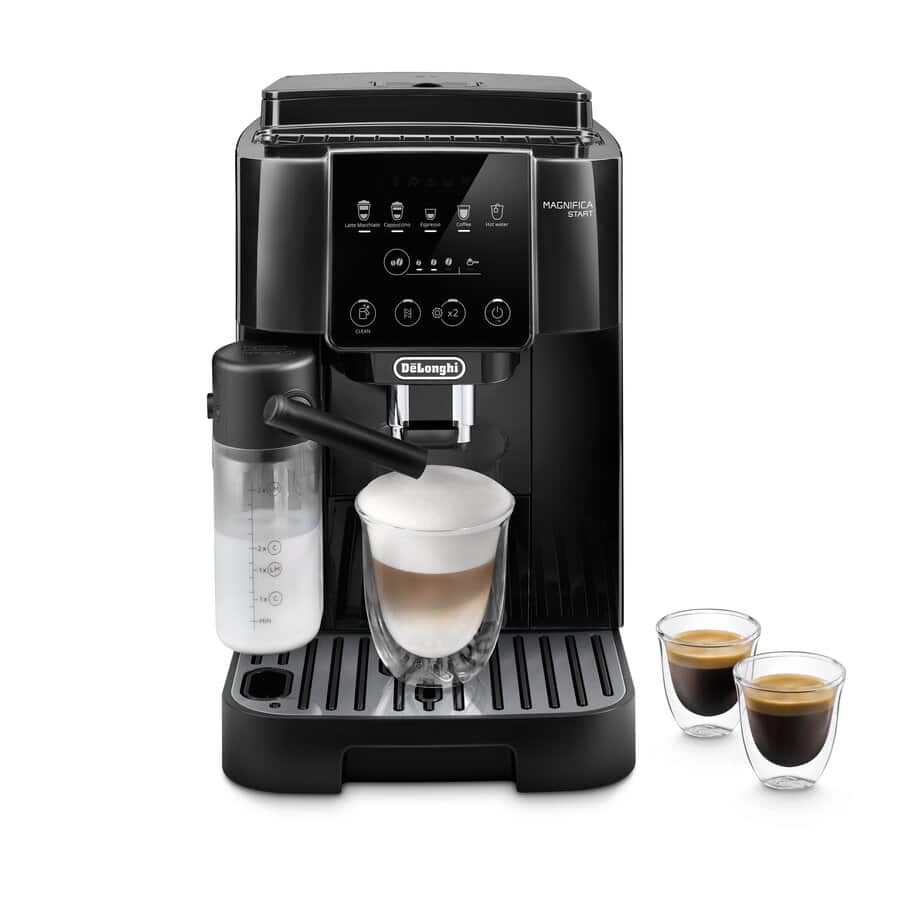
The De’Longhi Magnifica Start is the cheapest defensible way into a super-auto with an automatic milk system. Same LatteCrema Hot carafe family as the Evo, smaller footprint, around $150 less on the band. The pick for the reader graduating from a pod machine to push-button espresso.
The Start shares daily-use hardware with the Evo: the same LatteCrema Hot milk carafe and the same 13-setting stainless conical burr. Tom’s Coffee Corner calls it “an excellent midranged super-automatic,” and Coffeedant’s “convenience over craftsmanship at this price” is a verdict we’d echo. You step down on drink presets, build feel, and finest-grind resolution, but the milk system is the same, and that’s the part of the machine that decides whether you use it every morning.
Owners who grow into single-origin light roasts hit the Start’s grind-resolution limits faster than they would on the Evo. And yes, when we say “graduating from a pod machine,” we mean the exact reader who’s been telling themselves for three years that the Nespresso is “basically espresso.”
Pros:
- Same LatteCrema Hot milk hardware as the Evo. No downgrade on the daily-use element.
- Compact footprint. The smallest in the Magnifica line, good for tight kitchens.
- 13-setting integrated conical burr grinder.
- Auto-clean cycle included.
- Around $700 street price. The entry inflection point.
Cons:
- Plastic-forward build. You feel it on the buttons and drip tray more than in the shot.
- Fewer drink presets than the Evo.
- Grind resolution limited at the fine end. Owners chasing light-roast single origins outgrow it faster.
Side by side, the Start and Evo look almost identical. In use, the Evo does more and does it more solidly. Buy the Start if the Evo is out of budget. Buy the Evo if it isn’t.
Philips 3200 LatteGo — Best Easy-Cleanup Super-Automatic
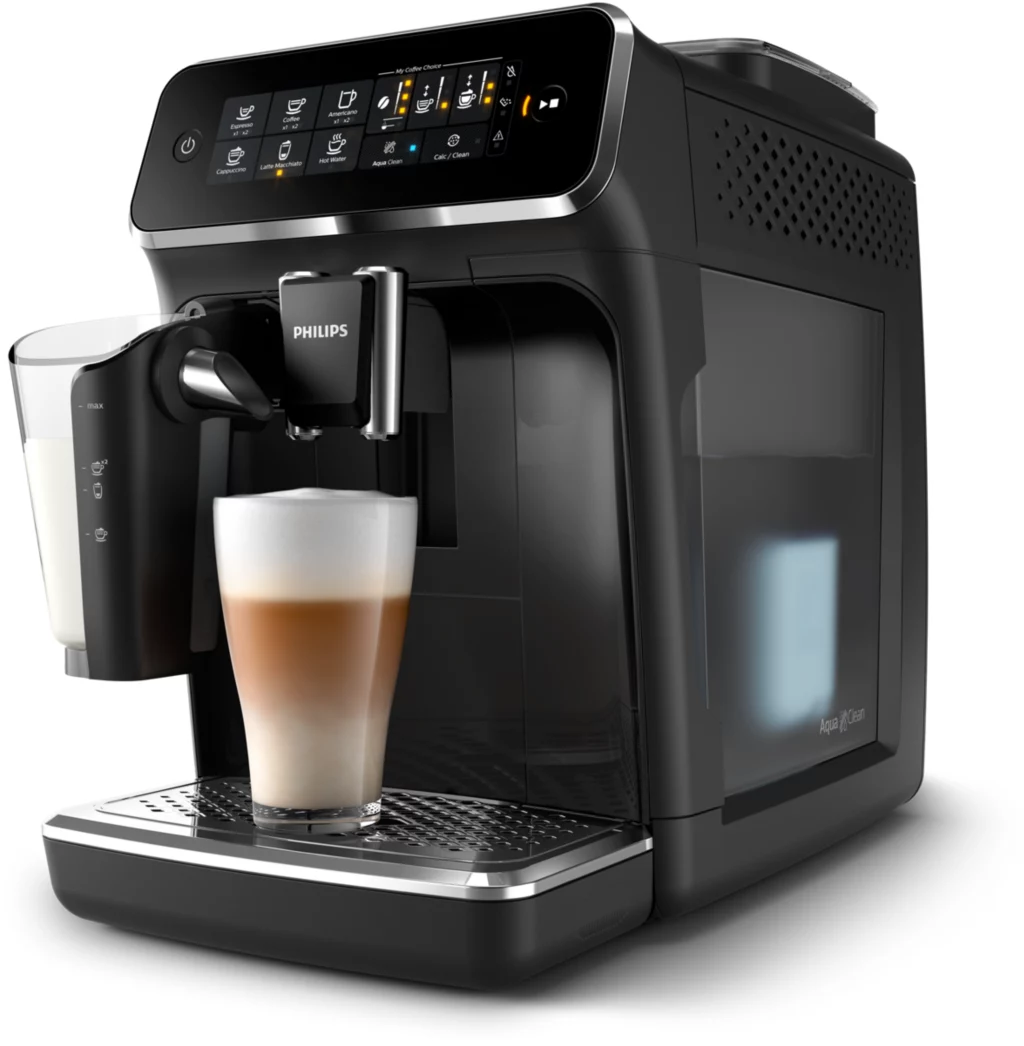
The Philips 3200 LatteGo is the super-auto for the buyer who’s honest with themselves that milk-system cleanup is what decides whether a machine gets used or shelved after week two. The LatteGo carafe is two parts, snaps apart, and rinses under the tap in about fifteen seconds. No tubes, nothing to clog. The pick for the daily-cappuccino household that dreads purging a milk line.
The 100% ceramic flat burr grinder runs cooler than a steel conical at speed (subtly cleaner in the cup side by side), AquaClean filtration extends the descale interval up to 5,000 cups on cadence, and the brew group pops out to rinse under the tap.
The LatteGo carafe is the reason to pick this one. Coffeedant calls it “the easiest daily cappuccino machine with sink-simple milk cleanup and rock-solid, no-drama upkeep,” a rare positive verdict on maintenance in the super-auto category. A milk carafe you have to unclip, disassemble, and rinse gets skipped after a week.
The recurring gripe is milk temperature. Coffeedant and multiple long-term reviewers put LatteGo output around 138 to 140°F, cooler than the De’Longhi machines and cool enough that drinkers who like their milk piping hot will notice. The drink menu is also shorter than the Evo’s (five recipes versus seven).
Pros:
- Easiest auto-frother to clean in the category. Two parts, no tubes, snaps apart, done.
- 100% ceramic flat burr grinder. Runs cooler than steel at speed.
- AquaClean filter extends descale interval up to 5,000 cups.
- Removable brew group. Rinses under the tap for real soap-and-water hygiene.
- Sub-$800 pricing.
Cons:
- Milk output around 138 to 140°F. Noticeably cooler than the Magnifica machines.
- Shorter drink menu than the Magnifica Evo.
- No user profiles. For a two-drinker household with their own presets, look at the Philips 4300.
Cleanup is the reason most super-autos get shelved after week two, and the Philips solves it. For a related category where an automated milk carafe lives on a drip machine, see coffee makers with frothers.
How to Choose an Automatic Coffee Maker
Deciding which automatic to buy comes before deciding which model. Sort the three categories first.
Start With Which “Automatic” You Actually Want
- Programmable drip. Grounds in, coffee out, no grinder. Best for the buyer who wants a hot pot ready at 6:45 AM. Our picks: Moccamaster, Aiden, OXO Brew 9-Cup. For the drip-only guide, see best drip coffee makers.
- Bean-to-cup drip. Whole beans in the hopper, drip coffee out, machine grinds per cup. Picks: TrueBrew (single-cup only), Breville Grind Control (single cup to 12-cup carafe), Cuisinart DGB-2 (budget). If “with grinder” was your refinement, this is your class.
- Super-automatic espresso. Whole beans in, espresso and milk drinks out under 9 bars of pressure, with an integrated milk carafe for cappuccinos. Picks: Magnifica Evo, Magnifica Start, Philips 3200 LatteGo.
Every Layer of Automation Is a Lever You Give Up
Every add on this list, from the timer to the built-in grinder to the milk carafe to the drink presets, costs you a lever you might eventually want to pull. If you’ll never want to dial in a shot yourself, automation is a real feature. If you might, the more automatic answer is the wrong answer. Buy the amount of automation your morning actually wants.
Your Habit Sets the Freshness Ceiling
Every bean-to-cup pick promises fresh-ground beans at one button, and the promise only holds if you refill the hopper on the same schedule you’d finish a bag of pre-ground coffee. Load a two-week supply on Sunday and by the following Sunday your carefully sourced beans taste like the hopper’s average. Best practice: load only what you’ll pull through in about a week, keep the rest sealed, and wipe the hopper before every top-up. Optimal taste window for a super-auto is roughly 7 to 21 days post-roast.
Match Brew Volume to the Household
- Single-cup only (TrueBrew, Cuisinart DGB-2). Solo drinkers, two-person households that stagger mornings, or a small office where cups happen throughout the day.
- Carafe (Moccamaster, Aiden, OXO Brew 9-Cup, Breville Grind Control). Households where multiple cups happen within a twenty-minute window.
- Drink-by-drink (super-autos). Households where each person wants a different drink.
Measure the Cabinet Clearance
Standard countertop-to-upper-cabinet clearance in most US kitchens runs about 18 inches (NKBA guideline), and every full-size super-auto in this guide plus the TrueBrew ships close to that. A machine that doesn’t fit under your uppers lives on the counter next to the toaster forever, or gets returned. Bring the tape measure into the coffee corner before you buy anything with a hopper.
When You Should Skip These Entirely
A few readers should walk right past this whole guide:
- You want café-quality espresso and you’ll do the work. A semi-automatic rig plus its own grinder delivers better in the cup than any super-auto at the same money, and by a wide margin above $2,000. Read espresso machines with grinder instead.
- You want lab-grade temperature at a lower price than the Fellow Aiden. The Behmor Brazen Plus 4.0 (SCA-certified, user-adjustable 190 to 210°F, pulsed pre-soak) is worth a look.
- You have four minutes to spare for a manual bloom-and-pour. A Chemex plus a decent kettle will out-cup any $400 automatic.
- You need commercial-grade uptime. Dual boilers and 12-hour service are a separate buy for a separate setting; this guide is home-user only.
So Which Automatic Coffee Maker Should You Buy?
If the query “automatic coffee maker” got you here without more context, the De’Longhi TrueBrew is the pick. It’s the most literal answer to the phrase and the honest answer to the “with grinder” refinement.
If you want a straightforward programmable drip that will last a decade, the Technivorm Moccamaster KBGV Select is the machine every editor pick agrees on. If the “automatic” you meant was a café-style cappuccino at one button, the De’Longhi Magnifica Evo is the sweet-spot super-auto.
Everything else is a scenario call. If bean-to-cup with a carafe is the requirement, the Breville Grind Control is the pick, and if the budget caps at sub-$200 the Cuisinart DGB-2 keeps you in fresh-ground for less. The brew-profile enthusiast wants the Fellow Aiden and its recipes-per-bean app; a cost-conscious drip drinker who wants SCA temperatures at half the money should go with the OXO Brew 9-Cup. If milk-system cleanup is what would eventually shelve a super-auto in your kitchen, the Philips 3200 LatteGo’s two-part carafe is the answer, and if the super-auto price bothers you, the Magnifica Start is the entry.
Whichever way you go, load a week of beans at a time and keep the rest sealed.
Frequently Asked Questions About Automatic Coffee Makers
What is an automatic coffee maker?
An automatic coffee maker is any coffee machine that brews unattended once you press start, with no standing there timing a pour or tamping a shot. The phrase covers three product classes: programmable drip (grounds in, drip coffee out on a timer), bean-to-cup drip (whole beans in, drip coffee out at one button), and super-automatic espresso (whole beans in, espresso and milk drinks out at one button). Each solves a different morning at a different price band.
What’s the difference between programmable drip, bean-to-cup drip, and super-automatic espresso?
The difference is what you put in and what comes out. Programmable drip: pre-ground coffee in, drip coffee out, no grinder. Bean-to-cup drip: whole beans in, drip coffee out, machine grinds on demand (the “automatic coffee maker with grinder” the refinement points at). Super-automatic espresso: whole beans in, espresso and milk drinks out under 9 bars of pressure, with an integrated milk system. Price bands run roughly $30 to $400 for programmable drip, $200 to $500 for bean-to-cup drip, and $700 to $3,000+ for super-auto espresso.
Is a bean-to-cup coffee maker with a grinder worth the money?
Worth it if you’ll actually keep the hopper stocked with fresh beans in small top-ups: a week’s supply at a time rather than a month’s. Grinding on demand at brew time measurably improves cup quality over pre-ground. But your habit sets the freshness ceiling. A hopper loaded with two weeks of beans on the first will taste tired by day fourteen no matter how good the burr is.
Is the De’Longhi TrueBrew a drip machine or an espresso machine?
Drip machine. “Bean Extract Technology” is De’Longhi’s name for the automatic grind-and-dose workflow, but the branding steers a few buyers into the espresso category by mistake. The TrueBrew grinds beans, doses them per cup, and brews drip coffee at six sizes from 3 to 24 ounces. If you want espresso and cappuccino at one button, you’re shopping the super-automatic espresso category (Magnifica Evo, Magnifica Start, Philips 3200 LatteGo).
Do I need an SCA-certified coffee maker?
You don’t need SCA certification to make good coffee, but on a drip machine it’s a useful shortcut for confirming the brewer holds the 197.6 to 204.8°F Golden Cup band across the whole brew. Certified picks in this guide: Fellow Aiden, OXO Brew 9-Cup, Moccamaster. Super-automatic espresso machines don’t carry SCA drip certification because espresso extraction is different physics (9 bars of pressure over 20 to 30 seconds at 195 to 205°F).
How long can beans sit in the hopper before they go stale?
About a week before noticeable staling. The optimal taste window for a super-auto is 7 to 21 days post-roast. Beans start oxidizing the moment they meet air, and small top-ups slow the process the way sealing a bag between pours does. Load only what you’ll drink in a week, keep the rest in the roaster’s bag, and wipe the hopper before every top-up.
What size automatic coffee maker will fit under my kitchen cabinets?
Most automatic coffee makers need about 18 inches of countertop-to-upper-cabinet clearance (the NKBA guideline for a standard US kitchen), and every full-size super-automatic in this guide plus the TrueBrew sits close to that ceiling. Compact pick like the OXO Brew 9-Cup have more headroom. Measure with the hopper lid closed AND with it open for loading; a machine that fits with an inch to spare when closed but not when open is a daily annoyance you’ll notice for years.